 Chuckanut Exterior
 Exteriors in York: A Different Kind of Wear and Tear
Homes in the York area, tucked against the Chuckanut corridor in Whatcom County, take a beating that inland Washington houses simply don't. It isn't one dramatic event that does the damage — it's the daily grind of salt-laden air off the water, driving rain that comes in sideways during winter storms, and a moss season that seems to stretch longer every year. Individually, none of these are catastrophic. Together, over ten or fifteen years, they find every weak point in a home's exterior: a nail pop in the siding, a shingle edge that lifts, a window sill that never quite dries out, a deck ledger board that's been slowly absorbing water since the day it was built.
We work on homes throughout this stretch of Whatcom County, and York has its own personality. Depending on where a home sits — closer to the water versus tucked back under tree cover — the exposure changes, but the underlying stressors are the same. Salt air accelerates corrosion on fasteners and flashing. Rain volume matters more than rain frequency. And moss doesn't just sit on a roof looking bad — it holds moisture against materials that were never designed to stay wet.
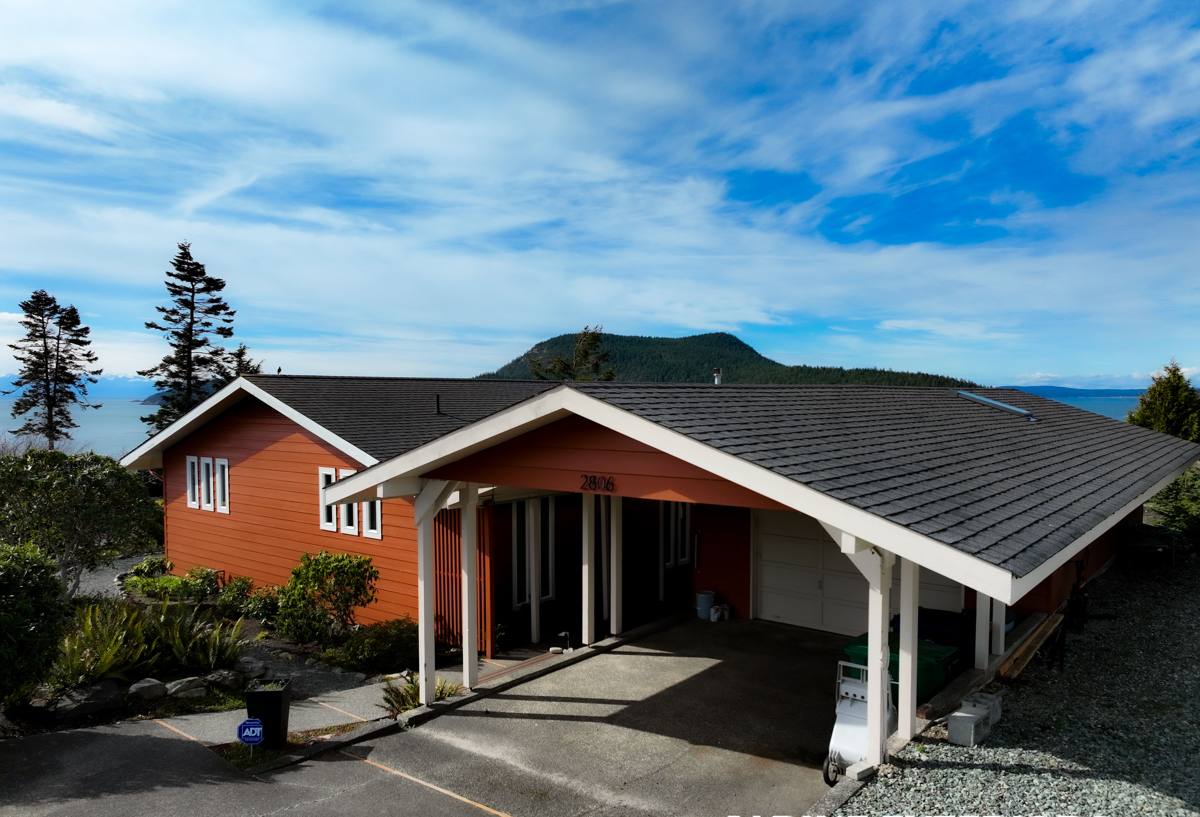
What Salt Air Actually Does to an Exterior
Salt air is often underestimated because the damage is slow and mostly invisible until it isn't. Airborne salt is corrosive to metal fasteners, flashing, and hardware, and it accelerates the breakdown of finishes that aren't rated for coastal exposure. On siding, that shows up as premature paint failure, chalking, or edges that start to swell or crack years before they should. On roofing, it can shorten the life of exposed metal components — flashing, valleys, fasteners — even when the shingles themselves still look fine.
This is one of the practical reasons we standardized on James Hardie fiber cement siding rather than offering a menu of materials. Wood-based products, including engineered wood siding like LP SmartSide, rely on a protective coating and careful edge-sealing to keep moisture and salt-laden air from reaching the wood fiber underneath. That coating has to be maintained. Vinyl siding doesn't rot, but it can become brittle and fade faster under coastal UV and salt exposure, and it isn't a structural or fire-rated product. Cedar and primed spruce are attractive, but they're the most maintenance-intensive option in a salt-air, high-rain environment — regular refinishing isn't optional, it's the cost of keeping the material alive.
Fiber cement, by contrast, is fundamentally a cement-and-sand composite. It doesn't have wood fiber for moisture to attack, and James Hardie's ColorPlus factory finish is baked on and warranted separately from the substrate, which matters when a home is exposed to salt air year-round.
Driving Rain and Why Installation Detail Matters More Than the Material
Whatcom County doesn't just get a lot of rain — a meaningful share of it comes in wind-driven, at an angle, rather than falling straight down. That changes what "waterproofing" actually means on an exterior. Flat rain mostly runs down a wall; driving rain gets pushed sideways and upward into laps, seams, and penetrations that were never meant to face water head-on.
This is why we talk about installation as much as we talk about material. Any siding, roofing, or window product can fail prematurely if it's installed without accounting for wind-driven rain: insufficient lap on siding courses, missing or undersized kick-out flashing at roof-to-wall transitions, window flashing that wasn't integrated with the water-resistive barrier correctly, or deck ledger flashing that relies on caulk instead of proper mechanical flashing. In a climate like this one, those shortcuts show up as interior moisture problems within a few years rather than a few decades.
Where We See the Most Damage in York-Area Homes
- Siding laps and corner boards facing prevailing wind and weather
- Roof-to-wall transitions and dormer flashing
- Window head flashing and sill pans, especially on original-construction homes
- Deck ledger boards and any rim-joist connection to the house
- North- and shade-facing walls and rooflines where moss and moisture linger longest
Moss Season: Longer Than It Used to Be
Moss doesn't just grow on roofs in this part of Washington — it grows on siding, decks, fences, and anything with a north-facing or shaded surface that stays damp. The problem isn't cosmetic. Moss holds moisture against the surface it's growing on, which on a roof can lift shingle edges and shorten shingle life, and on siding or decking can keep the material wet long after the rest of the house has dried out.
The right response isn't aggressive pressure washing, which can strip granules off asphalt shingles or damage siding finishes. It's a combination of design (keeping trees trimmed back to let air and light reach the roof and walls), gentle low-pressure cleaning on a reasonable schedule, and — where relevant — zinc or copper control strips on roofing to slow regrowth. We factor moss exposure into how we spec a roof replacement or a siding job for a York property, particularly on lots with heavy tree cover.
Siding: Our Position and Why We Hold It
We install James Hardie fiber cement siding exclusively. We don't offer vinyl, LP SmartSide, Cemplank, Allura, primed spruce, or cedar, and that's a deliberate standard, not a limitation of what we're capable of installing. Each of those alternatives has real strengths — vinyl is inexpensive and low-maintenance in mild climates, engineered wood siding is lighter and easier to install, cedar is genuinely beautiful. But in a salt air, high-rain, moss-heavy environment, they each carry a trade-off we're not willing to put our name behind: ongoing refinishing (cedar, primed spruce), coating and edge-sealing maintenance (engineered wood), or a non-structural, less fire-resistant assembly (vinyl).
James Hardie's HZ5 product line is engineered specifically for climates like this one — colder, wetter regions where moisture cycling and freeze-thaw matter. It's non-combustible, it holds paint and factory finish longer than wood-based alternatives, and it comes with a strong transferable warranty that's meaningful when a home changes hands, which happens often in this market.
Roofing, Windows, and Decks Alongside Siding
Siding gets a lot of the attention because it's the most visible surface, but a home's exterior only performs as a system. We handle roofing, windows, and decks alongside siding work because they share the same moisture-management logic and often the same failure points.
Roofing
On roofs, our focus in this area is on flashing detail, ventilation, and moss resistance as much as the shingle or material choice itself. A roof that's ventilated and flashed correctly will outlast one where the installer relied on caulk and hope at the valleys and transitions.
Windows
Window replacement in a driving-rain climate is as much about the flashing and sill pan detail as it is about the window unit itself. We integrate window flashing with the wall's water-resistive barrier so wind-driven rain has a planned path out, not a path in.
Decks
Deck ledger connections are one of the most common hidden failure points on older homes here — a deck attached to the house needs proper flashing at that connection, not just fasteners and caulk, or moisture works its way into the rim joist and framing over time.
Comparing Siding Approaches for This Climate
| Material | Salt Air / Moisture Behavior | Maintenance | Fire Rating |
|---|---|---|---|
| James Hardie fiber cement | Cement-based, doesn't absorb and swell like wood fiber | Low — factory finish is warranted separately | Non-combustible |
| Vinyl | Won't rot, but can become brittle and fade faster under coastal UV/salt | Low, but color is baked into the material and can't be refreshed | Combustible plastic |
| Engineered wood (e.g. LP SmartSide) | Depends on intact coating and sealed edges to resist moisture | Moderate — coating and edge maintenance needed | Wood-based, treated |
| Cedar / primed spruce | Natural wood, most sensitive to sustained moisture exposure | High — regular refinishing required | Combustible |
Why a Local Crew Matters Here
A lot of exterior problems in this region trace back to installation decisions that would be fine somewhere drier and calmer, but aren't fine here. A crew that mostly works inland or in milder climates may not default to the flashing details, fastener choices, and moss-conscious design decisions that matter along the Chuckanut corridor. A local crew has seen what actually fails on York-area homes over time — which corners take the worst weather, which roof valleys clog first, which decks rot at the ledger — and builds accordingly rather than by generic spec sheet.
Being local also means we're not disappearing after the job is done. Warranty follow-up, a question about maintenance, a storm that knocked something loose — a local crew can get back to a York property quickly, which matters more in a climate that doesn't give exteriors much of a break.
What to Expect From an Exterior Project With Us
Every project starts with an honest look at the specific exposure of the home — how much direct salt air it gets, how much tree cover and shade it has, which walls take the worst of the driving rain. From there we walk through material and scope options, with siding conversations centered on Hardie's product lines and colors rather than a broader menu, because that's what we install and stand behind.
Simple Maintenance Checklist for York-Area Homes
- Clear gutters and downspouts before the fall rains ramp up
- Keep tree limbs trimmed back from the roof and siding to reduce shade and moss buildup
- Have moss treated gently rather than pressure-washed aggressively
- Walk the exterior after major storms looking for lifted shingles, loose flashing, or siding damage
- Check deck ledger and rim-joist areas periodically for softness or staining
- Recaulk and inspect window perimeters every few years, especially on older installations
Timing an Exterior Project Around the Weather
Exterior work here is weather-dependent in a way it isn't in drier parts of the state. Siding, roofing, and deck installation all go better during the drier stretches of the year, and scheduling around the wettest months isn't just a convenience — it affects how well materials cure, seal, and integrate with flashing. We plan projects with the local rain pattern in mind rather than treating every month as interchangeable.
If you're weighing a siding, roofing, window, or deck project for a York-area home, we're happy to take a look and give you a straight assessment of what your exterior is facing and what it would take to address it properly. There's no pressure and no obligation — just fill out the form below for a free estimate.