 Chuckanut Exterior
 A Company Policy, Not a Sales Pitch
Most exterior contractors will install whatever a homeowner asks for. We don't. Chuckanut Exterior Companies installs James Hardie fiber cement siding and nothing else — no vinyl, no LP SmartSide, no Cemplank or Allura fiber cement, no primed spruce or cedar. That's an unusual position for a contractor to take, and homeowners in Chuckanut and across Whatcom County deserve to know why, in plain terms, rather than just being told "trust us."
The short version: this stretch of coastline is genuinely hard on a house exterior. Salt-laden air off Bellingham Bay and the Salish Sea, long stretches of driving rain, and a moss season that can run most of the year put more stress on siding here than in a lot of the country. We got tired of watching good-looking products fail early in exactly these conditions, and tired of re-explaining maintenance schedules that most homeowners never actually keep up with. Standardizing on one material system let us get better at installing it correctly, stand behind it with confidence, and stop selling products we didn't fully believe in.
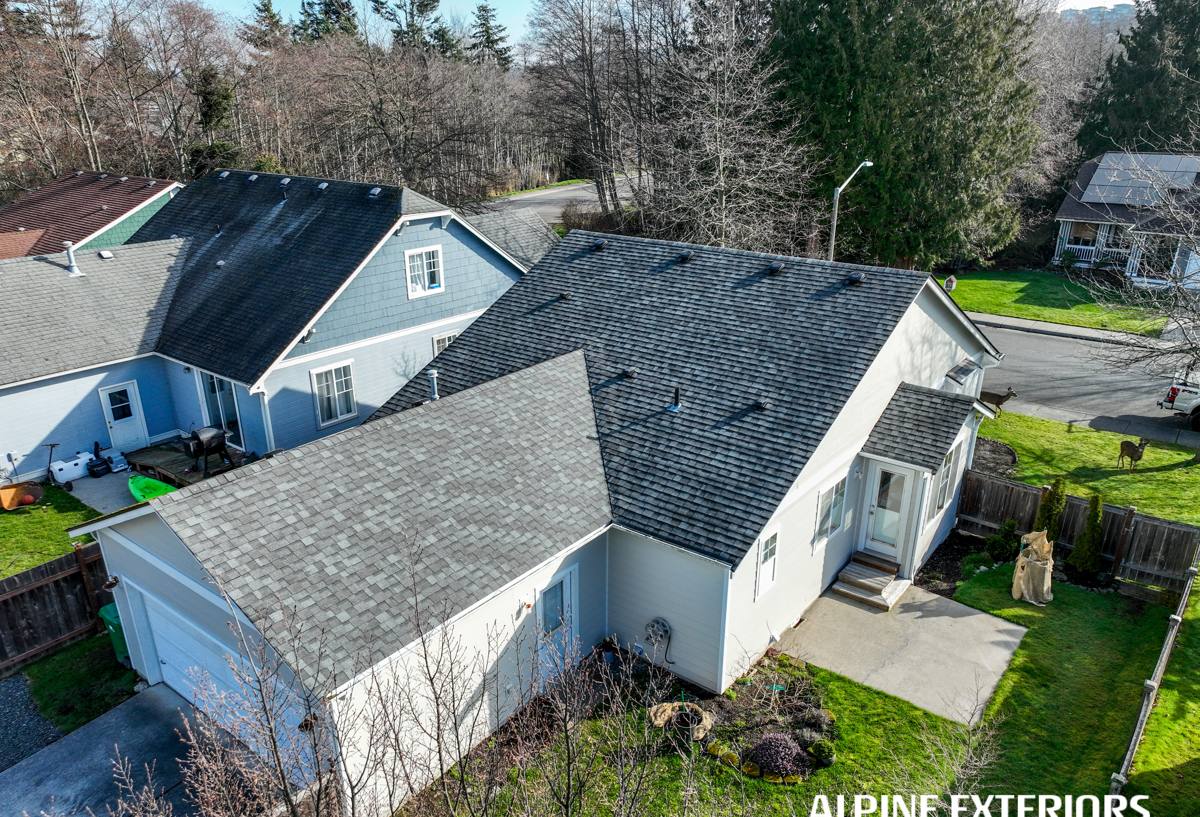
What Chuckanut's Climate Actually Does to a Wall
Salt Air
Airborne salt is corrosive to fasteners, trim hardware, and paint film, and it accelerates the breakdown of anything that relies on a surface coating to keep moisture out. Homes closer to the water take the worst of it, but salt carries further inland on wind than most people expect, especially through low-lying areas near Chuckanut Bay.
Driving Rain
Whatcom County doesn't just get a lot of rain — it gets wind-driven rain that hits siding at an angle instead of running straight down. That matters because it pushes water into seams, laps, and fastener penetrations that a product might otherwise shed fine in a calmer climate.
Moss and Prolonged Dampness
Shaded, tree-lined lots — common throughout this area — stay damp for extended stretches. Moss and algae don't just look bad; sustained organic growth against a wall traps moisture against the siding surface for weeks at a time, which is exactly the condition that punishes water-sensitive materials.
None of this is exotic. It's just the Pacific Northwest coastal climate doing what it does every year. But it means the margin for error on material choice and installation quality is smaller here than in a drier region.
The Materials We Set Aside — and Why
We're not going to tell you these products are junk, because that's not honest and it's not our call to make about a manufacturer's entire product line. Each of them does something reasonably well. What we can tell you is why they didn't fit the standard we wanted to hold ourselves to in this climate.
Vinyl Siding
Vinyl is affordable and low-maintenance in the sense that it doesn't need repainting. But it's a thin, flexible plastic product that expands and contracts significantly with temperature swings, can crack or warp in impact and cold, and telegraphs every irregularity in the wall behind it. In coastal wind exposure, panels can loosen or rattle over time, and once a piece is damaged, exact color matches for an older installation are often hard to find.
LP SmartSide
LP SmartSide is an engineered wood product — strand board with a resin-saturated overlay. It's genuinely improved over older OSB siding products and holds paint well when installed and maintained correctly. But it's still wood-based, which means cut edges, fastener penetrations, and any breach in the factory coating are entry points for moisture. In a climate with this much sustained dampness, that's a maintenance commitment we didn't want to keep asking homeowners to stay on top of.
Primed Spruce and Cedar
Solid wood siding, whether primed spruce boards or cedar, is a real product with real appeal — it's what a lot of older Chuckanut homes were originally built with. But it requires the most maintenance of anything on this list: regular repainting or staining, vigilance about caulking, and real vulnerability to rot, insect damage, and moss staining if upkeep slips even one season. We didn't want to build a business promising homeowners a maintenance schedule we knew from experience rarely gets followed.
Other Fiber Cement Brands (Cemplank, Allura)
These are legitimate fiber cement competitors to James Hardie, and fiber cement as a category is exactly the direction we believe in. Our reasons for choosing Hardie specifically over these brands come down to product line depth, the ColorPlus factory finish system, and warranty structure — not a claim that competing fiber cement is inferior material.
What James Hardie Fiber Cement Actually Is
James Hardie siding is made from cement, sand, and cellulose fiber, cured into a rigid, dense board. It doesn't expand and contract with humidity and temperature the way wood-based products do, it won't warp, and because it's composed of non-combustible materials, it carries a fire-resistance profile that wood and vinyl products simply can't match. That's a genuine safety consideration, not a marketing line — fiber cement doesn't contribute fuel to a fire the way wood siding can.
It's also engineered rather than sold as one generic product. James Hardie makes different formulations for different climates, and that regional engineering is a big part of why we standardized on the brand.
HZ5 — Built for This Climate
James Hardie's HZ5 product line is engineered specifically for the Pacific Northwest's wet, freeze-thaw-prone conditions. The formulation and installation specifications are built around exactly the kind of sustained moisture exposure and driving rain that Whatcom County sees. Installing a climate-matched product isn't a small detail — it's the difference between a system designed for this weather and one that's simply tolerant of it.
ColorPlus: Why the Finish Matters as Much as the Board
A lot of siding failure isn't really about the substrate — it's about the finish breaking down and letting weather get to what's underneath. James Hardie's ColorPlus Technology is a factory-applied, baked-on finish process, done under controlled conditions rather than painted on-site after installation. That gives a more consistent, durable color layer than field-applied paint, better fade resistance, and a color-specific warranty backing the finish itself, not just the board.
In a salt-air, high-UV-cycling, high-moisture environment, finish durability is not a cosmetic afterthought — it's a functional part of how long the siding actually protects the wall behind it.
Material Comparison at a Glance
| Factor | Vinyl | LP SmartSide | Primed Wood/Cedar | James Hardie |
|---|---|---|---|---|
| Moisture behavior in sustained damp | Doesn't absorb, but seams/panels shift | Vulnerable at cut edges/fasteners | High vulnerability without upkeep | Dimensionally stable, engineered for climate (HZ5) |
| Fire resistance | Melts/deforms | Combustible | Combustible | Non-combustible core |
| Finish durability | Molded-in color, can fade/chalk | Factory overlay, repaint eventually needed | Field paint/stain, regular upkeep required | Factory-baked ColorPlus finish |
| Typical maintenance | Low, but limited repair options | Periodic caulk/paint checks | Repaint/stain every few years | Occasional wash, minimal recoating |
| Impact/rigidity | Flexible, can crack in cold | Moderate | Moderate, dents/damages | Rigid, dense board |
Installation Is Half the Product
No siding material, including James Hardie, performs to spec if it's installed wrong. Fiber cement is heavier and less forgiving of shortcuts than vinyl — proper clearances, fastener placement, flashing detail, and caulking joints all matter more, not less, because the board itself is doing its job so well that any water intrusion has to come from an installation gap. We install exclusively to James Hardie's published specifications, which is also a requirement for the manufacturer's enhanced warranty coverage to apply.
- Verify the installer is James Hardie-trained or a recognized Preferred/Elite contractor, not just "familiar" with the product
- Confirm proper fastener spacing and type are being used, not generic siding nails
- Ask how flashing and butt joints are detailed at windows, corners, and roof lines
- Check that clearances from grade, decks, and roofing are being held to spec
- Get the installation and manufacturer warranty terms in writing, not verbally
The Warranty Question
James Hardie backs its siding with a long-term, transferable limited warranty, and ColorPlus finishes carry their own separate finish warranty. Transferability matters in a market like this one — it protects resale value, since a future buyer inherits real coverage rather than an expired or non-transferable claim. That combination of product warranty plus finish warranty is one of the concrete reasons we standardized on this brand over other fiber cement options.
Why We'd Rather Say No Than Install the Wrong Thing
Turning down installation requests for vinyl, LP SmartSide, or cedar costs us jobs. We've made that trade deliberately. Every siding failure we've seen called out to inspect — moss trapped behind loose panels, rot at cut edges, chalked and peeling field paint — traced back to a material or installation mismatch with what this climate actually demands. Standardizing on one system means every crew member knows the spec cold, every job gets the same attention to flashing and fastening detail, and we're not guessing at how a product we rarely touch will hold up five winters from now.
If you're planning a re-side in Chuckanut or anywhere in Whatcom County and want to talk through what James Hardie would look like on your home — colors, product line, and a straight answer on cost — we're happy to walk the property and put together a free, no-pressure estimate.