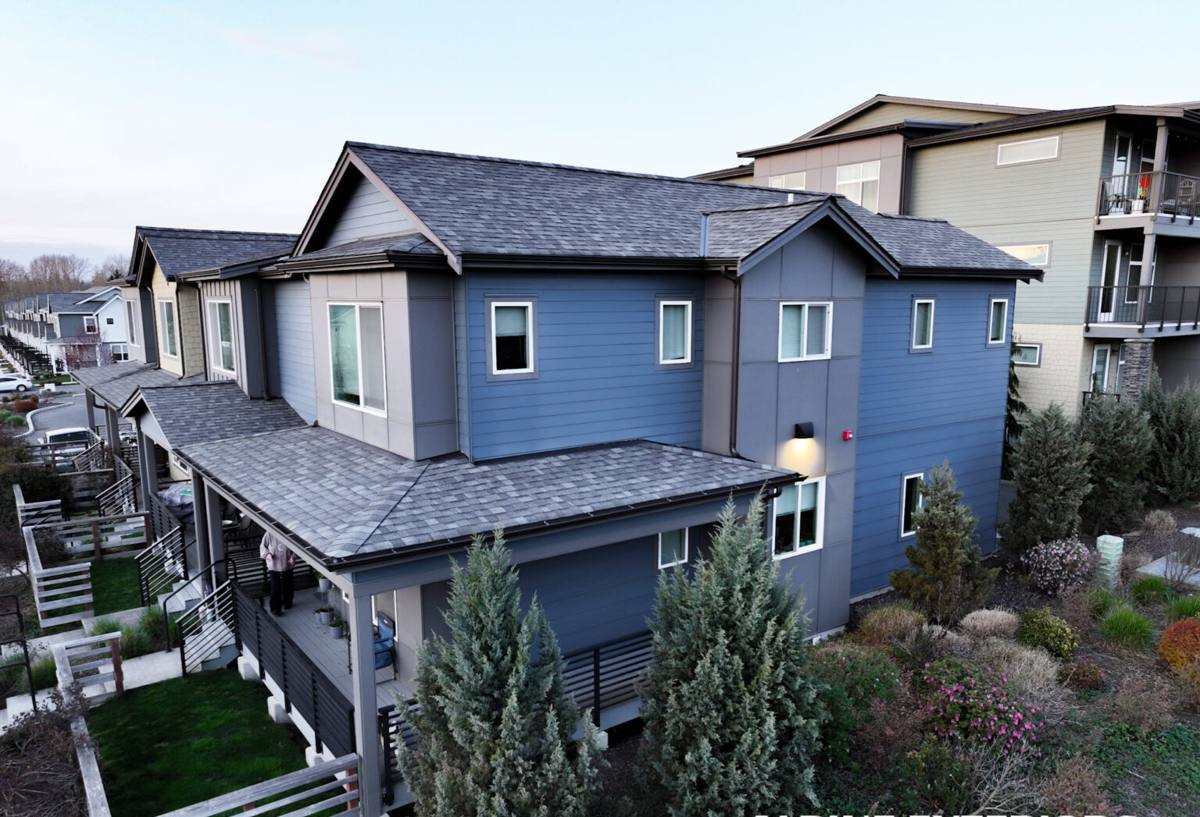
 Chuckanut Exterior
 If you're re-siding a home in Chuckanut or anywhere else in Whatcom County, you've probably come across two products in your research: James Hardie fiber cement and LP SmartSide engineered wood. Both are marketed as upgrades over vinyl, both claim to hold paint well, and both show up on contractor bid sheets around here. But they are fundamentally different materials with different long-term behavior, especially in a climate like ours — salt air off the water, driving rain that comes in sideways for days at a time, and a moss season that seems to stretch longer every year. This page walks through what each product actually is, where they differ, and why we standardized on Hardie for the homes we side.
What LP SmartSide Actually Is
LP SmartSide is an engineered wood product — strand-based wood fiber treated with resins, waxes, and zinc borate for insect and rot resistance, then pressed into panels or lap boards and coated with a factory primer. It's a real improvement over old-school untreated wood or hardboard siding from decades past, and it has a following among builders who like that it's lighter than fiber cement, easier to cut and nail without special blades, and less brutal on tools and lungs during installation. For dry climates or homes under deep roof overhangs, it can perform reasonably well over its service life.
The trade-off is that it is still, at its core, a wood product. Wood fiber — even engineered and treated — expands, contracts, and can absorb moisture at cut edges, fastener penetrations, and panel joints if those details aren't sealed and maintained exactly as the manufacturer specifies. That's not a flaw we're inventing to make a sale; it's the reason LP's own installation instructions are so specific about caulking, priming field-cut edges, and keeping the material off grade-contact points and away from prolonged water exposure.
What James Hardie Fiber Cement Actually Is
James Hardie siding is made from Portland cement, sand, and cellulose fiber, cured under pressure and heat. There's no wood fiber in the board itself, which means there's nothing for water to swell, no organic material for moss or mildew to feed on the way it can on a damp wood surface, and no insect food source. It's heavier and less forgiving to cut than engineered wood — you need fiber-cement-rated blades or shears, and installers have to manage silica dust properly — but the payoff is a board that doesn't move much with seasonal moisture swings and holds its factory finish for a long time.
Hardie's ColorPlus finish is baked on at the factory in a controlled environment, rather than field-applied primer that still needs a topcoat after installation. That matters here more than in drier climates: a factory-cured finish is simply more consistent than field-applied paint going on in Chuckanut's damp, cool shoulder seasons, when paint cure times stretch out and humidity works against a clean finish.
Head-to-Head: Material Behavior
| Factor | LP SmartSide | James Hardie Fiber Cement |
|---|---|---|
| Core material | Engineered wood strand, resin-treated | Cement, sand, cellulose fiber |
| Moisture response | Can swell at unsealed cuts/joints | Dimensionally stable, does not swell |
| Combustibility | Combustible (treated wood) | Non-combustible |
| Finish | Factory primer, field topcoat needed | Factory-cured ColorPlus finish available |
| Insect/rot vulnerability | Low with intact treatment, rises if damaged | Not a food source for insects or rot |
| Weight/handling | Lighter, easier field cutting | Heavier, requires proper blades and dust control |
| Typical manufacturer warranty | Limited warranty, often prorated | Non-prorated limited warranty, transferable |
Why the Local Climate Tips the Scale
Chuckanut sits close enough to the water that homes here take on real salt-laden air, and the weather pattern through Whatcom County means long stretches of steady, driving rain rather than quick passing showers. That combination is hard on any exterior material, but it's particularly unforgiving toward products where the manufacturer's own warranty depends on keeping every cut edge sealed and every joint maintained. On a wood-based product, a missed caulk line at a butt joint or a fastener that backs out slightly can let moisture into the panel core, and once that starts, the swelling and finish failure that follow tend to show up at exactly the joints and corners that are hardest to inspect from the ground.
Moss is the other local factor people underestimate. Our moss season runs long, and moss thrives on organic surfaces that hold moisture — which describes wood-based siding more than it describes cement board. Fiber cement doesn't eliminate moss from ever landing on a wall, but it doesn't feed it the way an organic substrate can, and it doesn't soften underneath a moss mat the way wood fiber can if that moss is left unaddressed for a season or two.
Where LP SmartSide Can Still Make Sense
To be fair, LP SmartSide isn't a bad product across the board. On a detached shop, a covered porch soffit, or a building with generous overhangs and low rain exposure, it can be a perfectly reasonable, lower-cost choice. Our concern is specifically full-exposure, primary-residence siding in a wet coastal climate over a 30-plus year ownership horizon — that's a different bar than a well-protected outbuilding.
Installation Sensitivity: The Part Bids Don't Show You
Both products are only as good as their installation, but the margin for error is different. LP SmartSide's warranty coverage is conditioned on field priming every cut edge before installation, maintaining specific gaps and flashing details, and keeping the material a set distance from grade, decks, and roof lines. Skip any of that under time pressure and you may not find out until years later, when the damage is already inside the wall.
Hardie has its own installation spec too — proper fastener placement, correct clearances, and manufacturer-approved caulk and flashing — but because the board itself doesn't absorb and swell the way wood fiber does, a small installation miss is less likely to snowball into hidden rot. That's a meaningful difference when you're hiring a crew you can't personally supervise every hour of every day.
Cost Considerations Over the Ownership Timeline
| Cost Factor | LP SmartSide | James Hardie |
|---|---|---|
| Upfront material cost | Generally lower | Generally higher |
| Field finishing cost | Topcoat paint labor typically required | Factory finish, less field paint labor |
| Repaint cycle | Shorter, climate-dependent | Longer with factory ColorPlus finish |
| Moisture-related repair risk | Higher if joints/cuts not maintained | Lower — material doesn't swell |
| Resale/warranty transfer | Varies by product line | Transferable limited warranty available |
The lower sticker price on engineered wood is real, and we won't pretend otherwise. Where the math shifts is over a 20-30 year ownership window, once you factor in repaint cycles and the risk premium of moisture-related repair on a wood-based product in a wet coastal climate. That's the calculation that led us to only install Hardie: we'd rather build a system once that holds up than have a homeowner call us back in a decade with hidden joint damage.
What to Check Before You Choose
- Ask any contractor exactly which fastening pattern and clearance spec they follow, and whether it matches the manufacturer's published install guide — not just "how we've always done it."
- Get the warranty document itself, not just a verbal summary — read what voids it (unsealed cuts, wrong fastener type, missing flashing).
- Ask whether the finish is factory-applied or field-applied, and what the manufacturer's recommended repaint interval is for our climate.
- Walk the home's north- and water-facing walls specifically — those see the most sustained moisture exposure in Chuckanut and are where material choice matters most.
- Confirm whether the crew doing the install is factory-trained on the specific product, since installation quality affects both products' real-world lifespan more than the spec sheet does.
Where We Land
We install James Hardie exclusively because it's the product we're comfortable standing behind for full-exposure residential siding in this climate — non-combustible, dimensionally stable, backed by a factory finish and a transferable warranty that doesn't hinge on every field seam staying perfectly sealed for three decades. That's not a knock on every use case for engineered wood; it's our professional judgment about what belongs on a primary home a few miles from saltwater with a rain season that doesn't quit and a moss season that follows right behind it.
If you're weighing options for your own home, we're happy to walk your specific walls, look at your exposure and overhangs, and give you a straight answer — including where a lower-cost option might genuinely be fine. Reach out for a free, no-pressure estimate using the form below.