 Chuckanut Exterior
 Siding Installation in York: Built for What This Corner of Chuckanut Actually Deals With
Homes in the York area of Chuckanut sit in one of the more demanding exterior environments in Whatcom County. You've got salt-laden air drifting up off the water, driving rain that comes in sideways during winter storms, and enough shade and moisture from the surrounding trees to keep moss and algae active for most of the year. None of that is exotic — it's just the normal cost of living somewhere this beautiful. But it means siding installation here isn't a one-size-fits-all job. What holds up on a dry, sunny lot two counties over will not hold up the same way on a shaded, wind-exposed property in York.
This page is specifically about siding installation for York homes — not a generic overview of siding in general. We'll walk through what the climate actually does to exterior materials, what a correct installation looks like from the framing out, how our process works, and why hiring a crew that already understands this neighborhood's conditions matters more here than in most places.
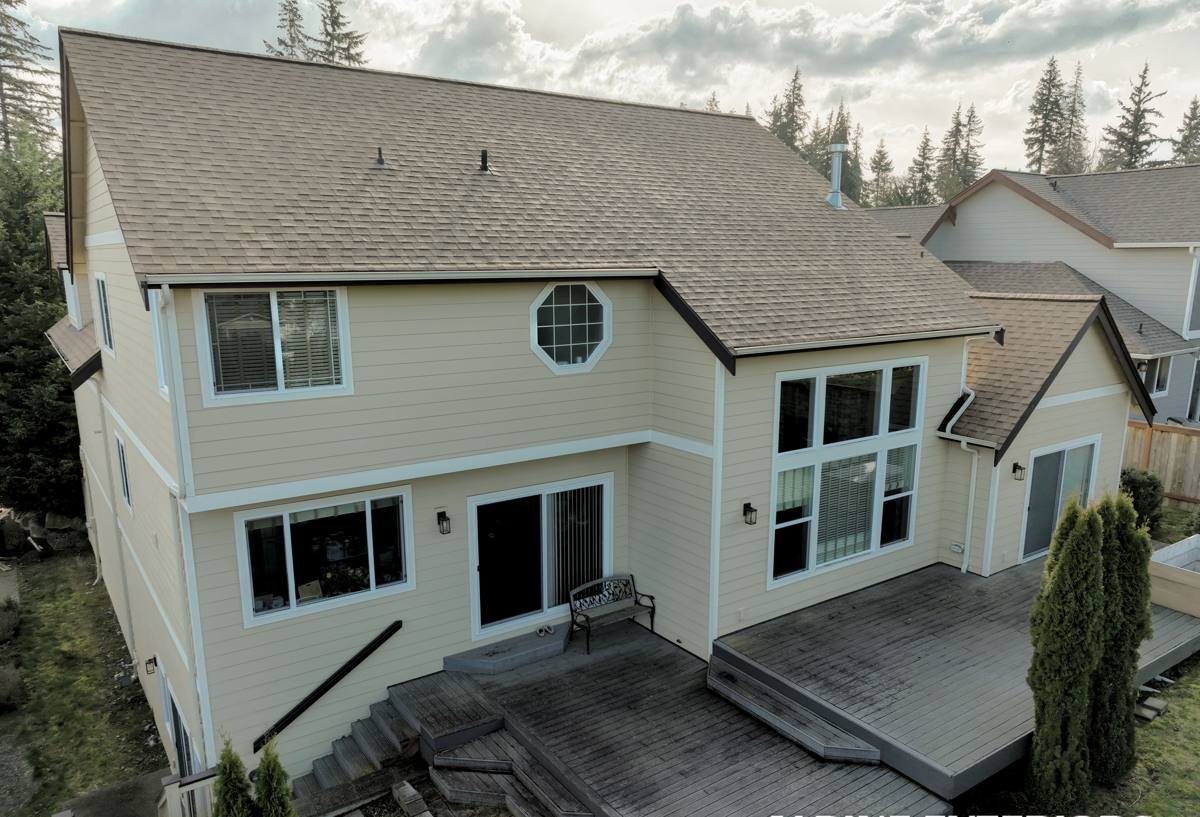
What Salt Air, Driving Rain, and Moss Season Do to a House
Salt air and coastal exposure
Even a few miles inland from Chuckanut Bay and Samish Bay, airborne salt finds its way onto exterior surfaces. Over years, it accelerates corrosion on exposed fasteners and trim metal, and it breaks down paint films faster than it would in a drier inland climate. Siding material that isn't dimensionally stable — meaning it swells, shrinks, or absorbs moisture unevenly — tends to show that stress first at seams, corners, and fastener points, which is exactly where salt exposure does the most damage.
Driving rain and wind-driven water
Whatcom County storms don't always come straight down. Wind pushes rain sideways and upward under laps, into butt joints, and behind trim if the water-resistive barrier and flashing details weren't done correctly the first time. A siding installation that looks fine from the curb can still be letting water behind the cladding if the underlying drainage plane wasn't built right — and that kind of failure often stays hidden for years before it shows up as rot in the sheathing.
Long moss season
Tree cover and persistent dampness in this part of Chuckanut mean moss and algae have a long growing window — often nine or ten months of the year. Moss holds moisture directly against a wall surface, and on materials that aren't rot-resistant, that constant dampness is what actually causes deterioration, not the moss itself. Siding choice, plus ongoing maintenance, both matter here more than in a drier climate.
What a Correct Siding Installation Actually Involves
Siding is a system, not a product. The panels are the visible part, but the parts nobody sees are what determine whether the house stays dry for the next 30-plus years. A correct installation for a York home includes:
- Inspection and repair of the substrate — any existing rot, soft sheathing, or compromised framing gets addressed before anything new goes up. Covering a problem never fixes it.
- A continuous water-resistive barrier — properly lapped and sealed, so any water that does get behind the siding has a way to drain out instead of soaking into the wall assembly.
- Correct flashing at every penetration — windows, doors, vents, hose bibs, and roof-to-wall transitions are where wind-driven rain finds its way in if flashing is skipped or done casually.
- A drainage gap or rainscreen approach where appropriate — giving bulk water and moisture vapor a path to escape rather than sitting against the back of the siding.
- Manufacturer-specified fastening — correct fastener type, spacing, and penetration depth. Under- or over-driven fasteners are one of the most common causes of early siding failure, and it's an installation error, not a product defect.
- Factory-finished, climate-rated material — chosen for the specific exposure (coastal, wind, moisture) rather than whatever happens to be cheapest that week.
Skip any one of these steps and the siding might still look right for a few years. In a climate like York's, it won't stay right for long.
Why We Install Only James Hardie Fiber Cement
We made a decision a while back to standardize on James Hardie fiber cement siding and stop installing vinyl, LP SmartSide, and other engineered wood or composite products — even though all of them have a place in the market and each does some things well. For a coastal, high-moisture, moss-prone environment like York, the trade-offs of those alternatives are exactly the ones that matter most:
- Vinyl expands and contracts significantly with temperature swings, which stresses seams and fastening over time, and it can warp or become brittle under sustained UV and cold exposure.
- Engineered wood products (like LP SmartSide) use wood strand or wood fiber substrates. They perform well when installation and maintenance are followed to the letter, but they're more sensitive to sustained moisture exposure and edge-swelling than fiber cement, which matters in a neighborhood with this much rain and shade.
- Non-Hardie fiber cement brands (Cemplank, Allura, and similar) are chemically similar to Hardie's product, but Hardie's ColorPlus factory finish, climate-engineered HZ product lines, and long, transferable warranty are the combination we've found most reliable to stand behind on the homes we install.
James Hardie fiber cement is non-combustible, dimensionally stable across our wet-then-dry seasonal swings, and doesn't feed moss or rot the way wood-based products can when moisture sits against them. It's not the cheapest option on the shelf, but for this specific climate, it's the one we're willing to put our name behind.
HardiePlank HZ5 — engineered for this region
James Hardie makes region-specific HZ (Hardiezone) product formulations, and the Pacific Northwest falls under the HZ5 designation — engineered for higher moisture exposure and freeze-thaw cycling compared to the HZ10 formulation used in drier, hotter climates. That's a meaningful distinction for a York home: the siding is formulated for the moisture load it's actually going to face, not a generic national spec.
Our Siding Installation Process for York Homes
Every job starts with the same structured approach, adjusted for the specifics of the property:
- On-site assessment. We walk the exterior, check for existing moisture damage, evaluate sun/shade exposure and wind orientation, and look at drainage patterns around the foundation — all of which affect how the new siding system should be detailed.
- Substrate repair. Any rotted sheathing, compromised framing, or existing moisture intrusion gets repaired before anything new is installed. We won't install new siding over a known problem.
- Water-resistive barrier and flashing. A continuous, correctly lapped barrier goes on first, with flashing detailed at every window, door, and penetration.
- Drainage plane installation. Depending on the wall assembly and exposure, this may include a rainscreen or furring approach to keep the siding itself off the wet side of the wall.
- James Hardie siding installation. Panels, fasteners, and trim are installed to manufacturer specification — not just "close enough" — because in this climate, the details are what determine longevity.
- Caulking, trim, and finish detail. Joints, corners, and transitions are sealed and finished so water has nowhere to collect or track behind the assembly.
- Final walk-through. We go over the completed work with the homeowner, explain what was done and why, and cover basic maintenance expectations going forward.
Signs a York Home Needs Siding Replacement, Not Just Repair
Given the climate, it's worth knowing what to look for before a small issue becomes a structural one. Common warning signs include:
- Soft or spongy spots when you press on the siding, especially near the bottom courses or around window trim
- Visible moss or algae buildup that returns quickly after cleaning, suggesting the surface stays damp longer than it should
- Paint that's peeling, bubbling, or failing repeatedly in the same spots — often a sign of moisture trapped behind the material
- Warping, cupping, or separation at seams and corners
- Interior signs like musty smells, discoloration on interior walls, or peeling interior paint near exterior walls, which can point to moisture getting through from the outside
Any one of these, especially in combination, is worth having looked at before it's patched over cosmetically.
Cost Factors for Siding Installation in York
Every home is different, and we don't quote sight-unseen, but these are the main factors that move the price of a siding installation project up or down:
| Factor | Why It Matters |
|---|---|
| Home size and wall complexity | More square footage, dormers, and cut-ins mean more material and labor time |
| Substrate condition | Rot or moisture damage found during tear-off adds repair scope before new siding goes on |
| Existing siding removal | Full tear-off versus installing over a prepared surface changes labor significantly |
| Trim and detail work | Custom trim, corner boards, and accent details take more time than straight lap siding |
| Access and site conditions | Steep lots, tree cover, and tight access — common around York — can affect staging and scaffolding needs |
| Product line and finish | HardiePlank, HardieShingle, and HardiePanel carry different material and installation costs |
We give a written, itemized estimate after an in-person assessment — not a rough number over the phone — because the substrate condition alone can change the scope significantly once we're actually looking at the walls.
Why Hiring a Crew That Already Works in York Matters
Siding installation isn't just about following a manufacturer's install guide — it's about knowing how a specific microclimate behaves. A crew that regularly works this part of Chuckanut already understands things a visiting or out-of-area contractor has to learn on your dime: which orientations take the worst wind-driven rain, where moss tends to establish fastest, how salt exposure changes maintenance timelines, and what flashing details actually hold up here versus what looks fine on paper. That local pattern recognition shows up in the small decisions — where to add extra flashing, how tight to detail a rainscreen gap, which trim details need extra attention — that separate a siding job that lasts three decades from one that needs attention again in eight years.
Maintaining James Hardie Siding After Installation
Fiber cement is low-maintenance, not no-maintenance. In a climate like York's, a simple annual routine keeps the siding performing the way it's designed to:
- Rinse the siding gently once or twice a year to keep salt residue, dust, and organic buildup from accumulating
- Keep gutters clean and downspouts directed away from the foundation so water isn't splashing back up onto lower courses
- Trim back vegetation and tree limbs that keep sections of the wall shaded and damp longer than the rest of the house
- Check caulking at trim and penetrations every year or two, and have any cracked or missing sealant redone promptly
- Address any moss regrowth early with a gentle wash rather than letting it establish for another season
None of this is heavy work, but skipping it in a climate this wet shortens the life of any siding system, Hardie included.
Let's Take a Look at Your Home
If you're weighing a siding replacement for a York property, we're happy to come take a look, walk the exterior with you, and give you an honest read on what's going on and what it would take to do the job right. There's no cost and no pressure for the estimate — just a straightforward look at your home's specific situation.