 Chuckanut Exterior
 Siding in Larrabee: A Different Kind of Exposure
Homes along the Chuckanut waterfront and the wooded slopes around Larrabee deal with a combination of stresses that most siding products were never built to handle at once. There's salt-laden air coming off the water, long stretches of driving rain pushed sideways by wind off the Sound, and deep shade from evergreen canopy that keeps north and east walls damp long after a storm clears. Add in a moss and algae season that, in this part of Whatcom County, can run nearly year-round on the shaded sides of a house, and you have a climate that punishes weak siding fast.
We work this stretch of Chuckanut regularly, and the pattern is consistent: siding failures here rarely start with a single dramatic event. They start small — a seam that never fully dries, a cut edge that wicks moisture, a caulk joint that gives out after a few freeze-thaw cycles — and compound over a few wet winters into rot, paint failure, or panel delamination. Choosing the right product and installing it correctly for this specific exposure matters more in Larrabee than it does a few miles inland.
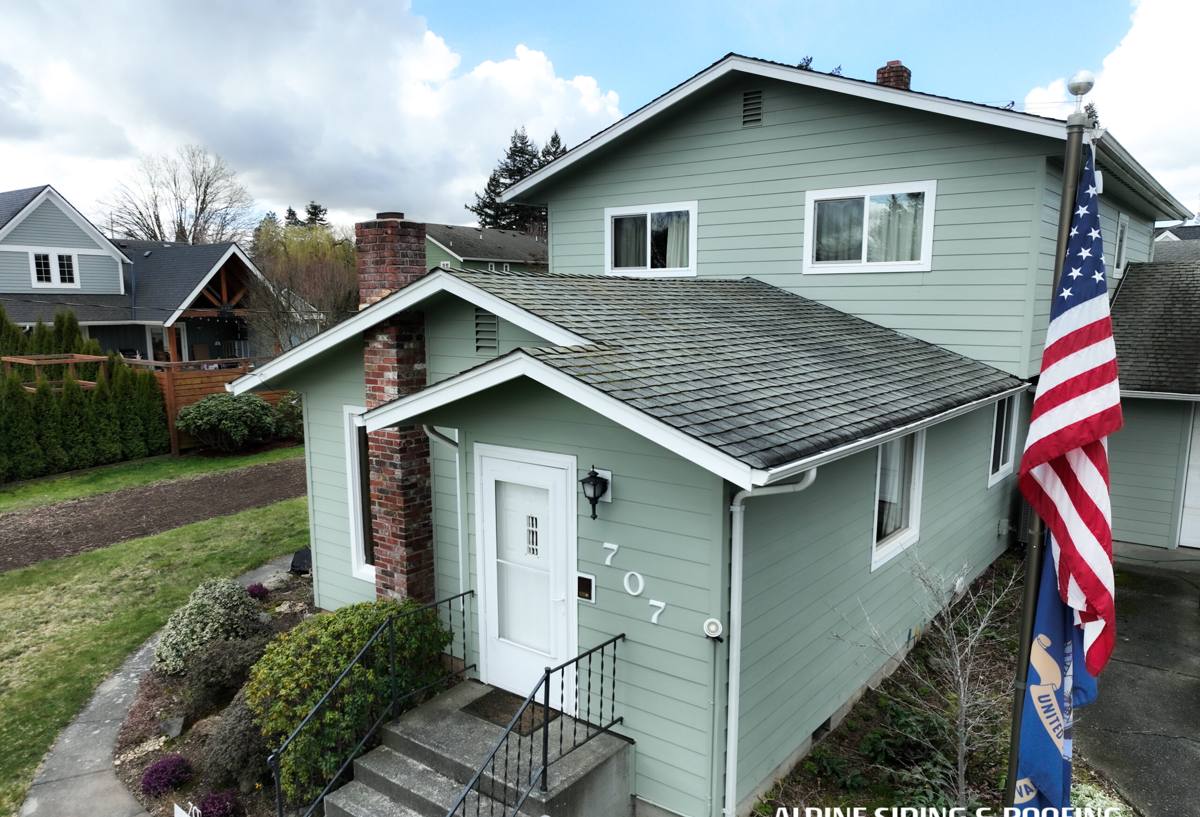
What Larrabee Homes Actually Need From Their Siding
Before talking about brands or products, it's worth being specific about what the material has to survive here:
- Salt air corrosion resistance — airborne salt accelerates the breakdown of paint films and can corrode unprotected fasteners and trim over time.
- Sustained moisture exposure — long rain events plus tree shade mean some wall sections stay wet far longer than a sunny, open lot would allow.
- Moss and mildew resistance — shaded, damp siding is where organic growth takes hold first, and it holds moisture against the surface once it does.
- Dimensional stability — repeated wet/dry and freeze/thaw cycling causes some materials to swell, crack, or lose their fastener grip over the years.
- Color and finish that doesn't chalk or fade quickly — factory-cured finishes hold up to UV and moisture cycling far better than field-applied paint.
Any siding sold as "low maintenance" needs to actually perform against that list in this specific climate, not just in a showroom or a drier region.
Why We Install Only James Hardie
We made a decision as a company to install James Hardie fiber cement exclusively, and Larrabee's climate is a good example of why. Fiber cement is non-combustible, which matters for a region with wooded lots and wildfire-aware building codes. It's dimensionally stable in a way vinyl and untreated wood products aren't, so it doesn't warp or buckle as it moves through wet Pacific Northwest winters and drier summers. And Hardie's ColorPlus finish is baked on and cured at the factory under controlled conditions, which holds color and resists fading, chalking, and moisture intrusion far better than a finish applied on-site in variable weather — a real concern on a job that gets rained on mid-project as often as coastal Whatcom County jobs do.
We don't install LP SmartSide, vinyl, Cemplank, Allura, primed spruce, or cedar. Some of those products have real strengths, but none of them combine non-combustibility, factory-cured color, and long-term dimensional stability the way Hardie does — and in a salt-air, high-moisture environment like Larrabee, that combination is what actually keeps a wall assembly healthy for decades instead of one.
The Hardie Product Lines We Use Here
| Product | Best Use on Larrabee Homes | Why It Fits |
|---|---|---|
| HardiePlank lap siding (HZ5) | Primary wall cladding, most homes | Engineered for the wetter, harsher climate zone (HZ5) that covers the Pacific Northwest coast |
| HardiePanel vertical siding | Accent gables, modern or mixed-material facades | Clean lines, fewer horizontal joints where water can collect |
| HardieShingle | Accent areas, dormers, gable ends | Traditional coastal look with the same moisture and fire performance |
| HardieTrim | Corners, fascia, window and door trim | Matches the wall system's stability so trim joints don't open up over time |
What a Correct Install Looks Like on a Shaded, Wet Lot
Hardie's warranty and long-term performance depend entirely on installation quality. On a lot like the ones common around Larrabee — shaded, close to the water, exposed to wind-driven rain — the details matter more than usual. Cutting corners on any of the following is exactly how a good product still ends up with a bad outcome.
Non-negotiables on a Chuckanut-area install:
- A properly installed drainage plane and rainscreen gap behind the siding, so any moisture that gets past the cladding can drain and dry instead of sitting against the sheathing.
- Correct flashing at every window, door, and roof-to-wall intersection — the majority of siding failures we find in this area trace back to flashing details, not the siding itself.
- Manufacturer-specified fastener type, spacing, and placement, since undersized or overdriven fasteners are a common source of premature panel movement.
- Factory-cut and factory-primed edges used wherever possible, with any field cuts properly sealed, since raw cut edges are the most vulnerable point on any fiber cement board.
- Correct clearance from grade, decks, and roof lines so siding isn't sitting in standing water or constant splash-back — a common issue on sloped, wooded lots.
- Caulk and sealant used only where Hardie's specifications call for it, not as a substitute for proper flashing and gapping.
This is also why we're skeptical of "just replace the boards" quotes on older Larrabee homes. If the underlying moisture management wasn't right the first time, new siding on top of the same problems just buys a few more years before the same failure shows up again.
Our Process, Start to Finish
- On-site assessment — we walk the exterior, check for existing moisture damage, rot, or flashing issues, and look specifically at shaded and water-facing walls where problems concentrate first.
- Straightforward proposal — what siding line, what prep work is actually needed, and a clear cost breakdown, with no pressure to decide on the spot.
- Prep and moisture check — any compromised sheathing, framing, or trim gets addressed before new siding goes up. Covering up a hidden problem doesn't happen on our jobs.
- Installation to manufacturer spec — rainscreen, flashing, fastening, and clearances handled the way this climate requires, not the fastest way to close out the job.
- Final walkthrough — we go over the finished work with you before we call it done.
What Drives Cost on a Larrabee Job
| Factor | Why It Matters Here |
|---|---|
| Existing moisture or rot damage | Shaded, waterfront lots see this more often, and it has to be fixed before new siding goes on |
| Home elevation and roofline complexity | Steep or multi-story homes on sloped lots take more time and access equipment |
| Siding profile and accent mix | Combining lap siding with shingle or panel accents adds labor versus a single profile |
| Trim scope | Full trim replacement versus reusing sound existing trim changes both cost and long-term durability |
| Access and site conditions | Tree cover, tight lot lines, and driveway access affect staging and timeline |
We don't quote off a phone call for this kind of exposure — the moisture history and prep needs on a shaded, coastal-adjacent lot vary too much to estimate honestly without seeing the walls.
Why Local Experience Matters More Than It Sounds
A crew that mostly works drier, inland neighborhoods can install Hardie siding perfectly well on paper and still miss the details that matter specifically along Chuckanut. Knowing which walls stay wet longest because of tree cover and sun angle, how much wind-driven rain a given elevation actually takes in a winter storm, and where moss and algae tend to establish first isn't something you get from a spec sheet — it's something you learn from working this exact stretch of coastline. We factor that local exposure pattern into flashing details, rainscreen design, and even which walls get extra attention during prep, because a generic install plan doesn't hold up the same way here that it would twenty miles inland.
Signs Your Current Siding Is Already Behind
- Persistent moss or dark staining on shaded walls that returns shortly after cleaning
- Paint that's chalking, peeling, or fading unevenly, especially on water-facing sides
- Soft spots, visible swelling, or seams that have separated slightly
- Caulk joints that are cracked, shrunk, or missing in sections
- Visible rust streaking near fasteners or trim
None of these mean immediate emergency, but they're worth having looked at before the next wet season — small fixes now are a lot cheaper than a full re-side later.
If you're weighing a siding replacement or repair on a Larrabee property, we're happy to take a look and give you a straightforward, no-pressure assessment of what your home actually needs. There's a free estimate request form below — reach out whenever it's convenient.