 Chuckanut Exterior
 Siding That Actually Holds Up at Lake Samish
Homes around Lake Samish sit in one of the more demanding microclimates in Whatcom County. The lake basin traps moisture, the surrounding tree cover keeps siding shaded and slow to dry, and the marine air moving up from Bellingham Bay and the Chuckanut shoreline carries a faint salt load that settles on every exterior surface in the area. Add in the region's long, wet winters and you have a setting where the wrong siding material shows problems within a few years rather than a few decades.
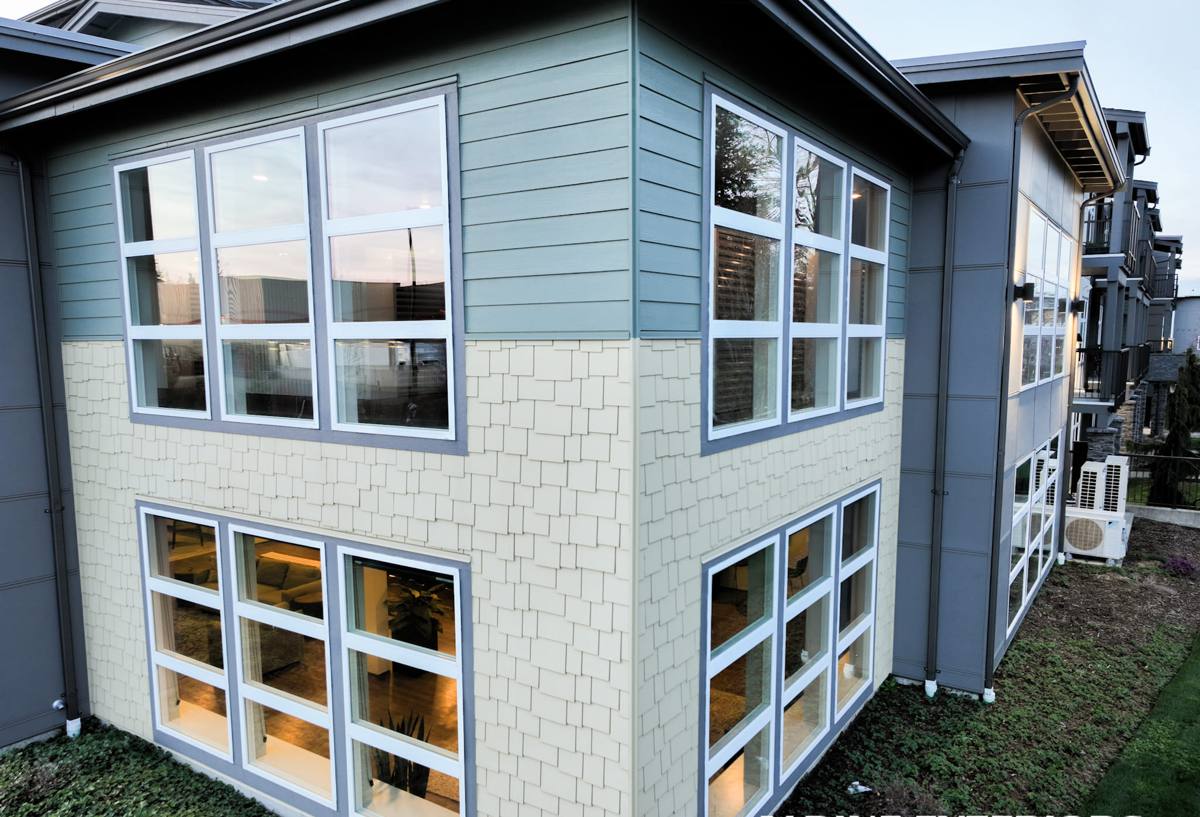
This page covers one thing specifically: James Hardie fiber cement siding installed correctly on Lake Samish homes. We don't sell vinyl, LP SmartSide, cedar, or other fiber cement brands, and we're not going to pretend this is a generic "siding options" article. It's a straight explanation of what this climate does to a house, what Hardie brings to the table, and what a correct install looks like.
What This Climate Does to a House
Moisture That Doesn't Leave
Lake-adjacent lots get more ambient humidity than homes even a mile away on higher, more open ground. Combined with tree canopy that blocks sun and wind, siding on these homes can stay damp for days after a storm passes. Any material that absorbs water instead of shedding it is working against the site from day one.
Moss Season Is Not a Season — It's Most of the Year
In Whatcom County, moss and algae growth on north-facing and shaded siding can run from fall through late spring. On a lake lot ringed with conifers, that window often stretches longer. Moss holds moisture directly against the siding surface and, on softer or more porous materials, that sustained dampness accelerates rot, delamination, and paint failure.
Salt-Tinged Marine Air
Chuckanut sits close enough to Bellingham Bay and the Salish Sea that homes in the area see some salt content in the wind, especially during winter storms. It's not the same load as a beachfront property, but over years it contributes to fastener corrosion, finish breakdown, and faster wear on anything not built for coastal-adjacent exposure.
Driving Rain and Wind-Driven Water
Storms off the Sound don't just fall straight down here — wind pushes rain sideways into wall assemblies. That means siding, flashing, and water-resistive barriers all have to work as a system. A siding product that looks fine on paper can still fail if the installation doesn't account for wind-driven moisture at every seam, corner, and penetration.
Why James Hardie Fits This Site
James Hardie fiber cement is engineered specifically for the kind of exposure Lake Samish homes deal with. A few reasons it holds up where other materials struggle:
- Non-combustible core: fiber cement doesn't feed a fire the way wood-based products can — relevant for homes near the tree cover common around the lake.
- Dimensionally stable: it doesn't swell, cup, or warp with repeated wet-dry cycles the way wood and wood-composite sidings can.
- Factory-applied ColorPlus finish: a baked-on finish that resists fading and moisture intrusion far better than field-applied paint, which matters when the siding stays damp longer than average.
- HZ5 climate engineering: James Hardie makes region-specific product formulations, and the HZ5 line is built for the cold, wet Pacific Northwest rather than a one-size-fits-all national spec.
- Pest resistance: fiber cement doesn't offer the food source that wood siding does, which matters on wooded lake lots with established insect populations.
None of this means Hardie is maintenance-free. It means the material itself isn't the weak point — the installation is where a Hardie job succeeds or fails.
What a Correct Installation Involves
Fiber cement siding is only as good as the details behind it. On a moisture-heavy site like Lake Samish, these are not optional refinements — they're the difference between a 30-plus year exterior and a callback in year five.
- Water-resistive barrier and flashing first. Correct house wrap, window and door flashing, and kick-out flashing at roof-wall intersections have to be right before a single board goes up. This is the layer that actually stops bulk water, not the siding itself.
- Proper clearances. Hardie specifies minimum gaps from grade, roofing, decks, and other horizontal surfaces. On lake lots with landscaping close to the foundation, these clearances get skipped more often than you'd expect — and that's exactly where moss and moisture damage start.
- Correct fastening. Hand-nailing or properly calibrated pneumatic nailing, at the manufacturer's specified pattern, into solid framing — not just sheathing. Blown-out or overdriven fasteners are a leading cause of premature siding failure.
- Sealed and caulked joints, done right. Butt joints, trim intersections, and penetrations need the correct sealant, applied correctly — not just caulked at the surface to look finished.
- Factory-cut edges preserved wherever possible. Cut edges expose raw fiber cement; any field cuts need to be sealed per Hardie's specification, especially on a site where boards stay wet longer between dry spells.
- Ventilation behind the cladding. A rainscreen or properly vented assembly lets any moisture that does get behind the siding actually dry out, instead of sitting against the wall sheathing.
Common Shortcuts We See on Older Lake-Area Homes
When we inspect existing siding on Lake Samish properties, the recurring issues are rarely about the siding material itself — they're installation shortcuts: missing kick-out flashing, siding buried in mulch or landscaping below the minimum clearance, caulk used to compensate for gaps instead of correct flashing, and fasteners driven into thin air at panel edges instead of framing.
Hardie vs. Other Siding Approaches for a Lake Lot
| Factor | James Hardie Fiber Cement | Vinyl | Wood / Engineered Wood |
|---|---|---|---|
| Moisture in a shaded, damp lot | Stable; doesn't absorb and swell | Doesn't absorb, but can trap moisture behind it at poor seams | Absorbs moisture; prone to swelling and rot over time |
| Moss and algae exposure | Finish resists staining; surface cleans up well | Can stain and become brittle in cold, wet cycles | Moss retains moisture against the material, speeding decay |
| Fire exposure near tree cover | Non-combustible | Can melt or deform under heat | Combustible |
| Finish longevity | Factory-baked ColorPlus finish, long fade resistance | Color molded through material but can chalk and fade | Field-applied paint/stain needs recoating every few years |
| Long-term cost | Higher upfront, lower lifetime maintenance | Lower upfront, moderate lifetime cost | Moderate upfront, highest lifetime maintenance cost |
This isn't a knock on every alternative product across every use case — it's specifically why, for the moisture and moss conditions around Lake Samish, we standardized on James Hardie and stopped installing the alternatives.
Our Process for Lake Samish Jobs
Lake lots come with logistics that flatland properties don't: narrower or shared access roads, mature trees close to the structure, septic systems and wells that need to be flagged before equipment moves in, and slopes that affect scaffolding and staging. A crew that's worked the area already knows to account for these before the job starts, not after a truck gets stuck or a septic line gets marked too late.
Our process on a Lake Samish siding project:
- On-site assessment. We look at existing siding, sheathing condition, flashing details, drainage around the foundation, and site access before quoting anything.
- Moisture check. Where there's any sign of past water intrusion, we check sheathing condition before covering it back up with new siding.
- Detailed proposal. Product line, color, trim details, and a clear scope — no vague "siding replacement" line item.
- Correct sequencing. Barrier and flashing work first, inspected, then Hardie installation to manufacturer spec.
- Final walkthrough. We review clearances, caulking, and finish quality with you before calling the job done.
Maintenance Checklist for Lake Samish Homeowners
- Rinse siding annually, focusing on shaded, north-facing walls where moss and grime build up fastest.
- Keep landscaping and mulch pulled back from the manufacturer's minimum clearance at the base of the siding.
- Check and clear gutters before the fall rains — overflow is one of the most common causes of localized siding damage.
- Trim back tree branches and vegetation that keep sections of the house in permanent shade.
- Inspect caulking at trim, windows, and joints every year or two, and have any cracked or missing sealant redone promptly.
- Watch for kick-out flashing at roof-to-wall intersections — a common failure point that's easy to miss during a casual look at the exterior.
Why Local Experience on This Lake Matters
Every lake lot in the Chuckanut area has its own combination of tree cover, slope, sun exposure, and access constraints. A crew that has already worked several homes around Lake Samish isn't guessing at how much shade a north wall gets in January, or where moss tends to establish first, or which access points give a truck room to stage material without tearing up a driveway. That experience shows up in fewer surprises during the job and in an installation that's actually tuned to the site instead of a generic spec sheet.
It also matters for follow-up. If a caulking line needs a touch-up in year three or a section needs a look after a hard storm, working with a crew that already knows the property and the area means faster, more accurate service — not starting from zero with a new contractor every time.
Ready for a Straight Answer on Your Siding?
If your Lake Samish home has siding that's struggling with moss, moisture, or finish failure — or you're planning ahead for a full replacement — we're happy to take a look and give you an honest assessment of what's actually going on and what correct James Hardie installation would involve. Request a free, no-pressure estimate using the form below.