 Chuckanut Exterior
 Lake Samish sits in a pocket of Whatcom County that holds onto moisture longer than most of the surrounding area. The lake basin, the tree cover on the surrounding slopes, and the region's proximity to Chuckanut Bay and the Salish Sea all combine to keep humidity high, sunlight limited on many lots, and siding wet for longer stretches than homes just a few miles inland. If you own a home around Lake Samish, you've probably already noticed what that does to exterior materials over time — green streaking on north-facing walls, soft spots where paint has failed, or trim that never quite dries out between storms.
Siding for this area has to be chosen and installed with that reality in mind. This page covers what fiber cement siding needs to do here, what a correct installation looks like, and why we install James Hardie fiber cement exclusively on the homes we work on.
What Lake Samish's Climate Does to Exterior Siding
Three conditions define this area's toll on siding, and they compound each other:
Salt Air and Driving Rain
Whatcom County's marine climate pushes moisture-laden air and wind-driven rain against exterior walls for much of the year, and homes closer to Chuckanut Bay and Samish Bay pick up some salt content in that air as well. Driving rain doesn't just wet a wall's surface — it forces water into seams, laps, and fastener penetrations if those details weren't built correctly the first time. Salt-laden moisture accelerates corrosion on fasteners and trim, which is one reason fastener choice and flashing detail matter as much as the siding material itself.
A Long Moss Season
Shaded, tree-lined lots around the lake stay damp long after storms pass. That extended wet period is exactly what moss and algae need to establish on siding, trim, and roof lines. Moss doesn't just look bad — where it takes hold on a wood-based or poorly sealed product, it holds moisture against the substrate and speeds up rot and paint failure underneath.
Limited Sun Exposure
Many Lake Samish properties are wooded or positioned with north- or east-facing walls that get little direct sun. Less sun means slower drying, which stacks on top of the rain and moss issues above. A siding product's ability to resist moisture absorption — not just shed rainwater — matters more here than on an open, sun-exposed lot.
Why We Only Install James Hardie Fiber Cement
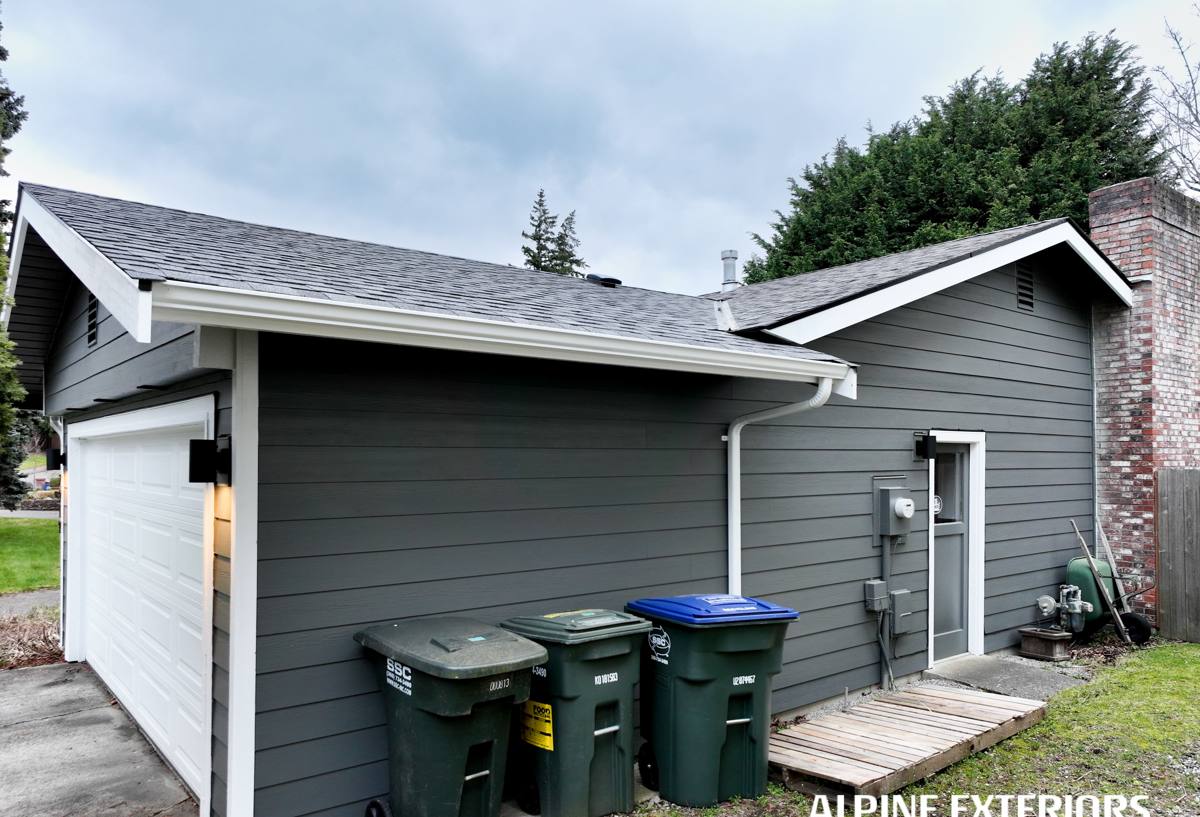
Given those conditions, we standardized on James Hardie fiber cement siding and don't install vinyl, LP SmartSide, primed wood, cedar, or other fiber cement brands. That's not a marketing position — it's a practical one built around what holds up in exactly this kind of climate.
Fiber cement is non-combustible, dimensionally stable in swings between wet and dry, and doesn't feed moss and mold the way wood-based products can. James Hardie specifically engineers its HZ5 product line for Pacific Northwest conditions — the freeze-thaw cycles, sustained moisture, and marine air common to Whatcom County — and backs its ColorPlus factory-applied finish with a long-term warranty that doesn't depend on the homeowner repainting on a schedule. When we've compared that combination against the alternatives, Hardie is consistently the product we're comfortable standing behind on a home that's going to sit in this kind of environment for decades.
What Correct Installation Looks Like Here
Fiber cement siding is only as good as the installation behind it. In a high-moisture, moss-prone area like Lake Samish, a handful of details separate a job that lasts from one that fails early:
| Detail | Why It Matters in This Climate |
|---|---|
| Weather-resistive barrier and rainscreen gap | Creates a drainage plane and airflow channel behind the siding, so any moisture that gets past the cladding can drain and dry instead of sitting against the wall sheathing |
| Correct nailing pattern and fastener type | Corrosion-resistant fasteners set per manufacturer spec prevent the streaking and loosening that salt-influenced moisture accelerates |
| Proper flashing at windows, doors, and penetrations | These are the highest-risk points for driving rain intrusion; poor flashing here is the most common cause of hidden rot |
| Minimum clearance from grade, decks, and roof lines | Keeps splash-back moisture and standing snow or debris off the bottom courses, where moss and rot typically start first |
| Factory-primed or ColorPlus-finished cut edges sealed | Exposed, unsealed cut edges absorb moisture fastest — sealing every field cut is a step that's easy to skip and expensive to ignore |
| Caulking limited to manufacturer-approved joints only | Over-caulking traps moisture instead of letting it drain; correct joint treatment follows Hardie's published details, not habit |
Choosing the Right Hardie Product for a Lake Samish Home
James Hardie's lineup gives us room to match the product to the specific exposure on each wall of a home, which matters on lots where sun, shade, and rain exposure can vary from one side of the house to the other:
- HardiePlank lap siding — the standard horizontal siding for most walls, available in several textures and exposure widths
- HardieShingle — a shingle-profile option for homes wanting a traditional Pacific Northwest look without the maintenance burden of real wood shingle
- HardiePanel — vertical panel siding often used for accents, gables, or a more modern elevation
- HardieTrim — matched trim boards that resist the same moisture and moss pressure as the field siding, so trim doesn't become the weak point
All of these come pre-finished with ColorPlus technology, which matters specifically in a shaded, damp environment — factory-baked finish adheres and weathers more consistently than field-applied paint, which is more prone to early failure in areas that don't get much direct sun to help it cure and dry between rain events.
Our Process for Lake Samish Projects
Every home around the lake is a little different depending on tree cover, sun exposure, and how close it sits to the water, so we walk the property before quoting anything:
- On-site inspection of existing siding, trim, and any visible moisture or moss damage
- Assessment of sun exposure and drainage on each wall to flag higher-risk areas
- Review of the existing weather barrier and sheathing condition once old siding is removed
- Installation following James Hardie's published installation and fastening specifications
- Final walkthrough covering flashing, clearances, and finish before we consider the job done
We don't shortcut the removal step. Old siding that's failed from moisture or moss often means the sheathing underneath needs attention before new siding goes on — covering that up instead of addressing it just moves the problem behind a new wall.
Living With Fiber Cement in a Moss-Prone, Shaded Setting
Correctly installed Hardie siding is low-maintenance, but "low" doesn't mean "none" in an environment like this. A short seasonal routine keeps siding performing the way it's designed to:
- Rinse siding annually, focusing on shaded and north-facing walls where moss and algae establish first
- Keep gutters clear so overflow doesn't run down and saturate wall sections below
- Trim back tree branches and shrubs that keep siding in constant shade or contact
- Watch for green or black staining early — it's easier to rinse off than to remove once established
- Inspect caulking at trim and penetrations every year or two, since even good sealant has a service life
- Avoid pressure washing directly into seams or at close range, which can force water behind the siding
Cost Factors for a Lake Samish Siding Project
Every property is different, but a few things consistently move the price on projects around the lake:
| Factor | How It Affects the Project |
|---|---|
| Condition of the sheathing underneath | Moisture damage found during tear-off means repair work before new siding goes on |
| Home access and site layout | Wooded, sloped, or lakeside lots can affect staging, scaffolding, and material handling |
| Product line and profile chosen | Lap, shingle, and panel products carry different material and labor costs |
| Trim and detail work | Homes with more window and roofline detail require more precise cutting and flashing labor |
| Existing siding removal | Tear-off and disposal of old material adds labor beyond a simple install |
We give firm numbers only after seeing the specific home — anyone quoting a Lake Samish project sight-unseen is guessing at the sheathing condition and site access, both of which move the price.
Why a Crew That Knows Lake Samish Matters
Siding contractors who mostly work drier, sun-exposed neighborhoods don't always account for how differently a shaded, lake-adjacent property behaves. Details like rainscreen gaps, clearance from grade, and flashing at penetrations aren't optional extras here — they're the difference between siding that lasts and siding that fails early in a spot that stays wet longer than most of the county. A crew that already works this area knows which walls tend to hold moisture, which lots need extra attention to drainage, and how the marine air affects fastener and trim choices over time.
If your Lake Samish home needs new siding or you're planning ahead for a replacement, we're happy to walk the property and give you a straight, no-pressure estimate — use the form below to get started.