 Chuckanut Exterior
 Bellingham Decks Live a Harder Life Than the Brochures Suggest
A deck in Bellingham doesn't sit in a controlled climate. It sits a short drive from saltwater, under a marine layer that keeps things damp for months at a stretch, and through a fall-into-spring stretch where moss and algae have every advantage. Composite decking is often marketed as "maintenance-free," which isn't quite true here — it's low-maintenance compared to wood, but Whatcom County weather still tests the material, the fasteners, and most of all the installation underneath it. A composite deck that's built right in Bellingham will shrug off decades of this climate. One that's built to a generic spec sheet, without accounting for our rain volume and salt exposure, will show problems in the substructure long before the boards themselves ever fail.
This page is about what a correct composite deck install actually requires for homes in and around Bellingham — not composite decking in general, but composite decking built for this specific climate.
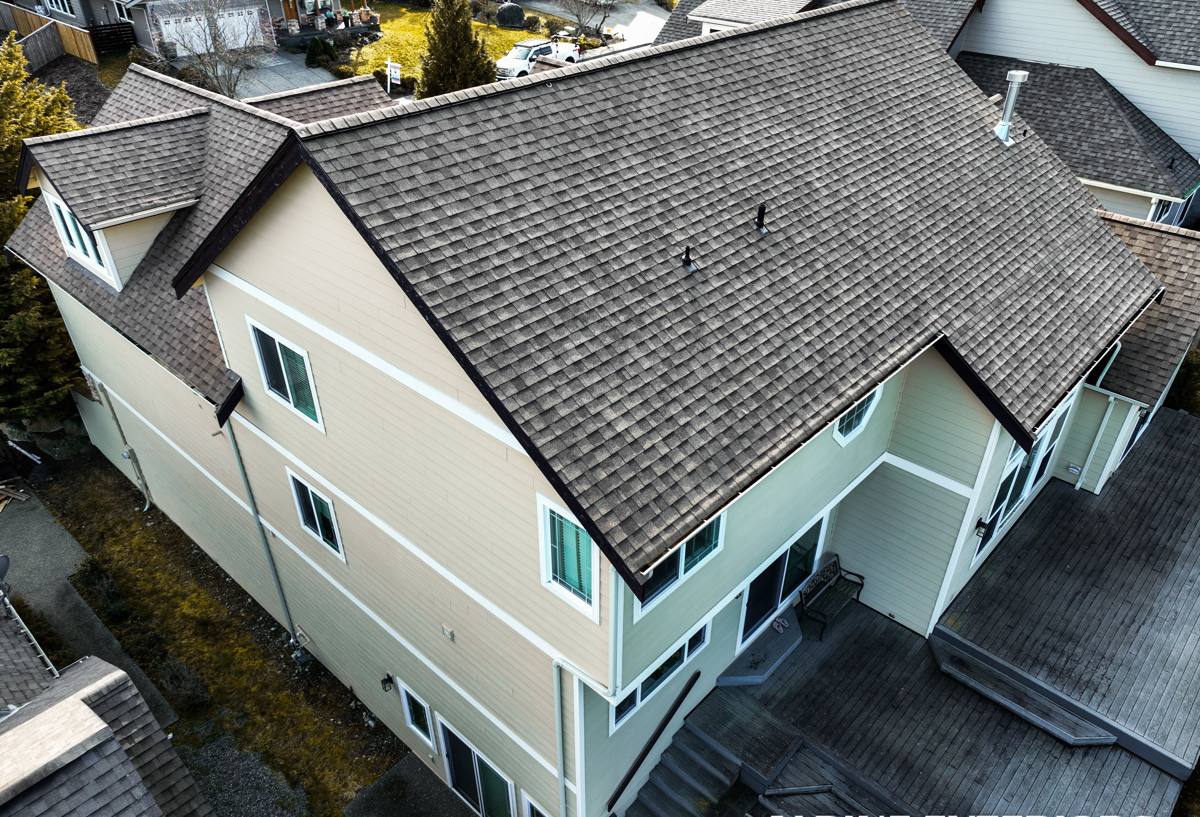
What Bellingham's Climate Actually Does to a Deck
Salt Air
Proximity to Bellingham Bay and the Salish Sound means airborne salt is a real factor, especially on decks with any western or water-facing exposure. Salt accelerates corrosion on exposed metal — screws, joist hangers, post bases, railing hardware — long before it does anything to a composite board itself. The board can look brand new while the fastener holding it down is rusting from the inside.
Driving Rain
Whatcom County doesn't get occasional showers, it gets sustained, wind-driven rain for weeks at a time. That matters more for what's under and behind the decking than for the surface. Ledger board flashing, gaps between boards, and drainage slope all get tested repeatedly every winter. A deck that drains poorly won't rot the composite boards, but it will pond water against the house, saturate the frame, and hold moisture against fasteners.
The Long Moss Season
Because Bellingham stays cool and damp for so much of the year, moss and green algae get a long runway to establish themselves — on composite as much as on wood. Composite doesn't feed rot the way wood does, but a textured composite surface with poor airflow underneath and no sun exposure will still grow moss on top and mold underneath if the deck can't dry out between rain events.
What a Correct Composite Deck Install Requires Here
None of the climate issues above are solved by the composite board itself — they're solved by how the deck is built. That's the part worth understanding before you hire anyone.
- Corrosion-resistant fasteners and hardware throughout — not just at the visible connections, but every hanger, screw, and bracket in the structure
- Proper ledger flashing where the deck meets the house, so water is directed away from the wall assembly instead of behind it
- Correct joist spacing for the specific composite product — composite boards vary in required span, and undersized framing causes flex and premature fastener failure
- A slight drainage slope away from the house, so water sheets off instead of pooling on the surface or against the ledger
- Airflow underneath the deck — adequate ventilation gaps so the frame and the underside of the boards can actually dry between rain events
- Board gapping set for our humidity swings, since composite still expands and contracts seasonally, just less dramatically than wood
Composite vs. the Alternatives, for This Climate
Homeowners usually come to us already leaning composite, but it's worth being honest about the trade-offs rather than just confirming the choice.
| Material | Behavior in Bellingham's Climate | Maintenance Reality |
|---|---|---|
| Wood (cedar/pressure-treated) | Absorbs moisture readily; needs consistent drying time between rain events to avoid rot and mold | Annual cleaning and refinishing; highest long-term upkeep |
| Composite | Doesn't rot or absorb water into the core, but surface can still grow moss/mildew without airflow and cleaning | Periodic surface cleaning; no staining or sealing required |
| PVC/capped polymer | Fully water-resistant surface; performs well in wet climates but can be less forgiving of substructure movement | Lowest surface maintenance; higher material cost |
We install composite for most Bellingham projects because it strikes a workable balance of upfront cost, moisture performance, and appearance — but it only delivers on that promise when the substructure underneath is built for this climate, not a generic one.
Our Installation Process for Bellingham Homes
- On-site assessment — we look at drainage direction, sun/shade exposure, proximity to salt air, and the condition of any existing structure we'd be replacing
- Framing and structural check — existing ledger, posts, and footings are evaluated against current code and against the load and span requirements of the composite product being installed
- Flashing and waterproofing at the house connection — this is the single most common failure point on older Bellingham decks, and it gets addressed before a single board goes down
- Substructure build-out — corrosion-resistant hardware, correct joist spacing, and proper ventilation gaps
- Composite board installation — hidden fastener systems where the product supports it, correct gapping, and attention to drainage slope
- Railing and trim — matched to the board system, with hardware selected for salt-air exposure
- Final walkthrough — we go over basic care specific to your deck's sun exposure and shade pattern, since that determines how often it'll need cleaning
Moss and Mildew: What Owning a Composite Deck Here Actually Looks Like
Composite decking doesn't need annual staining, but "maintenance-free" oversells it in a climate like ours. Realistic upkeep on a well-built composite deck in Bellingham looks like this:
- A seasonal wash-down (garden hose and a stiff bristle brush handle most of it) to keep moss from establishing, especially in shaded corners
- Keeping planters, furniture, and rugs off the deck surface for long stretches, since they trap moisture underneath and create the exact damp, dark conditions moss needs
- Clearing leaves and debris from between boards before the wet season settles in, since trapped organic matter holds moisture against the board
- An occasional check of railing hardware and fasteners for early corrosion, particularly on decks with more direct exposure to salt air
None of this is heavy work, but it's real, and any installer who tells you a composite deck here needs zero attention isn't being straight with you.
What Drives the Cost of a Bellingham Composite Deck
| Factor | Why It Matters Here |
|---|---|
| Composite product tier | Capped/PVC-composite boards cost more upfront but resist moisture and staining better than uncapped composite |
| Substructure condition | Older decks often need ledger flashing and framing repair before new decking goes down — this is where hidden costs usually come from |
| Deck size and layout | Multi-level decks, angled framing, and stairs all add labor beyond straight board footage |
| Railing system | Composite or metal railing systems vary widely in cost and in how well they hold up to salt air |
| Site access | Sloped lots and limited equipment access, common around Bellingham and the surrounding hillside neighborhoods, add labor time |
We won't quote a number without seeing the site, but as a general range, composite deck projects in this area typically run from the mid-thousands for a smaller, straightforward replacement up into the higher five figures for larger, multi-level builds with upgraded railing. Anything narrower than that range deserves a hard look at what's being cut — usually it's the substructure work that doesn't show up until years later.
Before You Hire: What to Ask
- Do you flash the ledger board connection, or just reattach to what's already there?
- What fastener and hardware grade do you use, given the salt air here?
- How do you handle drainage slope on a deck that's level with the house?
- What ventilation gap do you build under the decking for airflow?
- Can you walk me through the manufacturer's span and gapping specs for the product you're proposing?
If a contractor can't answer these specifically, they may be treating your Bellingham deck the same as one going up in a dry inland climate — and the difference shows up in five to ten years, not on installation day.
Why a Crew That Already Works Bellingham Matters
We build and repair decks throughout the Bellingham area and the rest of Whatcom County, which means we're not guessing at how this climate behaves — we're accounting for it in the framing, the flashing, and the hardware on every project, not just the boards you see on top. A deck built to a generic composite installation spec might look identical to one built for this coastline on the day it's finished. The difference shows up in year six, in the condition of the ledger flashing, the fasteners, and how well the deck has actually drained through a few full wet seasons.
If you're planning a new composite deck or replacing an aging one, we're happy to take a look and give you a straightforward assessment — no pressure, no inflated scope. Use the form below to request a free estimate.