 Chuckanut Exterior
 Why Happy Valley Siding Wears Out Faster Than the Warranty Sticker Suggests
Happy Valley sits close enough to Bellingham Bay and the Salish Sea that homes here take on a combination most siding products were never engineered for: salt-laden marine air, long stretches of driving rain off the water, and a shoulder season where everything north-facing stays damp long enough to grow moss. Add in the shade from mature trees that's common on Happy Valley lots, and you've got a microclimate that's harder on exterior cladding than most manufacturer test data accounts for.
None of this means Happy Valley is a bad place to own a home. It means siding here needs to be chosen and installed with the actual conditions in mind, not just the conditions on a spec sheet written for a drier region. When we talk about siding replacement in this neighborhood, we're talking about a job that has to hold up to salt exposure, sustained moisture, and moss pressure for decades, not just look good on installation day.
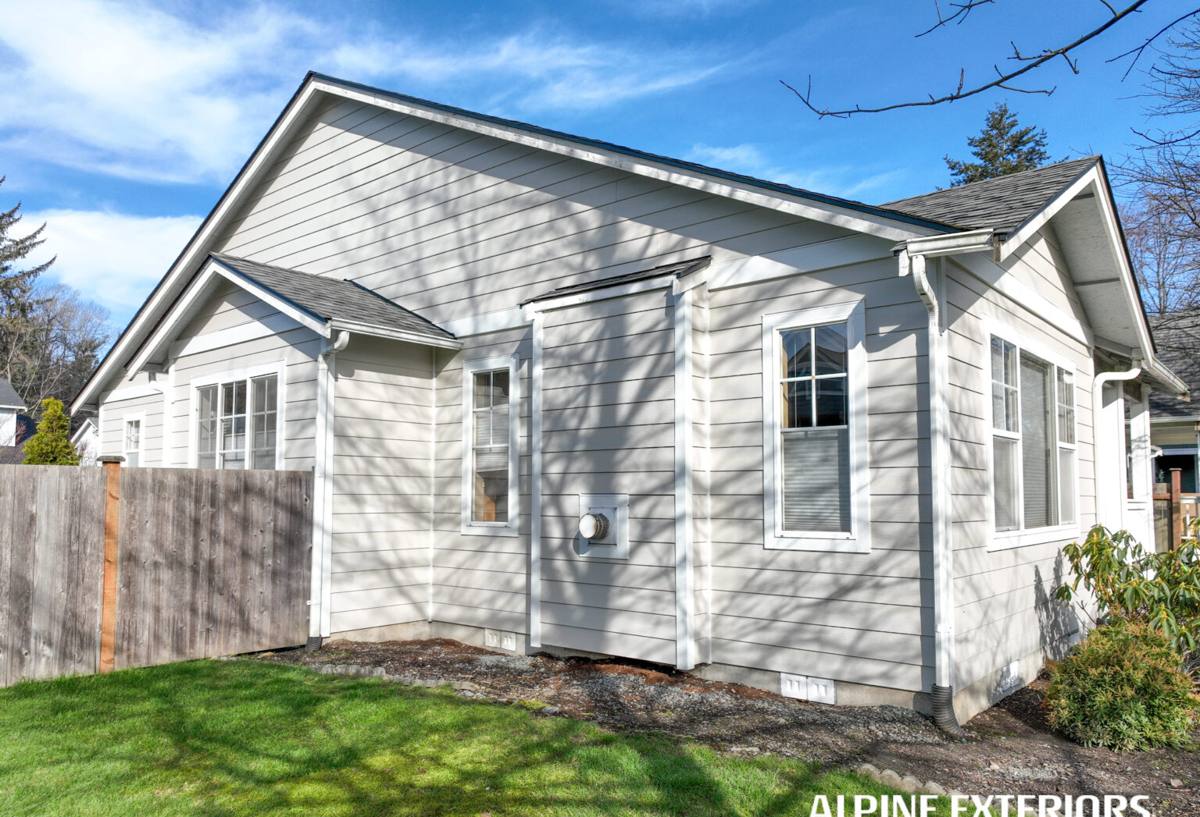
Signs Your Siding Has Crossed From "Repairable" to "Replace It"
Not every siding problem means a full tear-off. But in a climate like Whatcom County's, small problems compound fast once moisture gets past the surface. Here's how we sort it out on a walk-through.
Repair or recoat usually makes sense when:
- Damage is limited to one or two boards or a single wall section
- The underlying sheathing and moisture barrier are still dry and intact
- Caulking and paint have failed but the siding material itself hasn't
- The issue is cosmetic — fading, chalking, minor impact damage
Full replacement is the honest answer when:
- Siding is soft, delaminating, or crumbling when pressed
- Moisture has reached the sheathing, framing, or insulation behind the siding
- Persistent moss or algae staining keeps returning within a season of cleaning
- Multiple wall sections show cupping, buckling, or gapped seams
- The home has a material — old cedar, primed spruce, or aging vinyl — that's fundamentally mismatched to a wet marine climate
The difference matters because paying for repeated repairs on a material that's structurally losing the fight against moisture usually costs more, over a decade, than doing the replacement once with the right material.
What a Correct Siding Replacement Actually Involves
A siding replacement is not just "old boards off, new boards on." Done right, most of the work that actually determines how long the job lasts happens between those two steps, where nobody can see it once the job is finished.
The parts of the job that matter most:
- Full tear-off — removing old siding down to the sheathing rather than installing over it, so hidden rot or moisture damage can't be papered over
- Sheathing inspection — checking for soft spots, delamination, or water staining and repairing or replacing damaged panels before anything new goes up
- Weather-resistive barrier — installing a correctly lapped, continuous moisture barrier, since this layer (not the siding itself) is the home's real defense against wind-driven rain
- Flashing at every penetration — windows, doors, vents, and roof-to-wall transitions are where most siding failures actually start, and they need proper flashing and drip caps, not just caulk
- Correct fastening and clearances — manufacturer-specified nailing patterns, proper gaps at butt joints, and ground clearance so the bottom course isn't sitting in splashback
- Factory-finished material — reducing the number of field-painted surfaces and seams where moisture and salt air can find a way in
Skip any one of these steps and the new siding can look perfect for a year or two while a moisture problem builds behind it — which is exactly how a lot of Happy Valley homes ended up needing early replacement on siding that was supposedly good for 30 years.
Why We Only Install James Hardie Fiber Cement
We don't install vinyl, LP SmartSide, primed spruce, cedar, or other fiber cement brands. That's a deliberate standard, not a lack of options, and it's worth explaining honestly rather than just asserting it.
Vinyl is inexpensive and low-maintenance, but it's a petroleum-based product that expands, contracts, and can warp or crack in temperature swings, and it doesn't stand up well to the kind of driving, wind-loaded rain a marine climate throws at a wall. Wood products — cedar and primed spruce — look good going up, but they're organic material in a climate built to feed moss and rot; keeping them ahead of that takes ongoing paint, caulk, and vigilance that most homeowners underestimate. Engineered wood siding like LP SmartSide performs reasonably well but is still a wood-based composite, meaning it shares some of the same moisture-sensitivity concerns if the field cuts and seams aren't perfectly sealed and maintained.
James Hardie fiber cement is cement, sand, and cellulose fiber — non-combustible, dimensionally stable, and not a food source for moss or mildew the way wood-based products are. Hardie also builds region-specific "HZ" formulations engineered for different moisture and freeze exposure, which matters in a climate like this one. Combined with the factory-applied ColorPlus finish — baked on under controlled conditions rather than field-painted — and a strong transferable limited warranty, it's the product we're willing to put our name behind on a coastal Whatcom County home.
| Factor | Vinyl | Cedar / Primed Wood | James Hardie Fiber Cement |
|---|---|---|---|
| Moisture behavior | Doesn't rot, but can trap moisture behind it | Absorbs moisture; prone to rot without upkeep | Engineered for wet climates; doesn't absorb and swell |
| Combustibility | Melts/deforms under heat | Combustible | Non-combustible |
| Finish durability | Field color, fades over time | Field-painted; needs repainting | Factory ColorPlus finish, long repaint interval |
| Maintenance in moss season | Moderate — cleaning only | High — cleaning, spot treatment, recaulking | Low — periodic cleaning, minimal recaulking |
| Typical lifespan when correctly installed | 20–30 years | 15–25 years with upkeep | 30+ years |
Our Process, From Estimate to Finished Job
- Walk-through and honest assessment — we look at the actual condition of your siding, not just the surface, and tell you plainly whether you need repair or full replacement
- Written estimate — scope, material, and cost broken down so you know what you're paying for and why
- Tear-off and inspection — old siding comes off, sheathing gets inspected, and any hidden damage is documented and discussed with you before we cover it back up
- Moisture barrier and flashing installation — the unglamorous layer that determines whether the job lasts
- Hardie installation to manufacturer spec — correct fastening, clearances, and joint treatment
- Final walk-through — we go around the house with you before calling the job done
Cost Factors for a Happy Valley Siding Replacement
There's no honest flat number for siding replacement — it depends on the specifics of your home — but these are the factors that actually move the price up or down.
| Factor | Why it matters |
|---|---|
| Home size and wall complexity | More corners, gables, and dormers mean more cutting, flashing, and labor time |
| Condition of sheathing underneath | Hidden moisture or rot damage found during tear-off adds repair scope |
| Existing siding material | Some materials (like old cedar with lead-based paint layers) require more careful removal |
| Trim and detail work | Window and door trim, corner boards, and fascia details add labor beyond plain wall panels |
| Access and site conditions | Steep lots, mature landscaping, and limited staging area affect crew efficiency |
| Siding profile and color | Lap width, shake-style panels, and premium ColorPlus tones vary in material cost |
Why a Crew That Already Works Happy Valley Matters
A contractor who's worked this specific pocket of Whatcom County knows things a crew from outside the area has to learn on your dime: which wall orientations take the worst of the driving rain, how aggressive moss growth gets under the tree cover common on Happy Valley lots, and what local permitting and inspection expectations look like. That familiarity shows up in small decisions — extra flashing at a vulnerable transition, a slightly different fastening approach on a shaded north wall — that don't show up on a bid sheet but do show up in how the siding performs ten years later.
It also matters for accountability. A crew that plans to keep working in this neighborhood has a real incentive to do the job right the first time, because their reputation locally depends on it.
Living With New Siding Through Moss Season
Even the best siding material benefits from basic upkeep in a climate like this one. A few habits go a long way toward protecting your investment:
- Rinse siding annually, focusing on shaded and north-facing walls where moss and algae take hold first
- Keep gutters clear so overflow isn't running down and staining the siding face
- Trim back vegetation and tree limbs that keep walls damp and shaded longer than necessary
- Check caulking at trim and penetrations every couple of years and touch up as needed
- Address any impact damage or nail pops promptly rather than letting moisture find a way in
None of that is heavy maintenance — it's the kind of basic care that keeps a well-installed Hardie system performing for decades instead of just looking good for a few years.
If your Happy Valley home's siding is showing its age, we're happy to take a look and give you a straight answer about whether you need repair or full replacement — no pressure, no upsell. Use the form below to request a free estimate.