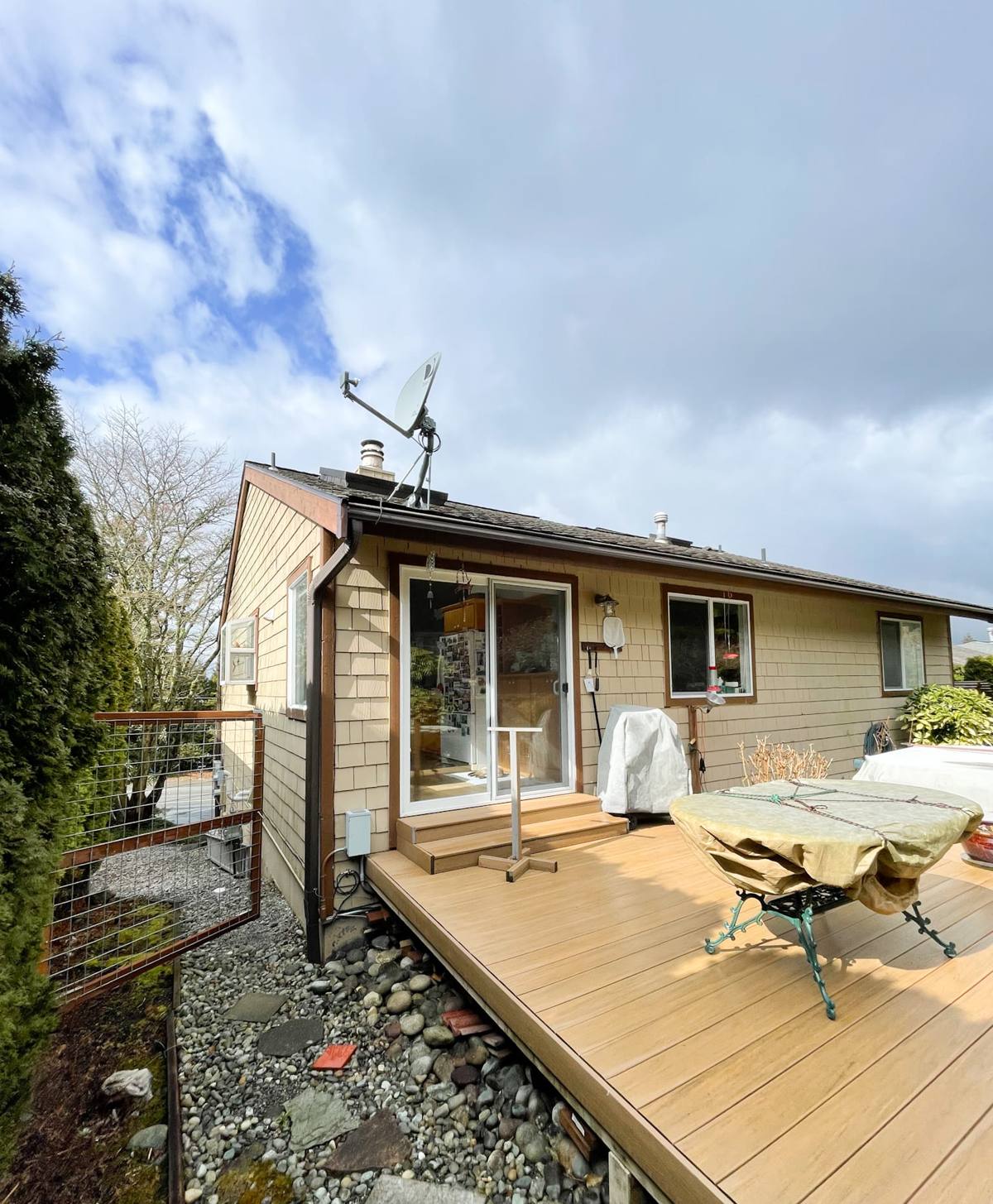
 Chuckanut Exterior
 Fairhaven sits close enough to the water that its houses live a different life than homes a few miles inland. Salt-laden air moves through the neighborhood daily, driving rain comes in sideways off Bellingham Bay during winter storms, and the shaded, damp lots that give Fairhaven its character also give moss a long growing season on anything that holds moisture. Siding here isn't just cosmetic — it's the first line of defense against a climate that never really lets a house dry out for long. When it's time to replace siding on a Fairhaven home, the material and the installation both need to answer to that reality.
Why Fairhaven Siding Wears Differently Than Other Whatcom County Neighborhoods
Every part of Whatcom County deals with Pacific Northwest rain, but proximity to salt water changes the equation. Airborne salt accelerates corrosion on fasteners and metal trim, and it interacts with certain siding coatings in ways that speed up chalking and fading. Combine that with Fairhaven's tree cover and older, established lots — plenty of shade, plenty of moisture that lingers on north-facing walls — and you get ideal conditions for moss, algae, and mildew to take hold on siding that isn't built to shed water and resist organic growth.
We also see a lot of older homes in this part of Chuckanut with original wood siding or aging cedar that's been through decades of this cycle. By the time a homeowner calls us, the siding is often past the point of another paint job — it's cupping, splitting, or soft at the butt joints and corners where water has been sitting the longest.
What Fails First
- Bottom courses near grade, where splashback and moisture sit longest
- North and northwest-facing walls that stay shaded and wet for days after a storm
- Butt joints and seams where old caulking has failed and water has worked its way behind the boards
- Trim and fascia where fasteners have corroded from salt exposure
- Areas around downspouts and roof valleys where water concentrates before it hits the wall
What Correct Siding Replacement Actually Involves
Replacing siding isn't just pulling off old boards and nailing up new ones. A correct job addresses what's behind the siding as much as the siding itself. On a Fairhaven job, that means:
Tearing Off Down to the Sheathing
We remove the old siding completely rather than covering over it. That's the only way to actually inspect the sheathing and framing underneath for rot, soft spots, or hidden moisture damage — which is common on homes that have had failing siding for years without anyone knowing what was happening behind it.
Correcting the Water Management System
Modern house wrap, properly lapped and taped, flashing at every window and door, and correct integration with roof and deck flashing all matter more in a high-moisture, salt-air environment than they do somewhere drier. Any gaps in this system are where the next round of hidden rot starts.
Installing to Manufacturer Spec
Proper fastener spacing, correct nailing patterns, the right gap at butt joints and corners for expansion, and back-priming or factory-finished edges where cuts are made. Skipping these details is exactly how a brand-new siding job ends up with the same failures in half the time.
Why We Only Install James Hardie Fiber Cement
We made a decision as a company to install James Hardie fiber cement siding exclusively — not vinyl, not LP SmartSide, not Cemplank or Allura, not primed spruce or cedar. That's not a marketing position, it's a standard we hold ourselves to because of what we've seen these products do over time in exactly the kind of climate Fairhaven has.
Vinyl siding can work fine in milder, drier conditions, but it's a poor match for a salt-air coastal environment — it becomes brittle and prone to cracking as it ages, and it doesn't stand up to wind-driven debris the way fiber cement does. Engineered wood products like LP SmartSide use wood strand cores that are more moisture-resistant than raw wood, but any breach in the coating or a poorly sealed cut edge gives water a path into a wood-based product, and that's a real risk in an area with this much sustained dampness. Other fiber cement brands like Cemplank and Allura are legitimate products, but we've standardized on one manufacturer's system, warranty structure, and factory finish rather than mixing installation methods across different brands. Primed spruce and cedar are honest, traditional materials, but they demand a maintenance schedule — repainting, sealing, moss and mildew treatment — that most homeowners don't want to keep up with indefinitely, especially somewhere as prone to moss growth as Fairhaven.
James Hardie fiber cement is non-combustible, dimensionally stable in wet climates, and comes with a factory-applied ColorPlus finish that's baked on and warranted against fading and chalking far longer than field-applied paint. Hardie also engineers specific product lines for different climate zones — the HZ5 line used in our region is built for wetter, harsher weather exposure. That combination of moisture resistance, finish durability, and non-combustibility is why it's the only siding we put on homes.
James Hardie Product Lines for a Fairhaven Home
| Product | Best Use | Why It Fits Fairhaven |
|---|---|---|
| HardiePlank Lap Siding | Most common wall application | Classic profile, factory-finished, resists moisture and salt exposure |
| HardieShingle | Accent areas, gables | Adds texture and character without the maintenance of real wood shingles |
| HardiePanel Vertical Siding | Modern facades, accent walls | Clean lines for contemporary Fairhaven homes near the waterfront |
| HardieTrim | Corners, fascia, window trim | Matches the siding's moisture resistance at the joints most prone to failure |
Cost Factors for a Fairhaven Siding Replacement
Every home is different, but a few factors consistently move the price on a project in this neighborhood:
| Factor | Impact |
|---|---|
| Extent of hidden sheathing damage | More rot found during tear-off means more repair before new siding goes on |
| Home size and wall complexity | Dormers, multiple gables, and cut-up facades increase labor and material waste |
| Product line and profile chosen | Lap siding, shingle accents, and panel siding carry different material costs |
| Trim and accent work | Full trim replacement adds cost but ensures consistent moisture protection at joints |
| Access and site conditions | Mature landscaping, narrow lots, and slope common in Fairhaven can affect staging and scaffolding |
We give every homeowner a detailed, itemized estimate after an in-person inspection rather than a ballpark number over the phone — too much of the real cost depends on what we find once the old siding comes off.
Our Process for a Fairhaven Siding Replacement
- On-site inspection. We walk the entire exterior, checking for soft spots, moss buildup, failed caulking, and areas of concern before we ever talk about products.
- Written estimate. A clear scope of work and pricing, including what we expect to find and what would change the price if we find more damage than expected.
- Tear-off and inspection. Full removal of old siding, sheathing inspection, and any necessary framing or sheathing repair before anything new goes up.
- Water management installation. House wrap, flashing, and joint treatment done to current best practice, not just whatever was there before.
- Hardie installation to spec. Correct fastening, spacing, and finishing details, including trim and caulking at every penetration.
- Final walkthrough. We go over the finished work with the homeowner and address anything before we consider the job complete.
Why Local Experience in Fairhaven Matters
A crew that's worked in Fairhaven and the broader Chuckanut area already knows what to expect before the tear-off even starts. We know which wall orientations tend to hide the worst moisture damage, how salt air affects fastener choice, and how much moss and organic buildup typically needs to be addressed as part of the job rather than treated as a surprise. That familiarity saves time during the estimate and prevents the kind of mid-project surprises that blow up budgets and timelines when a crew is guessing at regional conditions instead of working from experience with them.
It also means we're not learning on your house. We've seen how James Hardie siding performs on homes in this exact climate over years, not just in a manufacturer's brochure — and we install it the same correct way every time, because that's the only way it delivers on its warranty and its lifespan.
A Quick Checklist Before You Replace Your Siding
- Get a full exterior inspection, not just a look at the obviously damaged sections
- Ask any contractor exactly which siding brand and product line they install and why
- Confirm tear-off to bare sheathing is included, not installation over existing siding
- Ask how house wrap, flashing, and joint sealing will be handled
- Get the warranty terms in writing — both material and labor
- Ask whether the crew has worked in coastal or high-moisture neighborhoods like Fairhaven before
If your Fairhaven home's siding is showing moss, cracking, soft spots, or just isn't standing up to the weather anymore, we're happy to take a look and walk you through exactly what we'd recommend. Reach out for a free, no-pressure estimate using the form below.