 Chuckanut Exterior
 Building Decks for Fairhaven's Specific Conditions
Fairhaven sits close enough to the water that salt air is a daily fact of life for anything built outdoors. Add Whatcom County's long wet season and the moss growth that comes with months of shade and moisture, and a deck here has to work harder than a deck built inland or in a drier climate. A deck that looks fine going up in July can start showing problems by the second or third winter if the wrong materials or fastening details were used. Our approach to custom decks in Fairhaven starts with those local realities, not a generic build plan pulled from a catalog.
This page covers what we actually do when we build or replace a deck in this neighborhood: the material choices that hold up, the structural details that matter more here than elsewhere, and what our process looks like from first call to final walkthrough.
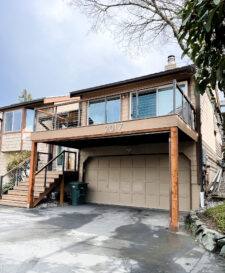
What Salt Air, Rain, and Moss Do to a Deck
Each of these three factors attacks a deck differently, and a correctly built deck accounts for all three at once.
Salt air and corrosion
Airborne salt accelerates corrosion in fasteners, brackets, and hardware. Standard hot-dip galvanized hardware can still corrode faster near the water than it would further inland, and once a fastener starts rusting, it weakens the connection long before the problem is visible from the top of the deck.
Driving rain and moisture intrusion
Rain that comes in sideways off Bellingham Bay doesn't just fall on a deck's surface — it drives into ledger connections, gets behind poorly flashed rim joists, and pools wherever drainage wasn't planned for. Most of the rot we find in older decks starts at these hidden connection points, not on the visible boards.
Moss and prolonged dampness
Whatcom County's long moss season means any deck surface that stays shaded and damp for extended stretches will grow moss if it isn't designed to shed water and dry out. Moss holds moisture against the wood or composite surface, which speeds up decay in real wood and can stain composite decking if it's left unaddressed.
Getting the Structure Right First
The parts of a deck nobody sees are the parts that determine how long it lasts. This is where we spend the most attention, because it's also where shortcuts are hardest to spot after the fact.
- Ledger board flashing that actually sheds water away from the house rim joist, not just a bead of caulk behind the board
- Stainless steel or coated fasteners rated for coastal exposure at every structural connection
- Joist tape or a comparable moisture barrier on top of every joist before decking goes down
- Proper joist spacing and blocking sized for the decking material chosen, not just code minimums
- Footings set to local frost depth and soil conditions, not guessed at
- Post bases that keep wood posts off the concrete and out of standing water
- Grading and drainage under the deck so water doesn't pool against footings
Skipping any one of these doesn't usually cause an immediate problem. It shows up two, five, or ten years later as soft spots, rust streaks, or a ledger connection that's failed quietly behind the siding.
Choosing Decking Material for This Climate
There's no single "best" decking material — the right choice depends on budget, how much maintenance the homeowner wants to do, and how exposed the deck is to sun, shade, and moisture. Here's how the common options compare for a Fairhaven property specifically.
| Material | Moisture & Moss Behavior | Maintenance | Typical Lifespan |
|---|---|---|---|
| Pressure-treated wood | Prone to moss and staining in shaded, damp spots without regular cleaning | Annual cleaning, periodic staining/sealing | 15–20 years with upkeep |
| Cedar | Naturally moisture-resistant but still needs sealing to resist moss and graying | Sealing every 1–3 years | 15–25 years with upkeep |
| Capped composite | Sheds water well, resists moss staining better than wood, still needs surface cleaning | Occasional washing, no sealing/staining | 25–30+ years |
| Uncapped composite (older style) | Can absorb moisture at the surface and stain or grow moss faster than capped composite | Regular cleaning | 15–25 years |
We don't push one material on every homeowner. A shaded, north-facing deck under trees has different needs than an open, sun-exposed deck closer to the water, and we'll walk through the honest trade-offs for your specific site during the estimate.
Design Details That Matter Locally
Board spacing and airflow
Gaps between deck boards that are too tight trap moisture and debris, which feeds moss growth. We space boards to allow proper drainage and airflow underneath, which matters more here than in drier regions.
Railing and fastener choices
Railing hardware exposed to salt-laden air benefits from stainless steel or marine-grade coated fasteners over standard zinc-plated options. It costs a little more up front and saves a rust-streaked railing a few years in.
Surface texture and slope
A deck surface with a slight slope away from the house, combined with a decking profile that isn't perfectly smooth, sheds rain faster and gives moss less of a foothold than a dead-flat, glass-smooth surface.
Under-deck drainage
For elevated decks, an under-deck drainage system keeps the space below usable and dry, and reduces the amount of standing moisture that would otherwise sit against the framing.
New Build vs. Deck Replacement
We handle both, and the right path depends on what's already there.
When replacement makes sense
If the existing framing has rot at the ledger, soft joists, or corroded hardware, patching the surface boards alone just hides the problem. A full or partial rebuild that replaces the structure is usually the more honest recommendation once framing is compromised.
When resurfacing is enough
If the framing underneath is sound — solid joists, intact ledger flashing, no hardware corrosion — replacing just the decking boards can be a reasonable, lower-cost option. We'll tell you honestly which situation you're in after inspecting the structure, not just the surface.
New builds
For a new deck from scratch, we plan the footprint, structure, and material together from day one, which lets us build in the drainage, flashing, and fastener details above without working around an existing layout.
Our Process for a Fairhaven Deck Project
- Site visit and assessment — we look at sun/shade exposure, drainage, soil, and (for replacements) the condition of existing framing.
- Design and material discussion — we go over decking options, layout, and railing choices based on your budget and how the deck will be used.
- Written estimate — a clear scope and price before any work starts, no surprise add-ons for the structural basics.
- Permitting — we handle the local permit process where required so the build meets code from the footings up.
- Construction — footings, framing, flashing, and decking installed in sequence, with structural details inspected before the surface goes on.
- Final walkthrough — we go over the finished deck with you, including basic care guidance for the material you chose.
Why a Crew That Knows Fairhaven Matters
Deck-building fundamentals don't change from region to region, but the details that determine whether a deck lasts do. A crew that regularly works in Whatcom County knows to flash a ledger for driving rain, to spec hardware for salt air exposure, and to plan drainage for a climate where moss has months to take hold every year. Those aren't add-ons — they're the baseline for building a deck that holds up here, and they're easy to skip if a crew is used to building in a drier or less coastal climate.
We also know that every lot in this area is a little different — how much shade a yard gets, how exposed it is to weather off the water, what the soil does when it's saturated for weeks at a stretch. That local familiarity shapes the specific recommendations we make, not just the general ones.
Maintenance to Protect the Investment
Whatever material you choose, a few habits go a long way in this climate:
- Sweep or blow off leaves and debris regularly, especially in fall, so damp organic material doesn't sit on the surface
- Clean moss and algae off the surface at the first sign of growth rather than waiting until it's established
- Check railing and stair hardware yearly for early rust or loosening
- Reseal or restain wood decking on the schedule appropriate to the product — don't stretch it to save time
- Keep gutters and downspouts near the deck clear so runoff isn't dumping extra water onto or under the structure
If you're weighing a new deck, a replacement, or just want an honest read on what shape your current deck is in, we're happy to take a look. Reach out for a free, no-pressure estimate using the form below.