 Chuckanut Exterior
 Why Edison-Area Homes Wear Out Siding Faster
Homes near Chuckanut and the Edison area sit close enough to the Salish Sea that salt-laden air is part of daily life, not an occasional event. Add in driving rain that comes sideways off the water during winter storms, and a shaded, damp growing season that lets moss and algae colonize a wall for months at a stretch, and you have three separate stresses working on the same siding at the same time. Most siding products were engineered and tested for average weather, not this specific combination.
Salt air accelerates the corrosion of fasteners, flashing, and any exposed metal trim. Driving rain finds every gap in flashing and caulk and pushes water sideways and upward, not just down, which is why siding that looks fine from the street can be rotting from behind. And a long moss season means organic growth sits against the wall surface, holding moisture in place long after the rain has stopped. None of these problems are dramatic on their own. Together, over years, they're what turns a 30-year siding job into a 12-year siding job.
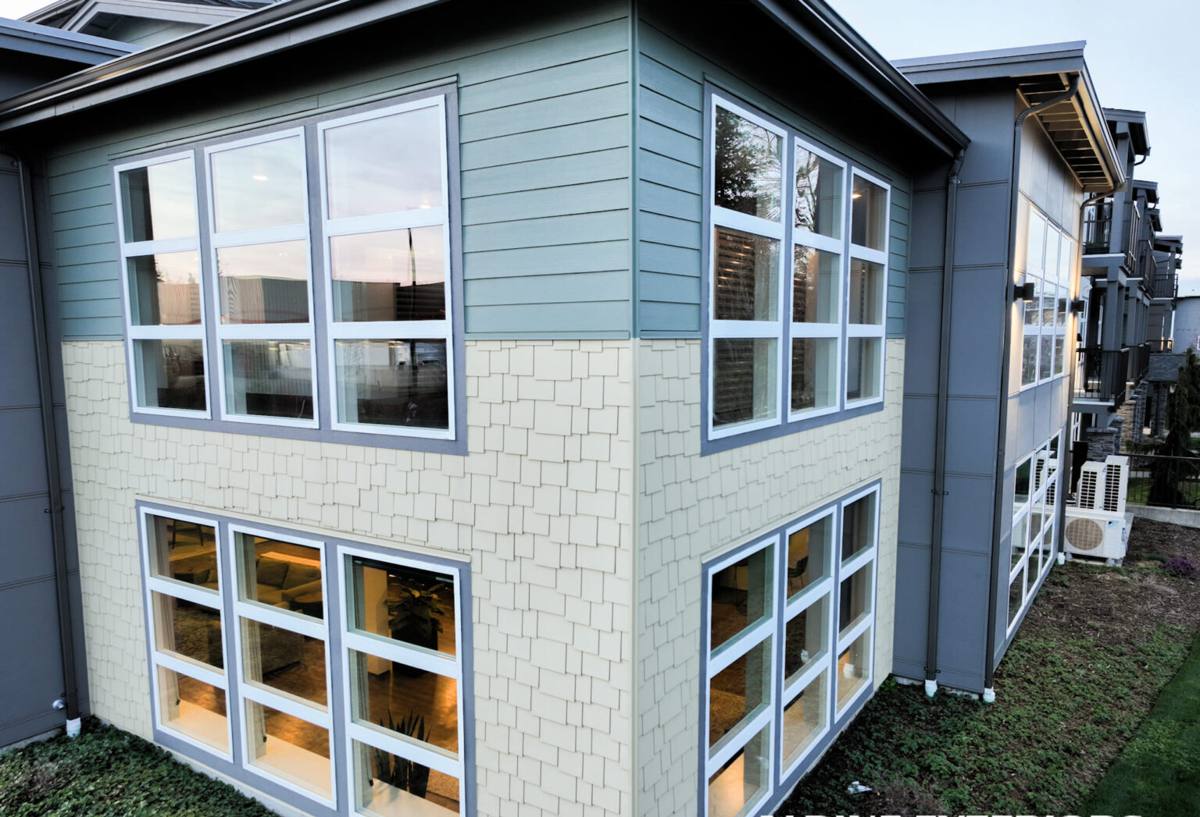
Signs Your Siding Has Reached the End of Its Service Life
What years of driving rain do
Wind-driven rain doesn't just wet the surface of a wall — it works its way behind laps, around trim, and into any nail hole that's lost its seal. Once water gets behind the siding, the sheathing and framing underneath start to absorb moisture long before anything visible shows up outside. By the time you see soft spots, dark staining, or bulging, the damage usually extends further than the visible area.
What a long moss season does
Moss and algae aren't just cosmetic. They hold water against the siding surface for weeks at a time, which keeps paint and factory finishes from ever fully drying between rain events. On wood-based products this accelerates rot at seams and butt joints. On any siding, thick moss growth is a sign the wall isn't shedding water and drying the way it should.
A few checks you can do from the ground before calling anyone out:
- Soft, spongy, or bulging spots when you press on the siding, especially near the bottom courses
- Paint that's peeling, bubbling, or chalking heavily rather than just fading
- Persistent moss or dark streaking that comes back within weeks of cleaning
- Visible gaps, warping, or separation at butt joints and corner trim
- Rust staining below nail heads or metal flashing
- A musty smell or noticeably higher humidity in rooms along an exterior wall
Any one of these can sometimes be a repair. Two or more, especially combined with siding that's original to a home more than 20-25 years old, usually points to full replacement being the more honest answer than patching.
What a Correct Siding Replacement Actually Involves
Tear-off and what's underneath
A proper job starts with removing the old siding down to the sheathing, not installing over it. That's the only way to actually inspect for rot, soft framing, or prior water damage — problems that are common on homes that have taken decades of driving rain and are invisible with the old siding still in place. Any damaged sheathing or framing gets replaced before anything new goes up; covering it over just locks the problem inside the wall.
Water-resistive barrier and flashing
In a climate with sustained wind-driven rain, the water-resistive barrier and flashing details matter more than the siding material itself. Window and door flashing has to be layered correctly — shingle-style, so water is always directed outward and down, never behind the layer below it. Housewrap seams get taped and lapped correctly, and every penetration (hose bibs, vents, light fixtures) gets properly flashed and sealed rather than just caulked over.
Fastening, clearances, and drainage
Fasteners need to be corrosion-resistant given the salt air, and driven to the manufacturer's specified depth — overdriving fasteners is one of the most common causes of premature siding failure, and it's invisible once the job is painted. Siding also needs proper clearance from grade, roofing, and decks so water and moss-holding debris don't sit against the bottom edge, and a drainage gap behind the siding so any moisture that does get in can escape and dry rather than being trapped against the wall.
Why We Install Only James Hardie Fiber Cement
We standardized on James Hardie fiber cement siding and don't install vinyl, LP SmartSide, Cemplank, Allura, primed spruce, or cedar. That's a deliberate call, not a default, and it's worth explaining honestly rather than just asserting it.
Vinyl is inexpensive and low-maintenance in mild climates, but it expands and contracts significantly with temperature swings, can warp or crack in wind-driven rain events, and isn't fire-resistant. Wood products — cedar and primed spruce — can look excellent, but they're the most vulnerable to the exact conditions this area produces: sustained moisture plus organic growth means ongoing repainting, caulking, and a real risk of rot at joints if maintenance ever slips. Engineered wood products like LP SmartSide perform reasonably well in drier climates but rely on an intact factory coating to keep moisture out of a wood-strand core; damage that coating in a climate this wet, and the core is exposed to exactly the conditions it handles worst.
James Hardie fiber cement is non-combustible, doesn't support rot, and holds up to repeated wet-dry cycling without warping. Its ColorPlus factory finish is baked on under controlled conditions and is more consistent and fade-resistant than field-applied paint, which matters when a wall spends months of the year damp. Hardie's HZ product lines are climate-engineered specifically for regions like this one, and the product carries a strong, transferable warranty when installed to spec — which is the other half of the equation. Fiber cement installed incorrectly still fails; the material and the installation have to both be right.
Comparing Siding Materials for This Climate
| Factor | James Hardie Fiber Cement | Vinyl | Wood / LP SmartSide |
|---|---|---|---|
| Moisture resistance | Does not rot; unaffected by sustained damp | Doesn't absorb water, but seams can let water behind panels | Vulnerable once coating or paint is compromised |
| Performance in driving rain | Rigid, holds flashing lines, resists warping | Can flex, buckle, or blow off in high wind-driven rain | Depends heavily on caulking and paint staying intact |
| Moss/algae resistance | Factory finish resists staining; cleans well | Can stain and is hard to fully clean without damage | Growth accelerates coating breakdown and rot |
| Fire resistance | Non-combustible | Melts/ignites at relatively low temperatures | Combustible |
| Maintenance over time | Occasional wash; repainting not required for years | Low, but limited repair options if damaged | Regular repainting/caulking to stay protected |
| Typical lifespan when installed correctly | Multiple decades | 15-25 years, shorter with UV/impact damage | Highly dependent on maintenance consistency |
Our Process, Start to Finish
- Walkthrough and assessment — we look at existing siding condition, trim, flashing, and any signs of moisture intrusion before quoting anything.
- Written estimate — clear scope, product line, color, and timeline, with no pressure to sign on the spot.
- Tear-off and inspection — old siding comes off, sheathing is checked, and any repairs are flagged and discussed before covering anything back up.
- Barrier and flashing installation — housewrap, window/door flashing, and penetration sealing done to spec, not shortcuts.
- Hardie installation — fastened, spaced, and finished to manufacturer requirements so the warranty stays valid.
- Final walkthrough — we go over the finished job with you before calling it done.
Why Local Experience Around Chuckanut and Edison Matters
Siding installation isn't one-size-fits-all across Washington. A crew that mostly works drier inland areas doesn't necessarily think in terms of shingle-lapped flashing details or drainage gaps sized for sustained coastal rain — because they've rarely had to. Working this area regularly means we're used to scheduling around real weather windows instead of assuming a dry stretch, familiar with the permitting expectations in Whatcom County, and used to seeing exactly how salt air and moss show up on real walls in this specific area, not just in a manufacturer's climate chart.
That local pattern-recognition is also what keeps a quote honest. We can usually tell from the walkthrough which homes will need extra flashing or sheathing repair and which won't, because we've already seen the range of what driving rain and a long moss season do to siding in this area over time.
Caring for Your New Siding After Installation
Fiber cement siding is low-maintenance, not zero-maintenance. A yearly rinse with a garden hose (avoid high-pressure washing directly at seams) keeps salt residue and early moss growth from building up. Keep an eye on caulking at trim joints and around penetrations, since caulk has a shorter service life than the siding itself. Trim back vegetation that shades a wall for long stretches of the day — the less time a wall stays damp, the less moss pressure it faces, regardless of what material it's clad in.
If your Edison-area home is showing any of the wear signs above, or you'd just like an honest opinion on whether repair or replacement makes sense, we're glad to take a look. The estimate is free, there's no pressure, and you'll get a straight answer either way — just fill out the form below.