 Chuckanut Exterior
 Why Decks in Bow Take More Punishment Than the Manufacturer's Brochure Suggests
Composite decking is marketed as a low-maintenance, weather-resistant product almost everywhere it's sold, and for the most part that's true. But "weather-resistant" means something different in Bow than it does in a showroom in Arizona. Homes here sit close enough to Samish Bay and the broader Salish Sea that salt-laden air is a constant, not an occasional coastal breeze. Add Whatcom County's long, wet fall-through-spring stretch and the shaded, damp conditions that let moss and algae take hold on almost any outdoor surface, and you've got a set of conditions that will find every weak point in a deck build — the fastener that wasn't rated for it, the board gap that was cut too tight, the substructure that wasn't given a way to dry out.
None of that means composite decking is a bad choice for this area. It's often the right one. But it does mean the installation details matter more here than they would in a drier climate, and a deck built to a generic spec sheet without local judgment will show problems years before it should.
What "Local Conditions" Actually Do to a Deck
- Salt air accelerates corrosion on fasteners, brackets, and any exposed metal hardware
- Driving rain pushes moisture sideways under rail caps, fascia boards, and ledger connections, not just straight down
- Persistent shade and moisture create ideal conditions for moss, algae, and mildew growth on decking surfaces and substructure alike
- Freeze-thaw cycles, while milder here than inland, still stress joints and fastener holes over repeated winters
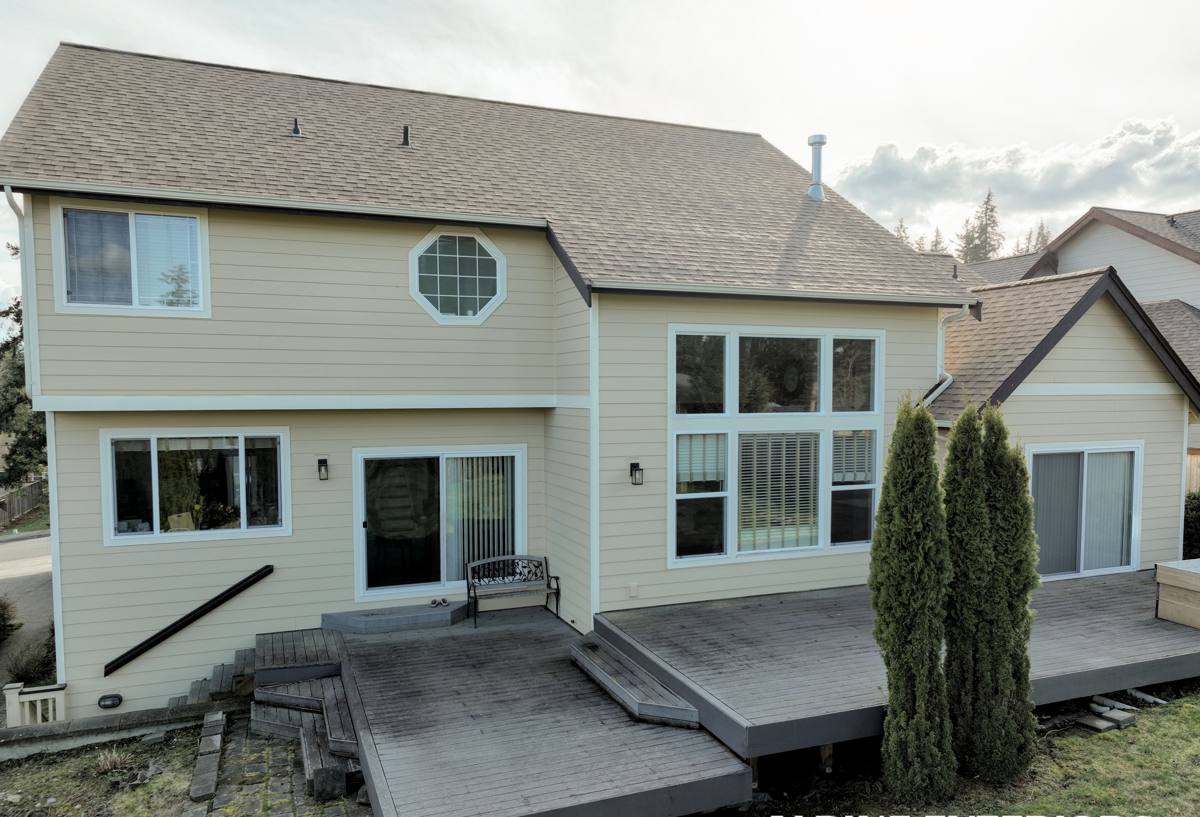
What a Correctly Built Composite Deck Involves in This Area
A composite deck is really two systems: the visible boards, rails, and fascia, and the substructure underneath that nobody sees once the job is done. In a climate like ours, the underneath work is where a deck earns its lifespan.
Substructure and Drainage
Composite boards themselves don't rot, but the joists, beams, and ledger board underneath them usually aren't composite — they're wood, and wood in a shaded, damp Whatcom County yard needs a real path to dry out between rain events. That means proper joist spacing for the board span being used, joist tape or a comparable barrier on top of each joist to keep standing water off the wood, and enough airflow underneath the deck that the substructure isn't sitting in a humid pocket all winter.
Ledger and Flashing
Where a deck attaches to the house, flashing has to be installed so water sheds away from the house wall, not into it. This is the single most common failure point we find on older or poorly built decks in this area — a ledger board that was lag-bolted to the rim joist without proper flashing, which lets rainwater track behind the siding for years before anyone notices the damage.
Fasteners and Hardware
Given the salt air off the bay, we treat hardware selection as a real decision, not an afterthought. Stainless steel or a coated fastener rated for coastal/marine exposure costs more up front than standard exterior-grade hardware, but it's the difference between hardware that's still tight in ten years and hardware that's rust-streaking the decking by year four.
Board Spacing and Movement
Composite boards expand and contract with temperature and moisture more than solid wood does in some cases, and less in others depending on the product. Getting the gap spacing right — between boards, and where boards meet a house wall or a fixed object — keeps water moving off the deck instead of pooling, and keeps the whole deck from buckling as the seasons turn.
Choosing the Right Composite Board for a Bow Property
Not all composite decking is built the same way, and the differences matter more in a coastal, high-moisture climate than most homeowners realize when they're just comparing colors in a sample rack.
| Board Type | How It Handles This Climate | Trade-Offs |
|---|---|---|
| Capped composite (PVC or polymer shell over composite core) | Best resistance to moisture absorption, staining, and mold/algae growth on the surface | Higher material cost; still needs a properly built substructure underneath |
| Uncapped composite | More affordable, decent durability, but the exposed surface can absorb moisture and is more prone to surface mildew in shaded, damp spots | Requires more regular cleaning to stay ahead of moss and algae |
| Solid PVC decking | Fully synthetic, excellent moisture resistance, doesn't support mold growth the way wood-fiber composites can | Higher cost; different look and feel than wood-composite blends, worth seeing in person before deciding |
Our standard for Bow installs is a capped composite or PVC board on any deck area that sits in regular shade or gets heavy rain exposure, since that's where uncapped products show algae and staining fastest. On sunnier, more exposed sections of a property, an uncapped composite can be a reasonable way to control cost — the decision really comes down to how much shade and moisture a specific deck footprint deals with.
How Our Process Works
- On-site walkthrough: We look at the actual site — grade, drainage, shade pattern, proximity to the house, and how exposed the location is to wind-driven rain — before recommending a board type or layout.
- Design and material selection: We go over board options, rail systems, and layout with you, including honest trade-offs between capped and uncapped products for that specific spot.
- Permitting: Deck projects in Whatcom County typically require a permit depending on height and size; we handle that process as part of the job rather than leaving it to you.
- Substructure build: Framing, ledger flashing, joist protection, and hardware selection done to hold up under our conditions, not just to pass a minimum code check.
- Decking, rail, and fascia installation: Boards installed with correct spacing and fastening for the specific product's expansion behavior.
- Final walkthrough: We go over care and maintenance specific to the board you chose before we consider the job done.
Moss, Mildew, and What Long-Term Care Actually Looks Like Here
Even the best composite board benefits from some seasonal attention in a climate like ours. Moss and algae need moisture and organic debris to establish, and a deck that collects fir needles or leaf litter under railings or in corners will grow a green film faster than one that's kept clear. This isn't a defect in the product — it's just what happens to any outdoor surface in Whatcom County's wet months if it's left alone.
What Keeps a Composite Deck Looking Right
- Sweep debris off the deck surface regularly, especially in fall when leaves and needles accumulate
- Rinse or wash the deck a couple of times a year with a soft-bristle brush and a cleaner appropriate for composite (avoid pressure washers on close settings — they can damage the surface texture)
- Keep gutters and downspouts near the deck clear so water isn't dumping directly onto or under it
- Check railing posts and stair connections annually for any looseness, which shows up faster where salt air is accelerating hardware wear
Cost Factors for a Bow Composite Deck
Every deck is different, and we don't quote a project without seeing the site, but the factors below are what actually move the price on a composite deck build in this area — broad ranges only, since size, access, and site conditions vary a lot.
| Factor | Why It Matters Here |
|---|---|
| Board tier (uncapped vs. capped vs. PVC) | Capped and PVC boards cost more but hold up better against our moisture and shade conditions |
| Substructure condition | Replacing or upgrading an old wood substructure, especially around a ledger with prior water damage, adds cost but is not optional if it's compromised |
| Site access and grade | Sloped or hard-to-access yards common around Bow properties can add labor time for framing and material staging |
| Rail and hardware selection | Marine-grade or coastal-rated hardware and rail systems cost more than standard exterior-grade options but last longer in salt air |
| Permitting and inspection | Whatcom County permit requirements depend on deck height and attachment; this is part of the project timeline, not an extra add-on we skip |
Mistakes We Commonly Find on Existing Decks in This Area
When we're called out to repair or replace a deck rather than build new, the same handful of issues show up again and again on properties around Chuckanut and Bow:
- Ledger boards attached without proper flashing, leading to hidden water damage at the house connection
- Standard (non-coastal-rated) fasteners rusting and staining the decking within a few years
- Boards installed with gaps too tight for the product's expansion behavior, causing buckling
- No joist protection, leaving the substructure exposed to moisture it was never given a chance to shed
- Shaded areas left uncleaned for years, allowing moss to build up a slick, slippery surface layer
Most of these aren't visible from the surface until they've already caused damage, which is part of why a deck's substructure deserves as much attention as the decking itself.
Why a Crew That Already Works Bow Matters
A deck built to a generic national spec sheet isn't necessarily built wrong, but it's often built without the local judgment calls that keep it performing well ten and fifteen years out. Knowing which fastener grade actually holds up against Samish Bay's salt air, which board types shed water instead of holding it in a shaded corner, and how Whatcom County's permitting process works for deck attachments isn't something you get from a spec sheet — it comes from building and repairing decks in this specific area, season after season. That's the standard we hold every Bow composite deck build to.
Before You Call — A Quick Homeowner Checklist
- Note where the deck will get shade through most of the day — that area needs the most moisture-resistant board
- Check whether an existing deck (if you have one) has any soft spots, rust streaks, or gaps between the house and ledger
- Think about how the space will actually be used (furniture load, grill placement, stairs) so the substructure is designed for it from the start
- Have your property's rough dimensions and any HOA or setback restrictions ready if known
If you're planning a new composite deck in Bow or need an honest look at one that's already showing its age, we're happy to walk the site with you and lay out real options — no pressure, no generic sales pitch. Use the form below to request a free estimate.