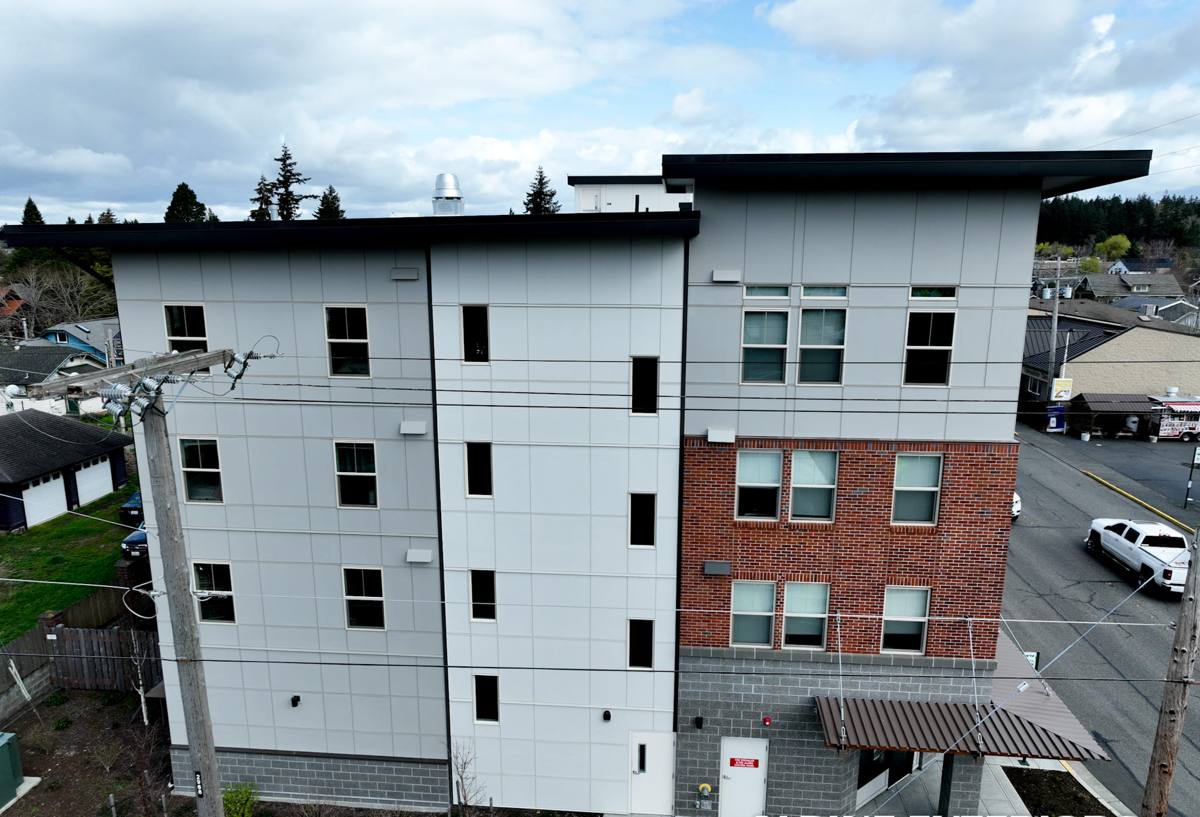
 Chuckanut Exterior
 Bellingham sits close enough to Bellingham Bay and the surrounding waterways that homes here deal with a specific combination of punishment: salt-laden air moving in off the water, long stretches of driving rain through fall and winter, and shaded, damp conditions that keep moss and algae established on north-facing walls for most of the year. Siding installed without that combination in mind tends to show it early — soft spots at the bottom courses, green staining that keeps coming back no matter how often it's washed, and paint that fails years ahead of schedule. Siding installed correctly, in the right material, handles all three without much drama for decades.
What Bellingham's Climate Actually Does to Siding
Whatcom County's marine climate is milder than most of the country, which is part of why people move here — but mild and dry are not the same thing. The exposures that matter most for siding are:
- Salt air: proximity to the bay means airborne salt settles on exterior surfaces, which accelerates corrosion of fasteners and trim metal, and works against coatings that aren't formulated to resist it.
- Driving rain: wind-driven rain off the water doesn't just fall straight down — it gets pushed sideways into wall assemblies, seams, and butt joints, which means the water management behind the siding matters as much as the siding itself.
- Moss and algae season: shaded, north- and east-facing walls in this region stay damp long enough that moss and algae get a foothold and keep coming back on surfaces that hold moisture at the surface.
None of this is unique to any one house in Bellingham — it's the baseline condition for the neighborhood, and it's why the products and installation details that work fine in a drier inland climate don't always hold up here.
Why Product Choice Matters More Here Than Elsewhere
We install James Hardie fiber cement siding exclusively. We don't install vinyl, LP SmartSide, or engineered wood products, and in a climate like Bellingham's, that's not a marginal preference — it's the difference between siding that ages gracefully and siding that turns into a maintenance project.
Wood-based and engineered wood siding
Products like LP SmartSide use wood strand technology with a resin-saturated shell, and they've improved a great deal over older wood siding. But they're still an organic substrate, and in a region with this much sustained moisture exposure and moss pressure, any breach in the factory coating — a cut edge, a fastener hole, a scuff during installation — gives moisture a path into wood fiber that swells, softens, and eventually needs to be replaced. The failure mode is slow and often invisible until it's advanced.
Vinyl siding
Vinyl is inexpensive and low-maintenance in the sense that it doesn't need painting, but it has its own problems in a coastal, high-wind, moisture-heavy environment: it expands and contracts significantly with temperature swings, it can warp or crack in sustained UV and salt exposure over time, and it relies almost entirely on the water-resistive barrier behind it since the panels themselves are not a sealed system. Color is also baked in rather than factory-cured onto a substrate, so it fades over time with no way to refinish it short of replacement.
Why we standardized on James Hardie
Fiber cement is made from cement, sand, and cellulose fiber — it doesn't rot, it isn't affected by moss or algae the way wood fiber can be, and it's non-combustible, which matters more each year as wildfire smoke and ember exposure become a regional concern even outside fire-prone zones. James Hardie's ColorPlus factory finish is baked on and warrantied against fading and chipping, which holds up better against salt air than field-applied paint. Hardie also engineers specific product lines (their HZ5 designation) for climates like ours, with formulations aimed at moisture and moss resistance rather than a one-size-fits-all approach.
| Factor | James Hardie Fiber Cement | Vinyl | Wood/Engineered Wood |
|---|---|---|---|
| Moisture/rot resistance | Not organic, doesn't rot | Doesn't rot, but relies on barrier behind it | Vulnerable if coating is breached |
| Moss/algae resistance | Strong, cement-based surface | Moderate, can trap moisture at laps | Weaker, organic surface feeds growth |
| Coastal salt exposure | Factory finish holds color | Can fade and become brittle over time | Field-applied finishes wear faster |
| Fire resistance | Non-combustible | Combustible | Combustible |
| Typical lifespan when installed to spec | 30+ years | 20-30 years | 15-25 years |
What a Correct Siding Installation Involves in Bellingham
The siding product is only part of the equation. In a driving-rain climate, the assembly behind the siding does most of the actual water-management work, and this is where a lot of installations quietly go wrong.
Water-resistive barrier and flashing
Every wall needs a continuous, correctly lapped weather-resistive barrier underneath the siding, with flashing integrated at every window, door, deck ledger, and penetration so that any water that does get past the siding face has a way out rather than a place to collect.
Rainscreen gap
In coastal, high-moisture climates, a furred-out rainscreen gap behind the siding gives incidental moisture a way to drain and dry rather than sitting against the back of the panel. This detail matters more in Bellingham than it would in a dry inland climate, and it's a detail that's easy to skip if a crew is moving fast.
Fastening and clearances
James Hardie specifies exact nailing patterns, fastener types, and minimum clearances from grade, decks, and roof lines. Getting these wrong doesn't show up immediately — it shows up a few years later as buckling, cracking at butt joints, or moisture intrusion at the bottom courses, which are exactly the spots most exposed to splash-back and driving rain.
Caulking and sealants
Not every seam should be caulked — some are designed to be left open so water can drain — but the ones that should be sealed need the right sealant, applied correctly, at trim, corners, and penetrations. Over-caulking traps moisture as often as under-caulking lets it in.
Our Process for a Bellingham Siding Project
- On-site assessment: we look at the existing siding, sheathing condition, and specific exposure of each wall — a west-facing wall taking direct weather is a different problem than a shaded north wall dealing with moss.
- Tear-off and sheathing check: we remove the old siding and inspect the sheathing and framing underneath for any moisture damage before anything new goes up — this is often the first time hidden problems get found.
- Water-resistive barrier and flashing: a continuous barrier and properly lapped flashing at every opening, installed before any siding panel goes on.
- Rainscreen and fastening to spec: furring where called for, and fastening per James Hardie's published installation instructions — not a generalized approach.
- Trim, caulking, and finish details: corners, trim boards, and sealant applied where it belongs and left open where drainage is the better design.
- Final walkthrough: we go over the finished job and the maintenance basics before we consider it done.
What Bellingham Homeowners Should Ask Any Contractor
- Do you install to the manufacturer's published specifications, or a generalized approach used everywhere you work?
- Will you inspect the sheathing before installing new siding, and what happens if you find damage?
- Do you install a rainscreen gap, and why or why not for this specific house?
- What's covered under the manufacturer's warranty versus your workmanship warranty, and how are they different?
- Have you worked in this specific area before, and do you understand its particular exposure — sun, wind, shade, and moisture?
Why Local Experience Matters
A crew that already works around Chuckanut and Bellingham knows which walls in this kind of setting tend to hold moss, which exposures see the worst of the driving rain, and which installation details actually matter here versus in a drier climate. That's not something you get from a general installation manual — it comes from doing this work, on homes like this one, in this specific corner of Whatcom County, repeatedly. It also means someone is nearby if a question comes up after the job is done, rather than a crew that installed your siding once and moved on to the next county.
Maintenance After Installation
Fiber cement is low-maintenance, not no-maintenance. A yearly rinse to keep organic buildup from establishing on shaded walls, a periodic visual check of caulked joints and trim, and prompt attention to anything that looks like it's holding water will keep a correctly installed system performing for decades. None of this compares to the sanding, re-coating, or panel replacement that other siding types eventually require.
If you're planning a siding project in Bellingham or anywhere else around Chuckanut, we're glad to take a look at your home, walk you through what we'd recommend and why, and put together a free, no-pressure estimate — no obligation either way.