 Chuckanut Exterior
 Alger Roofs Work Harder Than Most
If you own a home in Alger, you already know your roof doesn't get an easy life. Sitting close enough to the water to pick up salt-laden air, and squarely in the path of the wind-driven rain that rolls off the Chuckanut foothills, local roofs are dealing with three things at once: moisture, corrosion, and organic growth. Add in a moss season that can run from late fall through spring in a wet year, and it's no surprise that roofs here often need attention sooner than the same materials would in a drier inland town.
None of that means a roof is doomed — it means repairs have to be done with the local conditions in mind, not treated like a generic patch job. That's the difference between a repair that buys you a few dry months and one that actually holds up through the next several wet seasons.
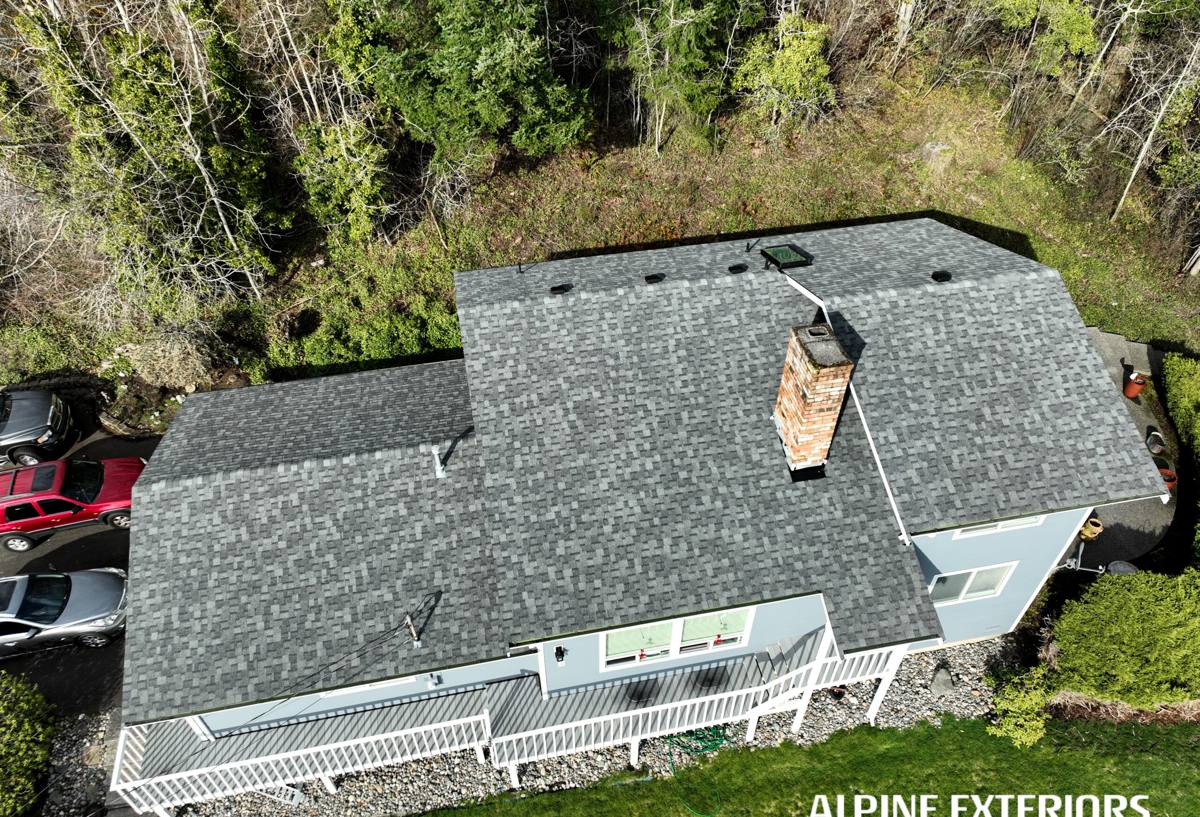
How Salt Air, Rain, and Moss Actually Damage a Roof
Salt Air and Metal Fatigue
Airborne salt accelerates corrosion on anything metal on your roof — nails, flashing, valley metal, vent boots with metal collars, and fasteners holding shingles or panels down. Corrosion doesn't announce itself. It shows up years later as a rusted-through flashing seam or a fastener that's lost its grip, usually right where water is already trying to get in.
Driving Rain and Wind-Driven Water
Rain that falls straight down is manageable for almost any roof. Rain that's being pushed sideways by wind is a different problem — it finds the smallest gap in a shingle lap, a nail head, or a flashing joint and works its way underneath instead of running off. Repairs in this area have to account for wind direction and exposure, not just patch the spot that's visibly leaking.
Moss and Trapped Moisture
Moss doesn't just look bad — it holds water against the roof surface and, on shingle roofs, works its way under the shingle tabs as it grows. Over a long moss season, that trapped moisture accelerates granule loss on asphalt shingles and can rot the wood decking underneath if it goes unaddressed for multiple seasons.
Signs an Alger Roof Needs Repair
Most roof problems give some warning before they become a full-blown leak. Here's what we look for, and what homeowners can watch for between visits.
Inside the House
- Discolored ceiling patches, especially after a windy rainstorm rather than a calm one
- A musty smell in the attic or top-floor closets
- Visible daylight through the roof deck when viewed from inside the attic
- Insulation that feels damp or looks matted down in one area
Outside on the Roof
- Dark streaking or thick moss growth, particularly on north-facing slopes that stay shaded and damp longer
- Shingle tabs that are curling, cracked, or missing their granules in patches
- Rust staining below metal flashing or vent stacks
- Sagging in the roofline, which points to a deeper decking issue rather than a surface repair
What a Correct Repair Actually Involves
A roof repair done right isn't just slapping sealant on the spot that's dripping. It starts with figuring out where water is actually entering — which is sometimes several feet from where the stain shows up inside, since water travels along rafters and sheathing before it drips.
Diagnosis Before Repair
We trace the leak path, check the condition of the decking underneath (soft, spongy wood means the repair needs to go deeper than the surface), and look at surrounding flashing, valleys, and penetrations — not just the immediate damaged area. A leak that shows up near a chimney or vent stack is very often a flashing problem, not a shingle problem.
Matching Materials
When we replace shingles, we match the existing material as closely as possible in type, profile, and where feasible, color, so the repair doesn't stand out as an obvious patch. On older roofs where the original shingle is no longer available, we'll explain the trade-offs honestly rather than pretend an exact match exists.
Flashing and Underlayment Work
Given how much of our repair work traces back to corroded or failed flashing, we treat flashing replacement as part of a proper repair, not an upsell. Same with underlayment around the repaired section — if the felt or synthetic underlayment nearby is degraded, patching shingles over it just delays the same leak coming back.
Repair or Replacement? What Actually Drives That Decision
Homeowners often ask us this before we've even looked at the roof, and it's a fair question. The honest answer depends on a handful of factors more than on age alone.
| Factor | Leans Toward Repair | Leans Toward Replacement |
|---|---|---|
| Extent of damage | Isolated to one section or penetration | Spread across multiple slopes |
| Decking condition | Solid, dry sheathing | Soft or rotted decking in several spots |
| Remaining roof life | Roof is mid-life with granule loss just starting | Roof is past its expected service life |
| Number of past repairs | First or second repair on this roof | Repeated repairs to the same areas |
| Moss and staining pattern | Surface growth only | Moss present for years with visible substrate damage |
We'll always tell you honestly when a repair is the right call and when it's a temporary fix on a roof that's genuinely near the end of its life. There's no benefit to us in either direction — the goal is a roof that actually stops leaking.
Our Repair Process
- Inspection and photos — we get on the roof (or use a pole camera on steep or wet sections when it's safer) and document the actual condition, not just the reported leak spot.
- Written explanation — you get a plain-English rundown of what's failing and why, before any work starts.
- Repair — decking replaced where needed, flashing redone where it's corroded or improperly lapped, shingles or panels matched and installed to shed water correctly for our wind and rain patterns.
- Cleanup and check — debris and old material hauled off, gutters checked for granule buildup or moss debris from the work area.
Materials We Use — and Why
For asphalt shingle repairs, we use architectural (dimensional) shingles matched to the existing roof wherever possible — they hold up better to wind uplift than older three-tab styles. For flashing, we favor corrosion-resistant metals over bare galvanized steel in this area specifically, since salt air shortens the working life of lower-grade metal considerably. On low-slope sections or additions, we use membrane systems rather than trying to force shingles onto a pitch they weren't designed for — that mismatch is a common source of repeat leaks we get called out to fix on other companies' work.
We don't push metal roofing or premium shake as a repair fix when a proper shingle and flashing repair will do the job. Upgrades have their place, but a repair should solve the actual problem in front of us, not sell you something you didn't come to us for.
Maintenance That Extends a Repair's Life
A good repair lasts a lot longer with basic upkeep between service calls. Here's what we recommend for homes in the Alger area specifically:
- Keep gutters clear so water isn't backing up under the lowest course of shingles
- Trim back tree limbs that shade the roof and keep moss-prone areas from drying out between rains
- Have moss physically removed rather than power-washed off, which can strip granules and drive water under shingles
- Schedule a roof check after any major windstorm, even if nothing looks obviously wrong from the ground
- Address small leaks the season you notice them — decking repairs get more expensive the longer trapped moisture sits
Why It Matters to Hire a Crew That Already Works This Area
Roofing problems in Alger tend to follow patterns — which slopes take the worst wind-driven rain, which roof styles hold moss longest, which flashing details fail first in salt air. A crew that already works this stretch of Whatcom County has seen those patterns repeatedly and knows what to check first instead of guessing. That translates into a faster, more accurate diagnosis and a repair that's built for the conditions your roof actually faces, not a one-size-fits-all fix.
It also means we're not disappearing after the invoice. If a repair doesn't hold the way it should, you're calling a company that knows your roof and is still around the corner, not chasing down someone who did a one-off job and moved on.
Get a Straight Answer About Your Roof
If you're dealing with a stain on the ceiling, moss that's gotten out of hand, or a roof that's just due for a look after a rough winter, we're glad to come take a look. The estimate is free, there's no pressure to buy more than you need, and you'll get an honest answer about whether a repair makes sense or whether it's time to start planning for something bigger. Fill out the form below and we'll get in touch to schedule a time.