 Chuckanut Exterior
 Why Bellingham Windows Wear Differently Than Windows Inland
Bellingham sits right on the water, and that changes what a window has to survive. Salt-laden air off Bellingham Bay works its way into hardware, weep holes, and fasteners faster than it would forty miles inland. Add Whatcom County's long stretch of driving rain each fall and winter, plus a moss season that can run from October into May on shaded, north-facing walls, and you have a climate that punishes any weak point in a window installation almost immediately. Homes here don't fail because the glass wears out — they fail because water, moss, or salt-driven corrosion found a gap the installer left behind.
We work on homes throughout Bellingham and the surrounding Chuckanut area, and the pattern repeats: a window that looked fine for years starts showing soft trim, a musty smell in the room, or a fogged pane, and the cause traces back to how it was set into the wall — not the window itself. That's the part of this job that actually matters, and it's the part a lot of installs skip.
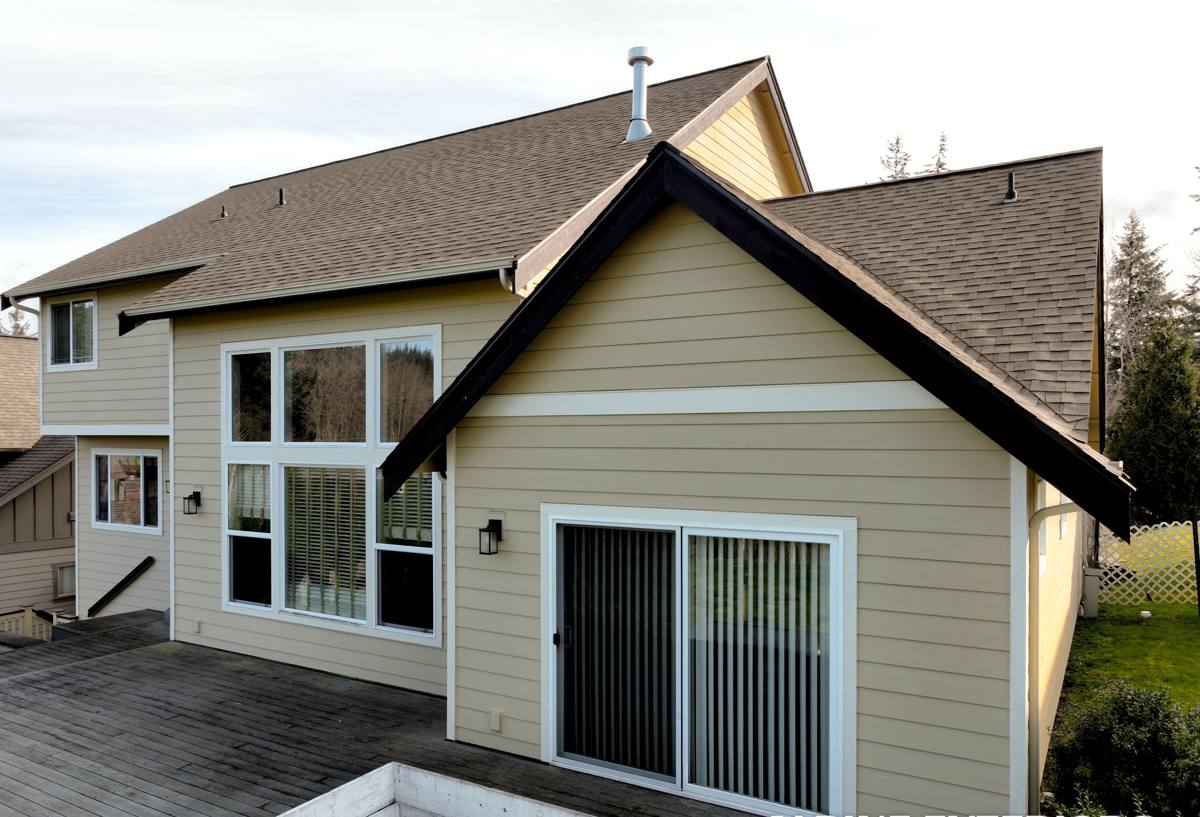
What a Correct Window Installation Actually Involves
Swapping glass is easy. Making sure water never gets behind that glass is the real job. A proper installation in this climate has to get several things right, in order, every time:
- A sloped sill pan under the window that directs any water that does get in back out to the exterior, not down into the wall framing
- Correct flashing sequence — building paper or house wrap lapped over the flashing at the top and sides, so water sheds down and over each layer like shingles
- Sealant used only where it belongs — at the exterior trim and nailing fin, never as a substitute for proper flashing, and never sealing the bottom of the window in a way that traps water inside the sill pan
- Shimming and squaring the unit so the sash operates correctly and weatherstripping seals evenly all the way around
- Insulating the gap between the window frame and rough opening with a compatible low-expansion foam or backer rod, not packed fiberglass that can wick moisture
Skip any one of these steps and the window can look perfect from the street while quietly rotting the framing around it. In a climate that gets this much rain, that failure shows up in years, not decades.
Condensation Is a Different Problem Than Leaks
Homeowners sometimes call about a "leaking" window that's actually condensing on the inside face of the glass. That's a sign of a cold spot — often an older single-pane or early double-pane unit — meeting the humid indoor air that's common in tightly built Northwest homes. It's not a defect in the installation, but it is a reason to talk through glass performance, not just frame material, when you're replacing windows here.
Retrofit vs. Full-Frame Replacement
One of the first decisions on any Bellingham window project is whether the existing frame stays or goes. Both approaches are legitimate — the right call depends on the condition of what's already in the wall.
| Approach | Best for | Trade-offs |
|---|---|---|
| Retrofit (insert) replacement | Sound existing frame, no rot, siding you don't want disturbed | Faster, less invasive, but any hidden frame damage stays hidden |
| Full-frame replacement | Rotted sill or jambs, old aluminum frames, or a siding project happening at the same time | More labor and cost, but lets us inspect and rebuild the opening correctly, including new flashing |
Given how much moisture this area sees, we lean toward pulling a full frame whenever there's any sign of past water intrusion — soft wood, stained sheathing, or a musty smell at the sill. Covering a problem with a new insert doesn't solve it; it just hides it for another season.
Choosing a Window Frame Material for This Climate
Frame material affects how a window handles moisture, temperature swings, and salt air over the long run. There's no single right answer for every house, but here's how the common options actually behave here:
| Material | How it holds up in Bellingham's climate | Maintenance |
|---|---|---|
| Vinyl | Good moisture resistance, won't corrode from salt air; can expand and contract more with temperature swings | Low — no painting, occasional track cleaning |
| Fiberglass | Very stable in temperature and humidity, strong long-term performance in coastal conditions | Low — factory finish holds up well, minimal upkeep |
| Wood-clad | Warm appearance, works well for older or historic-style homes, but any breach in the exterior cladding lets moisture reach the wood core | Higher — exterior finish and seals need periodic inspection |
| Bare aluminum | Poor fit for this climate — conducts cold, promotes condensation, and older units are prone to corrosion near the water | High — we generally recommend replacing rather than repairing these |
We're not going to tell you a single brand is "bad" — we just won't install bare aluminum in a full-frame replacement here, because the moisture and condensation behavior doesn't match what this climate demands. That's a professional standard, not a knock on any manufacturer.
Glass Performance Matters as Much as the Frame
In a marine climate with long gray stretches and driving rain, glass selection is about more than energy bills. A quality Low-E coating cuts heat loss through the glass, which reduces the cold-glass condensation problem mentioned earlier. Double-pane is standard on most replacement jobs; triple-pane adds meaningful comfort in rooms that face the water or catch the worst of the wind, at added cost and weight. Argon or krypton gas fill between panes is a minor cost adder that pays back in reduced drafts near the glass on cold, wet days — which in Whatcom County is most of the winter.
Our Installation Process
- On-site assessment. We check the existing frames, sills, and siding for rot or past water damage before quoting anything, since that determines retrofit vs. full-frame.
- Measure and order. Exact opening measurements go to the manufacturer; we build in the correct reveal for flashing and trim.
- Remove and inspect. Old units come out carefully so we can see the condition of the rough opening — this is where hidden moisture damage shows up.
- Repair the opening. Any soft or damaged framing gets replaced before a new window ever goes in. Installing a new window over rotted wood just delays the next repair.
- Flash, set, and seal. Sill pan, house wrap integration, shimming, and sealant go in the correct order, not just "caulk around the edges."
- Trim and finish. Interior and exterior trim are reinstalled or replaced to match, and everything is checked for square, level, and smooth operation.
- Final walkthrough. We test every window's operation and go over care and warranty details with you before we consider the job done.
Signs Your Current Windows Are Already Failing
Most homeowners don't notice window failure until it's well along. Watch for:
- Fogging or moisture trapped between panes of a double-pane unit — the seal has failed and the insulating gas is gone
- Soft, spongy, or discolored trim and sill wood, especially on walls that face prevailing weather
- Visible moss or dark green-black growth on the siding directly around a window frame
- Drafts you can feel with a hand near the sash even when the window is fully closed
- Difficulty opening, closing, or latching a window that used to operate smoothly
- A musty smell in the room nearest the window, particularly after a stretch of heavy rain
Any one of these is worth a look. Several together usually mean water has already reached the framing, and the window itself is the least of the problem.
Permits and Code Considerations Locally
Window replacement rules vary by jurisdiction and by what's changing. In general, a straightforward like-for-like replacement — same size opening, same rough framing — is treated differently than a project that enlarges an opening, adds an egress window to a bedroom, or is part of a larger exterior remodel. Bellingham and Whatcom County both have their own permitting requirements, and they can change, so we confirm what's needed for your specific project rather than assume. Egress code for bedroom windows is worth flagging specifically if you're replacing anything in a sleeping room — minimum opening size and sill height requirements apply, and it's far easier to address that during a full-frame replacement than after the fact.
Why a Crew That Already Works Bellingham Matters
A window installer who works elsewhere in Washington can certainly install a window correctly on a dry day. What's harder to pick up without local experience is judgment: knowing which older Bellingham neighborhoods tend to have original single-pane wood windows with rot risk around the sills, recognizing moss and algae staining as a maintenance signal rather than just a cosmetic issue, and building in enough margin on flashing details because this area's rain doesn't let up for months at a time. A crew that works Chuckanut, Bellingham, and the rest of Whatcom County regularly sees the same failure patterns often enough to know what to check before it becomes a problem, not after.
Caring for New Windows in a Wet Climate
A correctly installed window still benefits from basic upkeep here. Rinse accumulated grit and salt residue off exterior frames a couple of times a year, especially on sides facing the water. Keep gutters and downspouts clear so roof runoff isn't sheeting down across window heads. Check exterior caulk lines annually — sealant is the first thing UV and constant moisture cycling will break down, and catching a failed bead early is a five-minute fix instead of a repair. If moss starts forming on siding near a window, treat it and clear it rather than letting it hold moisture against the wall.
If you're weighing whether your current windows need attention, or you're ready to replace them and want it done in a way that actually holds up to Bellingham weather, we're happy to take a look. Estimates are free, there's no pressure, and you can reach us using the form below.