 Chuckanut Exterior
 Storm Damage Roof Repair for Alger Homes
Alger sits close enough to the water and to Chuckanut Mountain that its roofs deal with a specific mix of punishment: salt-laden air off the bay, wind that funnels through the gaps between the mountain and the shoreline, driving rain that finds every weak seam, and a moss season that can run most of the year in the shaded, damp lots common to this area. A storm doesn't have to be dramatic to cause real damage here — a few hours of sideways rain and gusty wind is often enough to lift shingles, work flashing loose, or push water into a spot that was already softened by months of trapped moisture under moss.
This page covers storm damage roof repair specifically for Alger properties — what tends to go wrong, what a correct repair actually involves, and how we approach the job when we're called out after a storm.
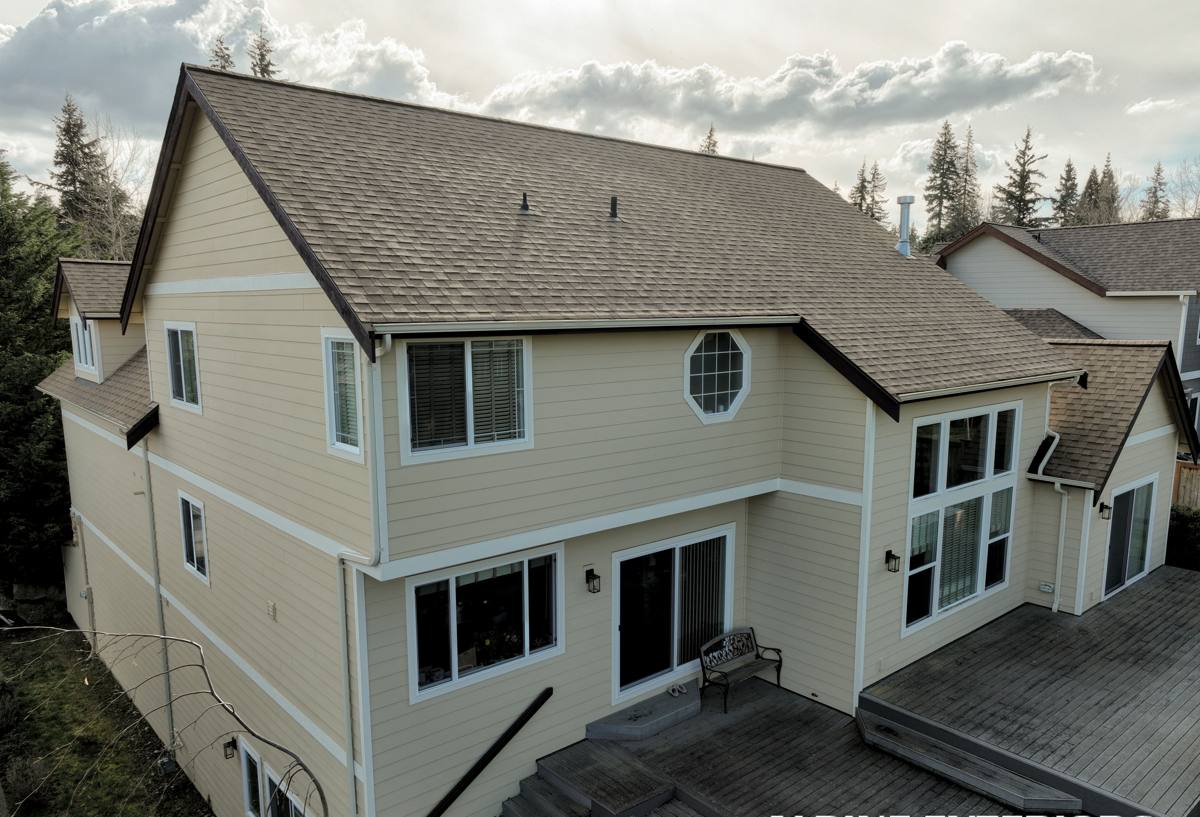
What Storm Damage Actually Looks Like on a Whatcom County Roof
Homeowners often expect storm damage to mean missing shingles scattered across the yard. Sometimes it's that obvious. More often, it's quieter and easier to miss until it's already caused interior damage:
- Shingles that are lifted, cracked, or creased at the tab but still nominally "in place"
- Flashing around chimneys, skylights, and roof-to-wall transitions pushed loose or bent by wind
- Wind-driven rain forced up and under shingle edges instead of running off normally
- Granule loss from wind abrasion, which shows up as bare, shiny patches on asphalt shingles
- Fastener heads backed out or corroded, especially on older metal flashing and fasteners exposed to salt air
- Branch or debris impact damage, even from limbs that didn't fully fall — just enough to crack or dent a section
- Moss mats that were already holding moisture against the roof deck, now torn loose or shifted by wind and pulling shingles with them
That last one is worth calling out on its own, because it's specific to this kind of climate.
Moss Isn't Separate From Storm Damage — It's a Multiplier
A roof with a healthy moss mat going into a storm is already compromised before the wind even picks up. Moss holds water against shingles and decking, keeps things from drying between rain events, and can pry up shingle edges as it grows. When a storm hits a roof like that, the same wind speed and rain volume that a clean, well-maintained roof would shrug off can cause real damage — lifted shingles, soaked underlayment, even deck rot underneath. Any honest storm damage repair in this area has to look past the obvious wind damage and check whether moss has already done quiet damage that the storm just exposed.
Why Alger's Location Matters for Repair Decisions
Being near the water and the mountain isn't just scenery — it shapes how a roof ages and fails. Salt air accelerates corrosion on exposed metal: nails, flashing, gutter fasteners, and any lower-grade hardware degrade faster here than they would further inland. Wind patterns funneled between Chuckanut Mountain and Samish Bay can create localized gusts that hit one section of a roof — often a specific slope or a corner near a gable — much harder than the rest of the house. And the shade and dampness common on wooded lots in this part of Whatcom County keep moss and moisture active for more of the year than in drier, more open areas.
Practically, that means a repair plan for an Alger roof needs to account for corrosion-resistant fasteners and flashing, pay close attention to whichever slope typically catches the wind, and treat moss control as part of the repair, not a separate maintenance item to deal with later.
What a Correct Storm Repair Actually Involves
A rushed storm repair patches the visible problem and moves on. A correct one treats the visible damage as a symptom and checks what's underneath it. Here's the difference:
| Rushed Repair | Correct Repair |
|---|---|
| Replace the shingles that are obviously missing or cracked | Pull back surrounding shingles to check underlayment and decking for hidden moisture |
| Re-nail lifted shingles with whatever fasteners are on hand | Use corrosion-resistant fasteners suited to salt-air exposure |
| Caulk over a flashing gap | Re-set or replace the flashing so water sheds correctly, not just gets sealed shut |
| Match shingles loosely by color | Match by manufacturer, line, and profile so the repair doesn't stand out or shed water differently |
| Leave existing moss in place around the repair | Clean and treat moss near the repair so the same area doesn't fail again next season |
| Skip the rest of the roof | Do a full-roof check, since one storm-damaged spot often means other areas are close to failing too |
The extra steps on the right side of that table are what keep a storm repair from becoming a repeat call six months later.
Our Process for Storm Damage Calls
When we get a storm damage call in Alger, we work through it in a consistent order:
- Immediate assessment. If there's active leaking or an open section exposed to weather, we prioritize a temporary cover to stop water intrusion before anything else.
- Full inspection, not just the damaged spot. We check the whole roof, because wind and moss damage rarely stay confined to one shingle. We also check attic or ceiling areas where accessible, since water can travel before it shows up as a stain.
- Honest damage report. We tell you what we found in plain terms — what's storm-related, what's pre-existing wear the storm exposed, and what can wait versus what shouldn't.
- Repair plan with real options. Depending on scope, that might mean a targeted repair, a partial section replacement, or a conversation about whether the roof is past the point where repair makes sense.
- The repair itself. Matched materials, proper flashing work, corrosion-resistant fasteners, and moss treatment where it's contributing to the problem.
- Documentation. Photos and notes on the damage and repair, useful if you're filing an insurance claim.
Repair or Replace? Factors That Actually Matter
Not every storm-damaged roof needs full replacement, and not every repair is worth doing instead of replacing. The right call depends on a few honest factors:
| Factor | Leans Toward Repair | Leans Toward Replacement |
|---|---|---|
| Age of roof | Under roughly half its expected lifespan | Nearing or past expected lifespan for its material |
| Extent of damage | Isolated to one area or slope | Spread across multiple slopes or recurring in the same spots |
| Underlying condition | Decking and underlayment are sound once uncovered | Decking is soft, underlayment is failing, or moss damage is widespread |
| Material availability | Matching shingles/material still available | Discontinued material forces a visible mismatch |
| History of repairs | First significant repair in years | Repeated patch jobs on the same roof |
We'll walk you through where your roof falls on that list rather than defaulting to whichever option is more profitable for us.
Insurance and Documentation
Many storm damage repairs in this area do get filed through homeowners insurance, especially after a named wind event. A few practical notes: take your own photos as soon as it's safe to do so, avoid getting on the roof yourself if it's still wet or windy, and keep any documentation we provide from our inspection. We're happy to provide a written damage assessment that you can submit alongside your claim — we just don't handle the claims process itself or guarantee what an adjuster will approve.
Choosing a Crew That Actually Works Alger Roofs
A contractor who mostly works drier, inland areas can still do competent work, but they may not think to spec corrosion-resistant hardware by default, or know which slope orientations tend to take the worst wind locally, or treat moss as part of a storm repair rather than an afterthought. Before hiring for storm damage repair, it's worth asking:
- Do you check the whole roof, or just the area I called about?
- What fasteners and flashing do you use, and are they rated for coastal/salt-air exposure?
- Will you provide written documentation I can use for an insurance claim?
- How do you match shingle color, profile, and manufacturer for a repair section?
- Do you address moss as part of the repair, or only the wind/rain damage itself?
- Are you licensed and insured, and can you show proof?
A crew that already works in and around Chuckanut and Whatcom County should be able to answer all of these without hesitation, because they're the same questions we ask ourselves on every storm call out here.
Get a Free, No-Pressure Estimate
If a recent storm has left your Alger roof with lifted shingles, loose flashing, or a leak you're not sure about, it's worth having someone take an honest look before the next round of rain gets into it further. Fill out the form below for a free estimate — no pressure, no upsell, just a clear read on what's actually going on with your roof.