 Chuckanut Exterior
 Why South Hill Homes Need Siding Built for This Setting
South Hill sits up in elevation above the water, which is a mixed blessing for the homes there. You get the views and the tree cover, but you also get weather that behaves differently than it does down in the flats. Wind off the water carries salt into the air, driving rain comes in sideways during winter storms, and the mature tree canopy that makes the neighborhood attractive also means shade, dampness, and moss that hangs around long after the rain stops. Whatcom County's climate is wet for most of the year, and on a hillside lot with tree cover, siding rarely gets a full, fast dry-out between storms the way it might on an open, sunny lot closer to sea level.
That combination — salt air, driving rain, and a long moss season — is hard on siding that isn't installed with those specific conditions in mind. Paint fails early, seams open up, and moisture finds its way behind the cladding before anyone notices a problem on the surface. Siding installation in South Hill isn't a generic job; it's a job that has to account for what this particular setting does to a house year after year.
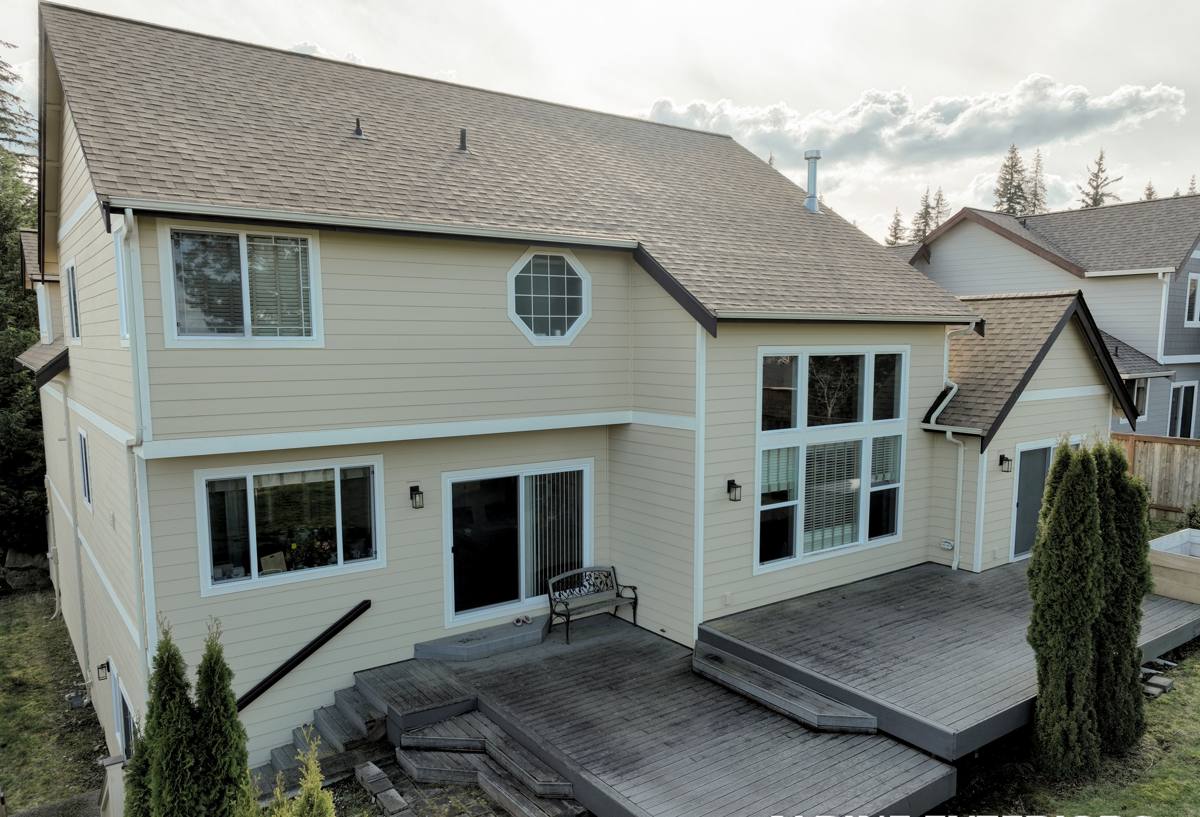
What "Correct" Siding Installation Actually Involves
A lot of siding problems we get called out to inspect aren't material failures — they're installation shortcuts. The siding itself may be fine; what failed is everything behind it. Correct installation is mostly invisible once the job is done, which is exactly why it's worth understanding before you hire someone.
Weather-Resistive Barrier and Flashing
Every wall needs a continuous weather-resistive barrier behind the siding, lapped correctly so water sheds downward and outward rather than working its way behind seams. Flashing at windows, doors, and any horizontal trim has to be integrated with that barrier in the right order — not caulked over as an afterthought. On a lot that gets driving, wind-blown rain, these details matter more than they would in a drier climate, because wind pressure can push water into gaps that would otherwise just run off.
Fastening, Gaps, and Clearances
Fiber cement siding needs to be fastened at the manufacturer's specified pattern and depth — overdriven or underdriven nails are one of the most common causes of early siding failure. Panels need proper gaps at butt joints and terminations to allow for expansion, and siding needs to be held up off decks, patios, and grade with the clearance the manufacturer requires. Skipping that clearance is a slow-motion mistake: it looks fine at handoff and starts wicking moisture a couple of years later.
Why We Install James Hardie — and Only Hardie
We don't install vinyl, LP SmartSide, Cemplank, Allura, primed spruce, or cedar. That's not a marketing position — it's a standard we set because of what we've seen these products do over time in conditions like South Hill's, and because we'd rather install one product very well than several products at a compromise level.
Built for Coastal Pacific Northwest Conditions
James Hardie's HZ5 product line is engineered specifically for climate zones like ours — freeze-thaw cycles, sustained moisture, and salt-air exposure. Fiber cement doesn't absorb water the way wood-based products can, and it won't support rot the way engineered wood or cedar can if moisture does get behind it. It's also non-combustible, which matters for long-term insurance considerations and simple peace of mind, independent of the wildfire risk conversations happening elsewhere in the state.
ColorPlus Factory Finish
Most Hardie siding we install uses the ColorPlus finish — baked on in a factory-controlled environment rather than painted on-site. That finish holds color and resists fading, chipping, and moisture intrusion at the surface far better than field-applied paint, which is one of the first things to fail on wood and engineered-wood siding in a wet, shaded climate. Less repainting means less scaffolding, less cost, and less exposure of the substrate underneath over the life of the siding.
The Warranty Actually Matters Here
Hardie backs its ColorPlus products with a strong, transferable limited warranty. In a climate that's actively working against your siding twelve months a year, that warranty structure is a real factor, not fine print — it reflects the manufacturer's confidence in how the product performs in exactly the conditions South Hill sees.
How Siding Materials Compare in This Climate
| Material | Moisture Behavior | Finish Durability | Maintenance Burden |
|---|---|---|---|
| James Hardie fiber cement (ColorPlus) | Does not absorb/swell like wood-based products | Factory-baked finish, resists fade and chip | Low — occasional wash, no repainting cycle |
| Vinyl | Sheds water but seams and gaps can trap moisture behind panels | Can fade, warp, or become brittle with age and sun exposure | Low to moderate — cracking and warping over time |
| LP SmartSide / engineered wood | Wood-strand core is more moisture-sensitive at cut edges and seams | Field or factory finish, edge sealing is critical and easy to miss | Moderate — edge maintenance is ongoing |
| Cedar / primed spruce | Natural wood absorbs moisture readily, especially in shade | Field-painted or stained, fails first in shaded, damp areas | High — repainting/staining on a recurring cycle |
This isn't a claim that other products are unusable everywhere — it's why, specifically in a wet, shaded, salt-air setting like South Hill, we've standardized on one material we trust to hold up without a heavy maintenance schedule.
Our Installation Process on South Hill Homes
- On-site assessment — we look at existing siding condition, wall assembly, drainage patterns on the lot, and how much shade and tree cover the walls get.
- Removal and inspection — old siding comes off and sheathing gets inspected for hidden moisture damage before anything new goes up.
- Weather-resistive barrier and flashing — installed and lapped correctly at every penetration, window, and door before any siding is hung.
- Hardie installation to spec — correct fastening pattern, gaps, and clearances from decks, patios, and grade, following manufacturer requirements exactly.
- Trim, caulking, and touch-up — factory-finished ColorPlus panels need minimal field touch-up, which keeps the finish consistent.
- Final walkthrough — we go over the completed work with you before calling the job done.
Moss, Algae, and Shade: The South Hill Factor
Homes on wooded, elevated lots deal with a longer moss and algae season than homes in open, sunny spots. Shade keeps siding damp longer after rain, and that moisture is what moss and algae need to take hold. This is mostly a surface and gutter-and-drainage issue rather than a siding-material issue, but it does affect how a house should be detailed and maintained:
- Keep gutters clear so water isn't sheeting down wall sections during storms
- Trim back branches and foliage that hold walls in constant shade where practical
- Rinse siding periodically in shaded areas that don't get natural rain-wash from wind angle
- Watch trim and butt joints first — they're where trapped moisture shows up earliest
- Address any moss on roofing promptly, since roof runoff carries spores onto siding below
Fiber cement doesn't feed moss and algae growth the way a wood-based substrate can if the finish fails, which is one more reason it holds up better on shaded lots long-term.
Signs Your Current Siding Is Already Struggling
- Paint that's peeling, bubbling, or chalking, especially on north- and west-facing walls
- Soft or spongy spots when you press on the siding near the bottom courses
- Visible gaps opening up at butt joints or corner trim
- Persistent moss or algae staining that comes back shortly after cleaning
- Warping, cupping, or panels that no longer sit flat against the wall
- Musty smell or visible staining on interior walls that back up to exterior siding
Any one of these on its own might be minor. Several at once, especially on a shaded or wind-exposed wall, usually means moisture has already gotten behind the siding.
Why It Matters That We Already Work South Hill
A crew that's done siding work in this specific neighborhood already understands how the elevation, tree cover, and exposure to weather off the water affect a job — where a house is likely to take the worst of the driving rain, which walls stay shaded and damp longest, and how drainage tends to move across a hillside lot. That's not something you can fully account for from a set of photos or a quick drive-by. It shapes decisions on flashing details, clearance heights, and where extra attention needs to go during installation, and it means fewer surprises once the walls are open.
Local, established crews also tend to have a better handle on permitting and inspection timelines with Whatcom County and the local jurisdiction, which keeps a project moving instead of stalling out waiting on paperwork nobody anticipated.
After Installation: What Ongoing Care Looks Like
Correctly installed Hardie siding with a ColorPlus finish is genuinely low-maintenance, but "low" isn't "none." A periodic rinse-down, especially on shaded walls, keeps moss and algae from building up. Caulking at trim joints should be checked every year or two and refreshed if it's cracking or pulling away. Keep an eye on anywhere siding meets a roofline, deck, or patio, since those transitions are where water has the most opportunity to collect. None of this is heavy work — it's the kind of occasional check that keeps a well-installed system performing the way it's supposed to for decades.
If your South Hill home's siding is showing its age, or you're planning ahead before the next wet season sets in, we're happy to take a look and talk through what we'd actually recommend for your walls — no pressure, no upsell. Reach out for a free estimate using the form below.