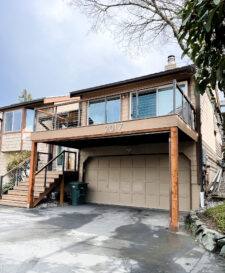
 Chuckanut Exterior
 Why Decks Wear Out Faster in Happy Valley
Happy Valley sits in one of the wetter, greener corners of Whatcom County, and that has real consequences for anything built outdoors. A deck here isn't just fighting rain — it's fighting a long, low-angle wet season, tree cover that keeps surfaces from drying out between storms, and, depending on how close a property sits to the water, a steady dose of salt-laden air. That combination is hard on wood, hard on fasteners, and hard on anything with a seam or a joint where moisture can collect.
Most of the decks we're asked to replace in this neighborhood aren't failing because they were built badly. They're failing because they were built for a drier climate, or built to a budget that skipped the details that matter most once the rain sets in for six months straight. The frame underneath is usually the first thing to go — ledger boards, joists, and posts that stayed damp long after the surface boards looked fine.
The Real Culprits: Moisture, Moss, and Salt
Driving Rain and Standing Moisture
Whatcom County gets rain that doesn't just fall straight down — wind-driven rain gets pushed sideways into ledger connections, under railing posts, and into any gap where flashing wasn't installed or was installed wrong. Once water gets behind a board or into end grain, it doesn't evaporate quickly under a shaded canopy. That's where rot starts, usually invisible from the top for years.
The Moss Season
Moss and algae aren't just a cosmetic nuisance here — a moss-covered deck surface holds moisture against the wood far longer than bare wood does, and it turns stairs and walking surfaces slick and genuinely dangerous. A deck with poor airflow underneath, tight board spacing, or the wrong finish will grow moss faster than one built with drainage and drying in mind.
Salt Air, When It Applies
For homes with any proximity to Bellingham Bay or the Sound, airborne salt accelerates corrosion on fasteners, hardware, and fixtures. Standard exterior screws and hangers that would hold up fine inland can start rusting and staining within a few seasons closer to the water. This is one of the most commonly overlooked details in deck construction — the hardware inside the structure matters as much as the boards on top.
Signs a Deck Needs Replacement, Not Just Repair
Not every tired-looking deck needs to come out. But there's a point where patching boards is just delaying a bigger, more expensive failure. Here's what tells us a full replacement is the honest recommendation:
- Soft, spongy, or spring-y decking boards, especially near the house or in shaded corners
- A ledger board that's soft, discolored, or pulling away from the house rim joist
- Posts or footings that show rot, heaving, or movement when the railing is pushed
- Persistent moss or dark staining that returns within weeks of cleaning
- Fasteners that are rusted, backing out, or staining the wood around them
- A structure that predates current flashing and hardware standards, even if the boards look okay
- Railings that flex or feel loose — a safety issue, not a cosmetic one
If two or three of these apply, repair usually turns into a cycle of chasing problems rather than solving them. A full replacement lets us fix the structure once, correctly, instead of layering new boards over an aging frame.
What a Correct Deck Replacement Actually Involves
A deck is only as good as what's underneath it, and in this climate, the parts you never see are what determine whether it lasts ten years or thirty. A proper replacement includes:
Structural Frame
Ledger boards flashed correctly at the house connection, joists sized and spaced to code, and posts and footings set below frost depth and rated for the actual load — not just the load the old deck happened to carry.
Flashing and Water Management
This is the single most important — and most commonly shortcut — part of the job. A proper ledger flashing detail (including a drainage gap or self-adhered membrane where the ledger meets the house) keeps water from ever reaching the rim joist. This is where most rot-driven failures in wet climates actually start.
Fasteners and Hardware
Corrosion-resistant, code-rated hangers, screws, and structural connectors sized for the application — not just whatever is fastest to install. This matters more here than in drier regions, and it matters even more for homes with any salt air exposure.
Drainage and Airflow
Proper board spacing, ground clearance, and where needed, under-deck drainage systems so water and debris don't sit trapped against the frame — a major factor in slowing moss growth and extending the life of the structure.
Choosing the Right Decking Material for This Climate
There's no single "best" decking material — there's a best fit for how a homeowner wants to use and maintain the deck. Here's how the common options actually perform under Chuckanut's wet, shaded, moss-prone conditions:
| Material | Moisture Performance | Moss/Algae Resistance | Maintenance |
|---|---|---|---|
| Pressure-treated wood | Good if properly finished; vulnerable if finish is neglected | Moderate — needs regular cleaning | Annual cleaning, periodic staining/sealing |
| Cedar | Naturally moisture-resistant, but still needs sealing over time | Moderate; look fades without upkeep | Regular sealing to maintain color and protection |
| Composite decking | Very good — won't rot or absorb water like wood | Better than wood, but capped boards still need periodic cleaning | Low — occasional washing |
| PVC/capstock decking | Excellent — fully sealed surface, no absorption | Best resistance of the group with regular rinsing | Lowest — mostly rinsing off debris |
We install all of these depending on the homeowner's priorities and budget. What we won't do is cut corners on the structure underneath to save money on a premium board — a composite or PVC deck built over a poorly flashed, undersized frame will still fail early, just with a nicer-looking top.
Our Deck Replacement Process
- On-site assessment — we check the ledger, framing, footings, and drainage, not just the surface boards, so the estimate reflects what's actually needed.
- Honest scope and pricing — a clear breakdown of what's being replaced, what materials are involved, and why, before any work starts.
- Permitting — most structural deck replacements in Whatcom County require a permit; we handle that process so it's done correctly and doesn't create problems at resale.
- Demolition and structural rebuild — old decking, framing, and any compromised posts or footings are removed and replaced to current code.
- Flashing and hardware installation — the water-management details that determine long-term performance in this climate.
- Decking, railing, and finish work — installed to the manufacturer's specifications, which matters for both performance and warranty coverage.
- Final walkthrough — we go over care and maintenance specific to the material chosen, so the deck actually reaches its expected lifespan.
Permits and Local Code Considerations
Deck replacement in Whatcom County typically involves a building permit when structural elements — framing, footings, or the ledger connection — are being replaced, not just surface boards. Requirements vary depending on the deck's size, height, and attachment to the home, so we confirm what applies to a given property before work begins rather than assuming. Skipping this step is one of the more common mistakes we see on decks that were "fixed" by a previous contractor — it can complicate insurance claims and home sales down the road.
Maintaining a New Deck in Happy Valley's Climate
The material and installation quality determine how long a deck can last — how it's cared for determines whether it actually gets there. A short maintenance routine goes a long way in this climate:
- Clear leaves and debris from between boards regularly, especially in fall and through the wet season
- Rinse or lightly scrub visible moss growth before it establishes rather than waiting until it's thick
- Check railings and stair connections annually for looseness
- Reseal or restain wood decking on the schedule recommended for the specific product used
- Keep gutters and downspouts near the deck clear so runoff isn't dumping directly onto it
- Inspect the ledger area yearly for staining or soft wood — the earliest sign of a flashing problem
Why a Crew That Already Works This Neighborhood Matters
Deck construction that works in a drier inland climate can fail early here, and a crew that hasn't spent real time building and repairing decks under Whatcom County's rain, tree cover, and moss conditions is more likely to repeat the same mistakes that led to the last deck failing. We've seen the pattern often enough — soft ledgers, rusted hardware, moss-slicked boards — to build around it from the start, not discover it three years later.
Working regularly in Happy Valley also means we're familiar with the practical realities of the area: sloped or shaded lots, tree-heavy properties that limit sun exposure and drying time, and the kind of year-round moisture that makes water management the priority on every deck we build, not an afterthought.
Get a Straight Answer on Your Deck
If your deck is showing soft spots, persistent moss, loose railings, or you're just not sure whether it's worth repairing again, we're happy to take a look and give you an honest assessment — no pressure, no upsell. Use the form below to request a free estimate, and we'll walk the deck with you and explain exactly what we find.