 Chuckanut Exterior
 South Hill's Siding Takes a Different Kind of Beating
South Hill sits close enough to the water that salt-laden air is a constant factor, not an occasional one. Add Whatcom County's long wet season, driving rain that comes in sideways off the water during winter storms, and a moss season that can run most of the year in shaded, north-facing spots, and you have a combination that ages siding faster than almost anywhere else in the region. We see the same failure patterns on South Hill homes over and over: paint that gives out years ahead of schedule, moisture trapped behind boards that never fully dry, and moss creeping up from the bottom edge of siding until it's holding water against the wall.
None of this means South Hill homes are doomed to constant repair. It means siding repair here has to account for causes, not just symptoms. Patching a soft board without figuring out why it went soft just buys you a shorter repeat visit.
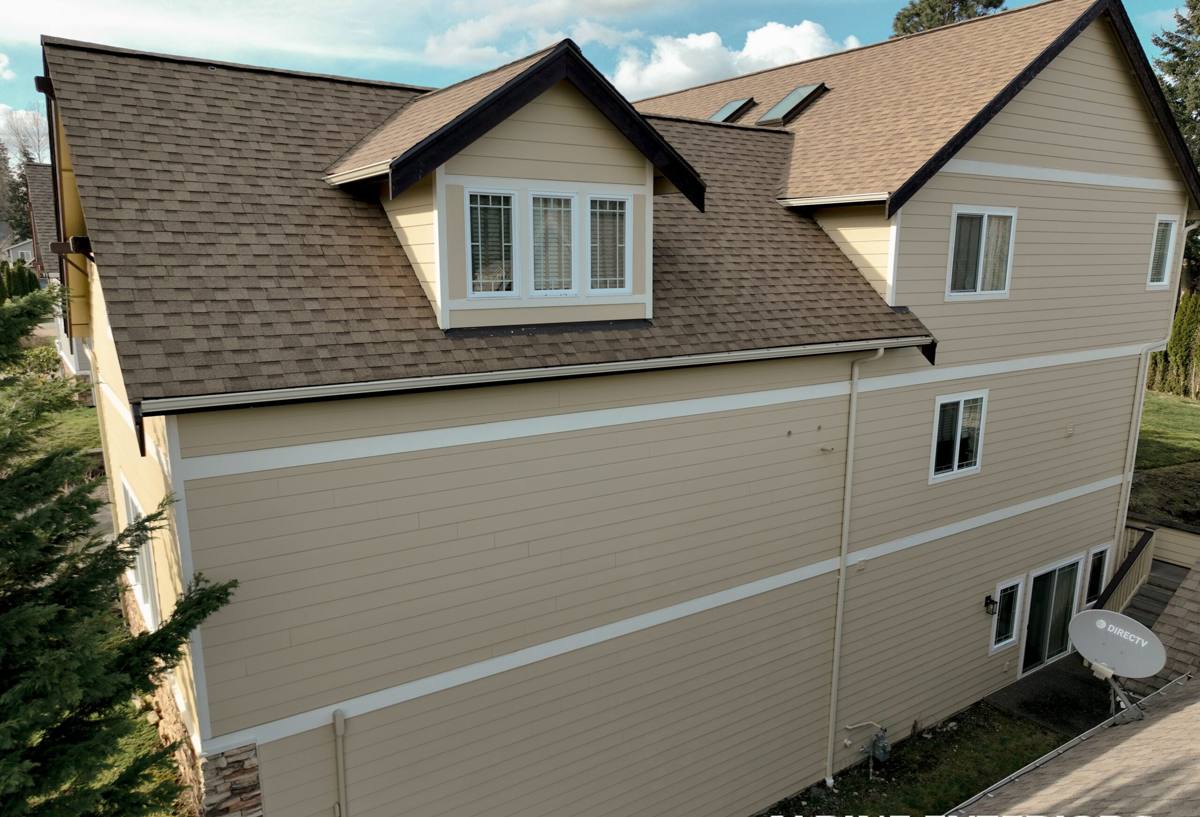
What Salt Air, Rain, and Moss Actually Do to Siding
Salt Air
Airborne salt is corrosive to fasteners and hardware, and it breaks down paint and caulk faster than inland exposure. On older siding, this often shows up first as chalky, faded paint on the sides of the house facing open water or prevailing wind, along with rust streaks below nail heads and trim fasteners.
Driving Rain
Wind-driven rain doesn't just wet the surface of siding — it gets pushed sideways and upward into gaps, laps, and seams that were only ever designed to shed water moving straight down. Homes on South Hill with exposed elevations or minimal roof overhangs take the brunt of this, and it's where we most often find water tracking behind siding rather than off of it.
Moss Season
Shaded north and east-facing walls, fences, and foundation lines on South Hill can stay damp for weeks at a time in fall and winter. Moss and algae take hold in that dampness, and once established they hold moisture against the siding surface around the clock — long after a normal rain event would have dried out. That constant dampness is what turns a cosmetic issue into a rot issue.
Signs Your South Hill Home Needs Siding Repair
- Soft or spongy spots when you press on siding, especially near the bottom courses and around window and door trim
- Paint that's peeling, bubbling, or chalking well before its expected lifespan
- Visible moss or dark green-black staining that keeps returning after cleaning
- Gaps opening up at seams, corners, or where siding meets trim
- Warping, cupping, or boards that no longer sit flat against the wall
- Rust streaking below nails or fasteners
- A musty smell near exterior walls inside the house, or drywall staining on an exterior-facing wall
- Siding near ground level or near downspouts that looks consistently darker or wetter than the rest of the wall
What Correct Siding Repair Actually Involves
A repair that holds up on South Hill has to do more than replace the piece that looks bad. Done right, it includes:
- Finding the water source. Failed caulk, a gap in flashing, a clogged gutter, or grade sloping toward the foundation are common root causes we look for before touching the siding itself.
- Checking the sheathing and framing behind the siding. If water has been getting in for a while, the siding may be the least of the problem — soft sheathing or framing needs to be addressed before new siding goes back on.
- Restoring proper drainage and flashing details at windows, doors, and any point where two materials meet, so water sheds outward instead of pooling.
- Matching the replacement material correctly in thickness, profile, and exposure so the new section performs the same as the surrounding siding, not just looks similar from the ground.
- Re-sealing and repainting to spec, using products rated for the moisture and salt exposure this area sees, not just whatever's on the shelf.
Skip any one of these steps and the repair looks fine for a season or two, then fails again — often in the same spot.
Repair vs. Replacement: How We Help You Decide
Not every problem area needs full replacement, and not every problem area should be patched. The right call depends on how much of the wall is affected, what's causing the damage, and what's underneath.
| Factor | Repair Usually Makes Sense | Replacement Usually Makes Sense |
|---|---|---|
| Extent of damage | Isolated to one or two boards or a small section | Spread across multiple walls or elevations |
| Sheathing condition | Solid, dry framing behind the siding | Soft or rotted sheathing found behind the siding |
| Material match | Original material still available or closely matchable | Original product discontinued or badly weathered elsewhere |
| Underlying material | Fiber cement or other durable material in otherwise good shape | Original material (older wood, vinyl, or lower-grade composite) showing widespread age-related failure |
| Long-term cost | Lower upfront cost, addresses the immediate issue | Higher upfront cost, resets the clock on the whole exterior |
We'll always tell you honestly which category your home falls into. If a section can be properly repaired, we repair it — there's no reason to sell a full re-side when a targeted fix will hold up.
Why Material Matching Determines Whether a Repair Lasts
One of the most common repair mistakes we see on South Hill homes is a patch job done with whatever material was easiest to find at the time, rather than what actually matches the original siding's behavior. Mixing materials — say, patching wood lap siding with a different composite, or using a thinner-profile product next to a thicker original — creates uneven expansion, uneven paint absorption, and new seams that are more likely to open up under this area's rain and wind exposure.
When a section of siding is too far gone to patch cleanly, or when the original material (older cedar, LP-style composite, or aging vinyl) is failing house-wide rather than in one spot, we'll say so directly and talk through replacement options rather than layering a mismatched patch onto a failing system. In those cases, we install James Hardie fiber cement, and only James Hardie — it's the one product line we've standardized on for repairs and full replacements alike. It's non-combustible, holds its factory-applied ColorPlus finish far longer than field-painted repairs, and its HZ product lines are engineered specifically for climates like this one, with moisture and impact resistance that holds up to salt air and driving rain rather than just tolerating it.
Our Siding Repair Process
- On-site inspection. We walk the exterior, check every elevation (not just the visibly damaged one), and probe suspect areas to find soft spots before we quote anything.
- Root-cause diagnosis. We identify what let water in — flashing, caulk failure, grade, gutter issues, moss buildup — so the repair actually solves the problem.
- Honest scope and options. You get a clear explanation of what's repairable, what should be replaced, and why, with no upsell pressure either direction.
- Repair or replacement work. We address any damaged sheathing or framing first, then install matched or replacement siding with correct flashing and sealing details.
- Finish and cleanup. Paint or finish work is done to match, and the site is cleaned up before we call the job done.
Why It Matters to Hire a Crew That Already Works South Hill
Siding repair isn't one-size-fits-all across Whatcom County. A crew that mostly works drier, inland areas may not think twice about moss buildup or salt exposure — details that are routine to a crew that works South Hill regularly. Knowing which elevations typically take the worst of the driving rain, how fast moss re-establishes in shaded spots here, and which fastener and sealant products actually hold up to salt air over time isn't guesswork to us — it's what we see on every job in this area. That familiarity is what keeps a repair from becoming a repeat call a year later.
Keeping Repaired Siding in Good Shape Afterward
- Keep gutters and downspouts clear so water isn't overflowing directly onto siding or pooling at the foundation
- Trim back vegetation and branches that keep walls shaded and damp longer than necessary
- Rinse off moss and algae buildup before it thickens, especially on north and east-facing walls
- Check caulking around windows, doors, and trim yearly, since it's usually the first thing to fail
- Watch the same spots that failed before — if a repaired area starts showing the same signs again, the root cause may not have been fully resolved
If you're noticing soft spots, peeling paint, or persistent moss on your South Hill home, we're happy to take a look and give you a straightforward, no-pressure assessment of what's going on and what it would take to fix it right. There's a form below to request a free estimate.