 Chuckanut Exterior
 Why Decks in Sedro-Woolley Wear Out Faster Than the Brochure Says
A deck in this part of Washington doesn't fail the way a deck fails in a dry climate. It doesn't crack from heat or bleach out from constant sun. It fails from the bottom up and from the inside out — moisture working into joints, fasteners corroding where you can't see them, and a layer of moss and organic buildup holding water against the wood for months at a stretch. Add the salt-laden air that moves through Whatcom County off the Sound, and you've got a combination that ages a deck a lot faster than the same structure would age somewhere inland.
Homeowners in Sedro-Woolley usually notice deck problems the same way: a board that feels a little spongy underfoot, a railing post that's developed some play, or green-black staining that keeps coming back no matter how many times it's power-washed. None of those are cosmetic issues. They're symptoms of moisture getting where it shouldn't, and they're exactly the kind of thing that's cheap to fix early and expensive to ignore.
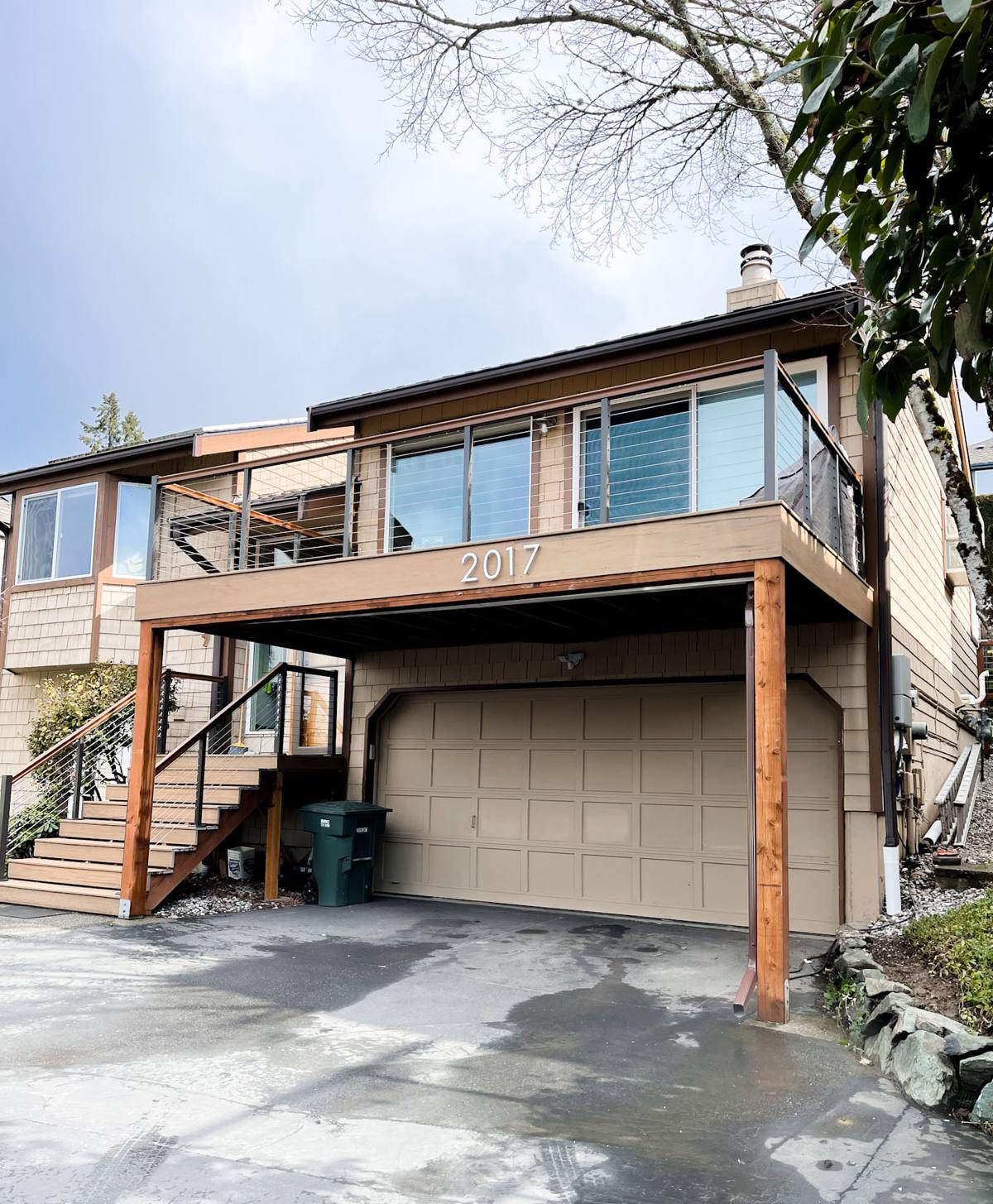
What Driving Rain and Moss Season Actually Do to a Deck
Driving Rain
Rain that falls straight down mostly sheds off a deck surface the way it's supposed to. Rain that comes in sideways — which is common here — gets driven under railings, behind fascia boards, and into the gap between decking boards and the framing beneath them. Over a season or two, that repeated wetting cycle is what rots ledger boards, rusts fasteners, and softens the top of support posts where they meet a beam.
Moss and Organic Growth
Moss doesn't just sit on top of a deck looking bad. It holds moisture against the wood surface long after the rain has stopped, which is exactly the environment that promotes rot and slowly breaks down the wood fibers underneath. On stairs and low-traffic areas of a deck, a moss layer can also turn a plain walking surface into a genuine slipping hazard, which is a safety issue as much as a maintenance one.
Salt Air
Being close enough to the Sound to get salt-laden air in the mix means metal hardware — nails, screws, joist hangers, bolts — corrodes faster than it would inland. A lot of older decks in this area were built with standard galvanized fasteners that were adequate when installed but are now due for an upgrade during any repair.
Signs Your Deck Needs Repair — Not Just a Cleaning
Not every deck problem calls for structural work, and we'd rather tell a homeowner "this is cosmetic, save your money" than sell a repair that isn't needed. Here's how we sort the two apart.
- Soft or springy decking boards — usually means moisture has gotten into the board itself or the joist beneath it.
- Railings that wiggle or flex — often a loose or rotted post base, which is a safety issue, not a cosmetic one.
- Gaps opening up between boards — can be normal seasonal movement, or a sign fasteners are backing out.
- Staining or dark streaking under the deck — points to water tracking through connections that should be sealed or flashed.
- Stair stringers that feel uneven or bouncy — stairs take more repeated stress than the rest of the deck and often show wear first.
- Persistent moss or green film — cosmetic on its own, but a warning sign if it keeps returning in the same spot season after season.
What a Correct Deck Repair Actually Involves
A lot of "deck repair" that gets sold in this region is really just surface work — a board swap here, a coat of stain there — without anyone checking what's happening underneath. A repair that actually holds up starts with the structure, not the finish.
The Substructure Comes First
Before we touch a single decking board, we check the framing: joists, beams, posts, and the ledger board where the deck attaches to the house. The ledger connection is one of the most common failure points on older decks in wet climates, because it's a joint where water collects and it's often out of sight. If the substructure is compromised, resurfacing over it just hides the problem for another season or two.
Fasteners and Hardware
Where a deck was built with standard fasteners, we typically replace them with stainless steel or heavy hot-dip galvanized hardware during a repair, since that's the standard that actually holds up to salt air and years of wet-dry cycling. This matters more here than it does in drier parts of the state.
Decking, Railings, and Stairs
Individual boards, railing components, and stair parts get replaced in kind, matched as closely as possible to the surrounding material. Where wood has rotted, we cut back to solid material rather than patching over soft spots — a repair on top of rot doesn't buy you anything.
Drainage and Airflow
A huge percentage of repeat deck problems trace back to poor drainage or blocked airflow underneath the deck. Part of a correct repair is making sure water has somewhere to go and that the space under the deck isn't trapping moisture against the framing — sometimes that means adjusting flashing, sometimes it means clearing vegetation or debris that's built up underneath over the years.
Deck Materials: How They Hold Up in This Climate
What a deck is built from changes how it ages here, and it changes what a repair should look like. We'll work with whatever material is already on your deck, but it's worth understanding the trade-offs when you're deciding how to repair or partially rebuild.
| Material | How It Ages Locally | Repair Considerations |
|---|---|---|
| Pressure-treated wood | Handles moisture well when properly maintained, but moss and mildew take hold quickly without regular cleaning | Individual board replacement is straightforward and cost-effective |
| Cedar | Naturally resists rot better than most softwoods, but graying and surface checking happen faster in constant damp | Matching weathered cedar color takes time; structural repairs are similar to pressure-treated |
| Composite decking | Resists rot and moss staining on the surface, but the substructure beneath it still needs the same moisture protection | Board replacement requires matching the specific product line; framing repairs underneath are unaffected by the decking material |
| Older/reclaimed wood decks | Most likely to have hidden rot at connection points from years of cumulative moisture exposure | Often need more substructure work than surface work suggests |
We don't push homeowners toward one material over another. Each has a different maintenance burden and a different repair profile, and the right call depends on your budget, how the deck is used, and how much upkeep you want to do going forward.
Our Deck Repair Process
1. On-Site Inspection
We walk the whole deck — surface, railings, stairs, and underneath where we can access it — and check moisture levels in the framing, not just the visible boards. This is where we tell you honestly whether you're looking at a repair or something more extensive.
2. A Written Scope
You get a clear description of what needs to be done, what materials will be used, and roughly what it involves. No vague line items.
3. The Repair Itself
We remove and replace only what's actually damaged, rebuild connections to current hardware standards, and check drainage and airflow while we're already in there. If we find additional rot once we open things up, we stop and talk to you before proceeding — we don't upsell off a surprise.
4. Cleanup and Walkthrough
We clear debris, including any moss or organic material we removed during the repair, and walk the deck with you before we consider the job done.
Repair or Replace? Cost Factors to Weigh
This is the question almost every homeowner asks, and the honest answer is: it depends on how far the damage has spread and how the deck was originally built. Here's what actually drives that decision.
| Factor | Leans Toward Repair | Leans Toward Replacement |
|---|---|---|
| Extent of rot | Isolated to a few boards or one connection point | Spread across multiple joists, the ledger, or several posts |
| Age of the deck | Under 15-20 years, built to a reasonable standard | Original construction is old enough that most components are near end-of-life together |
| Substructure condition | Framing is sound once surface issues are addressed | Framing itself is compromised in multiple areas |
| Code and safety | Current structure meets safety expectations once repaired | Railing height, spacing, or footing depth doesn't meet current standards |
| Budget goals | Extending the deck's life a number of years at lower cost | Wanting a clean start with updated materials and design |
Broadly speaking, targeted repairs run a modest fraction of what a full rebuild costs, but that only holds true if the damage is genuinely limited. Part of our job during the inspection is telling you honestly which category your deck falls into, even when repair is the smaller, less profitable job for us.
Keeping a Repaired Deck From Needing the Same Repair Again
A repair only pays off if the conditions that caused the damage get addressed too. That's especially true in a climate that puts moss, rain, and salt air to work on a deck year-round.
- Clear moss and organic debris off the surface and out of board gaps at least once or twice a year, more often on shaded areas.
- Keep gutters and downspouts near the deck clear so runoff isn't dumping extra water onto or under the structure.
- Trim back vegetation that's shading the deck or blocking airflow underneath — shade and stagnant air are what let moss take hold in the first place.
- Reseal or re-stain wood decking on the manufacturer's recommended schedule, not just when it looks faded.
- Check railings and stair posts for movement once a year — catching a loose post early is a small fix; catching it late can mean replacing the whole post.
- Make sure the area underneath the deck has somewhere for water to drain rather than pooling against posts and framing.
Why Hiring a Crew That Already Works in Sedro-Woolley Matters
Deck repair isn't the same job everywhere in the country, and it isn't even the same job in every part of Washington. A crew that mostly works drier climates east of the mountains, or that's used to a totally different building style, doesn't necessarily know to check the specific connection points that fail first out here, or to spec hardware for salt air and near-constant dampness instead of just whatever's cheapest at the supply house.
Working regularly in Whatcom County means we see the same patterns of wear repeatedly — where moss builds up fastest, which fastener types hold up and which don't, how a deck built in this area typically drains, or fails to. That's the kind of knowledge that comes from doing the work here, season after season, not from a general contracting background applied to a new region.
It also means we're not guessing at timelines around the wet season. We know when moss growth accelerates, when driving rain is most likely to expose weak points, and when it makes sense to schedule a repair before conditions get worse rather than after.
Timing Your Repair Around Sedro-Woolley's Wet Season
Deck repairs can be done for most of the year here, but timing matters. Doing structural work — replacing joists, ledger connections, or posts — during a stretch of heavy, sustained rain makes it harder to get an accurate read on moisture damage and harder to work efficiently. Where the schedule allows, we like to get ahead of the wettest months rather than react to them, since a deck that goes into a long moss season already compromised tends to develop new problems faster than one that's been shored up beforehand.
That said, if you've got a soft board, a wobbly railing, or visible rot right now, waiting for "better weather" usually isn't the right call — those issues tend to get worse, not better, while they sit.
If you're noticing any of the signs above, or you just want an honest read on how much life is left in your deck, we're happy to come take a look. The estimate is free, there's no pressure attached to it, and if the right answer is "this doesn't need much," we'll tell you that too. Use the form below to get started.