 Chuckanut Exterior
 Samish Sits Where the Weather Doesn't Let Up
Homes in Samish take a different kind of beating than houses twenty miles inland. Between the salt-laden air rolling off the water near Chuckanut, the driving rain that comes sideways off Whatcom County storms, and a moss season that seems to stretch longer every year, exterior siding here has to work harder just to look normal. Most siding products aren't built with that combination in mind — they're built for a national average climate, then installed everywhere regardless of what the local weather actually does to them.
That's the gap we address. We install James Hardie fiber cement siding exclusively, and this page is specifically about what that means for a Samish property: what the climate does to siding here, what a correct installation looks like, and why the details matter more in this pocket of Whatcom County than they do in a lot of other places we could work.
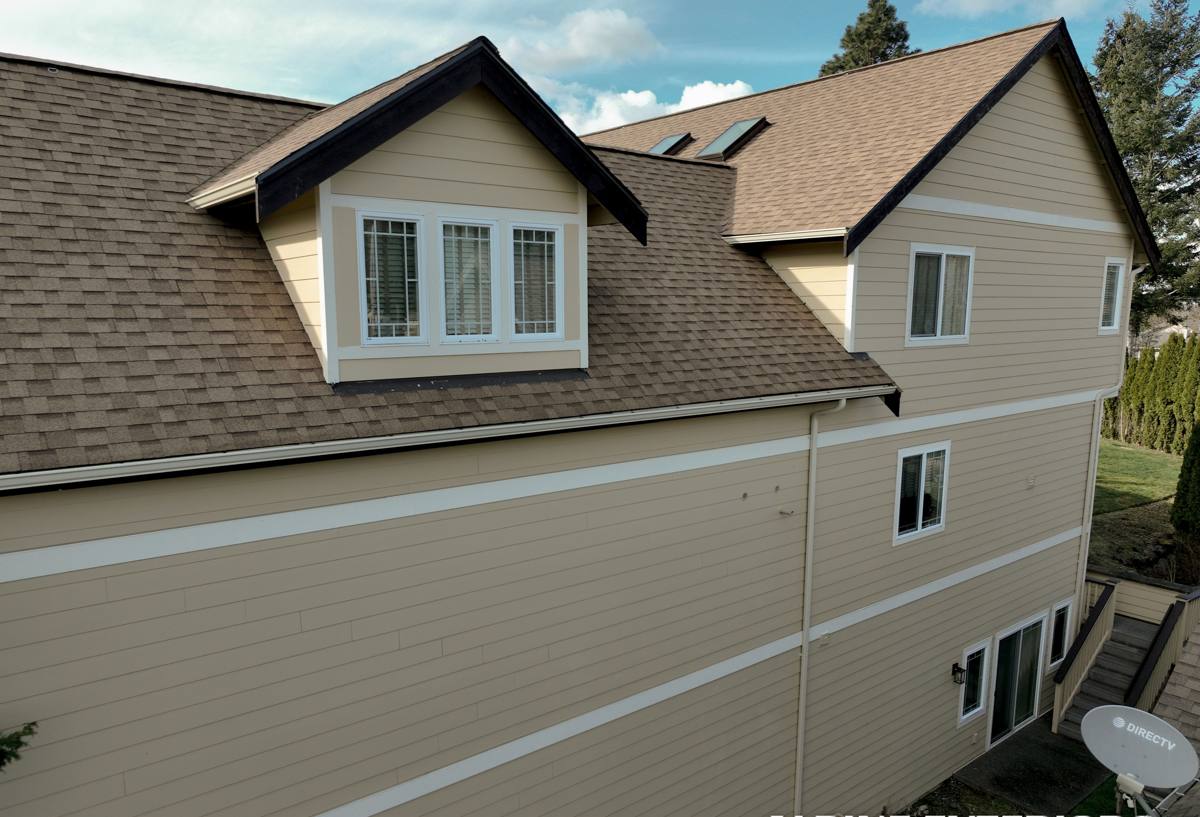
What Salt Air, Rain, and Moss Actually Do to a Home's Exterior
Salt Air
Proximity to saltwater means airborne salt settles on exterior surfaces year-round. Over time it accelerates corrosion of exposed metal fasteners and trim, and it can degrade lower-quality paint finishes faster than manufacturers' published fade ratings would suggest. Materials and finishes that aren't engineered to resist that kind of exposure tend to show it first at fastener heads, corners, and anywhere metal meets the weather.
Driving Rain
Rain that comes in at an angle — which is common in storms moving through this part of Washington — doesn't just wet the face of a wall. It gets pushed into laps, seams, and any gap where flashing or caulking is incomplete. Siding systems that rely heavily on caulk and paint film to stay watertight are the ones most likely to let moisture behind the cladding during these events, which is where real damage starts: not on the surface, but in the wall assembly nobody can see.
Moss and Algae
A long, damp moss season means anything shaded, north-facing, or tucked under tree cover stays wet longer between dry spells. Organic growth on siding isn't just cosmetic — moss and algae hold moisture against the surface, which shortens the life of paint film and, on wood-based products, can contribute to rot at the point of contact.
Why We Standardized on James Hardie for Homes Like These
James Hardie fiber cement is manufactured from cement, sand, and cellulose fiber — not wood or wood by-products. That composition matters directly for the three issues above: it doesn't provide the organic material moss and algae feed on the way wood-based sidings can, it's dimensionally stable so it doesn't swell and crack when it absorbs moisture the way wood or OSB-based products can, and it carries a factory-applied ColorPlus finish that's baked on and warranted against fading in a way field-applied paint isn't.
Hardie also engineers specific product formulations for different climate zones — HZ5 for the wetter, more moderate zones that include the Pacific Northwest. That's a meaningful distinction from a one-size-fits-all siding product, and it's a large part of why we don't install alternatives like vinyl, LP SmartSide, primed spruce, or cedar on homes in this climate. Each of those products has legitimate strengths, but none of them is engineered specifically for sustained damp, salt-influenced, moss-prone conditions the way Hardie's HZ5 line is.
How Different Siding Materials Hold Up in This Climate
| Factor | James Hardie Fiber Cement | Vinyl | Wood / Primed Spruce / Cedar | LP SmartSide (OSB-based) |
|---|---|---|---|---|
| Moss & algae resistance | High — non-organic material | Moderate — can trap moisture behind panels | Low — organic surface, feeds growth | Low to moderate — wood-based core |
| Moisture/swelling behavior | Dimensionally stable when sealed correctly | Stable but seams can let water behind | Prone to swelling, cupping, rot at exposed edges | Prone to edge swelling if coating is compromised |
| Salt-air durability | Strong — factory finish resists fade and chalking | Can become brittle and discolored over time | Requires frequent repainting to hold up | Coating wears faster in coastal exposure |
| Fire performance | Non-combustible core | Combustible, can melt/deform | Combustible | Combustible |
| Typical maintenance | Occasional wash, repaint on a much longer cycle | Low, but cracks/warps aren't repairable | Regular repainting and moisture checks | Coating maintenance to protect the OSB core |
None of this means the other products are junk — vinyl is inexpensive and low-maintenance in mild climates, cedar has real aesthetic appeal, and LP SmartSide has a following for a reason. It means that for the specific combination of salt air, driving rain, and moss that Samish homes deal with, we've made a professional call that Hardie fiber cement is the product that holds up best over the long run, and it's the only one we put our name behind.
What We Typically Find Tearing Off Old Siding in This Area
On older Samish homes, tear-off often reveals problems that were invisible from the street: moisture staining on sheathing behind lap joints that were never properly flashed, soft or delaminated trim at corners and window returns, and moss or algae staining concentrated on shaded north- and west-facing walls. Fastener corrosion is common wherever the wrong fastener material was used for a coastal-influenced environment. None of this is unusual for the climate — it's exactly what you'd expect when a siding system wasn't detailed for sustained damp exposure. It's also why a straightforward re-side sometimes turns into a conversation about sheathing repair once the old material comes off.
What a Correct James Hardie Installation Actually Involves
The siding board itself is only part of the system. On a Samish home, the details around it are what determine whether the wall stays dry for the next several decades:
- Proper clearance from grade and hard surfaces — Hardie's minimum clearances from soil, decks, and pavement keep splash-back moisture off the bottom edge of the siding.
- Correct flashing at every penetration — windows, doors, hose bibs, light fixtures, and roof-to-wall intersections all need flashing detailed to shed water outward, not caulk relied on as the only barrier.
- A functioning weather-resistive barrier and drainage plane — behind the siding, so any moisture that does get past the cladding has somewhere to go.
- Manufacturer-specified fastening — correct fastener type, spacing, and depth; over-driven or corrosion-prone fasteners are one of the most common causes of early siding failure.
- Correct joint and butt-seam treatment — sealed or flashed per Hardie's published details, not just caulked and painted over.
- Field-cut edge sealing — any cut edge of a Hardie board gets sealed with the appropriate primer before installation, protecting the exposed core.
Skip any one of these and the board itself performing well doesn't matter much — water finds the shortcut every time.
Our Process for a Samish Siding Project
1. On-Site Assessment
We walk the exterior, check current siding condition, look at drainage and grading around the foundation, and note any areas with heavy moss, shade, or moisture staining that need special attention.
2. Scope and Estimate
You get a written scope covering tear-off, any sheathing repair anticipated, the specific Hardie product line and profile, color, trim details, and a clear price — no vague allowances.
3. Tear-Off and Substrate Check
Old siding comes off, and we inspect sheathing before anything new goes up. If there's hidden moisture damage, we flag it and address it before closing the wall back up — not after.
4. Installation to Manufacturer Spec
Weather-resistive barrier, flashing, and Hardie boards go on per the details above, with attention to the clearances and fastening that matter most in this climate.
5. Final Walkthrough
We go around the finished exterior together, check trim, caulking lines, and touch-up paint at any field cuts, and make sure everything matches what was scoped.
Choosing the Right Hardie Line and Look for a Samish Property
James Hardie's HZ5 formulation is the baseline we work from in this climate zone. From there, the decision is mostly about the look you want: HardiePlank lap siding is the most common choice for traditional Pacific Northwest home styles, HardieShingle gives a cedar-shake look without the maintenance cedar demands, and HardiePanel works well for modern or mixed-material facades. ColorPlus finishes come in a range of colors baked on at the factory, which matters in a climate where field-applied paint tends to fade and chalk faster than it would somewhere drier — one less repaint cycle to worry about over the life of the siding.
Questions Worth Asking Before You Hire Anyone for This Job
- Are they installing the product to the manufacturer's published details, including flashing and clearance requirements — or just nailing boards to the wall?
- Do they inspect and address sheathing condition before re-siding, or just cover over whatever's underneath?
- Can they explain why they recommend one Hardie product line and profile over another for your specific home?
- Do they carry proper insurance and offer a written workmanship warranty separate from the manufacturer's product warranty?
- Have they worked on homes in Samish or similar Whatcom County coastal-influenced areas before, or is this climate new to them?
Why Local Experience in Samish Specifically Matters
A crew that already works in and around Samish and Chuckanut knows what this climate does to a house before the tear-off even starts — where moisture tends to collect, which sides of a home take the worst of the driving rain, and how much of a head start moss gets on shaded walls here compared to more inland parts of Whatcom County. That's the difference between a generic installation and one that's actually built to hold up where it's going. It also means faster, more realistic scheduling around the wet stretches of the year, since we're not guessing at local weather patterns from somewhere else.
If you're weighing a siding replacement on a Samish home and want a straight answer about what your house needs and what it would take to do the job right with James Hardie siding, we're happy to take a look and put together a free, no-pressure estimate.