 Chuckanut Exterior
 Why Burlington Roofs Wear Out Faster Than the Brochure Says
Most roofing materials are rated for a generic "average" climate that doesn't really exist anywhere in Whatcom County. Homes in and around Burlington deal with a specific combination of stresses: salt-laden air moving in off the water, long stretches of driving rain that gets pushed sideways under normal wind loads, and a moss season that can run most of the year in shaded, north-facing sections of a roof. None of these factors is dramatic on its own, but together they shorten the useful life of a roof system that wasn't detailed correctly for this environment.
Salt air accelerates corrosion on exposed fasteners, flashing, and metal roof panels. Driving rain finds every weak lap, nail pop, and undersized flashing detail and pushes water sideways and upward instead of straight down, which is the condition most roof underlayment and flashing systems are actually designed to resist. And moss doesn't just look bad — it holds moisture against the roofing material, lifts shingle edges, and works its way into fastener penetrations over several seasons. A roof replacement done right in Burlington has to account for all three, not just meet the minimum building code.
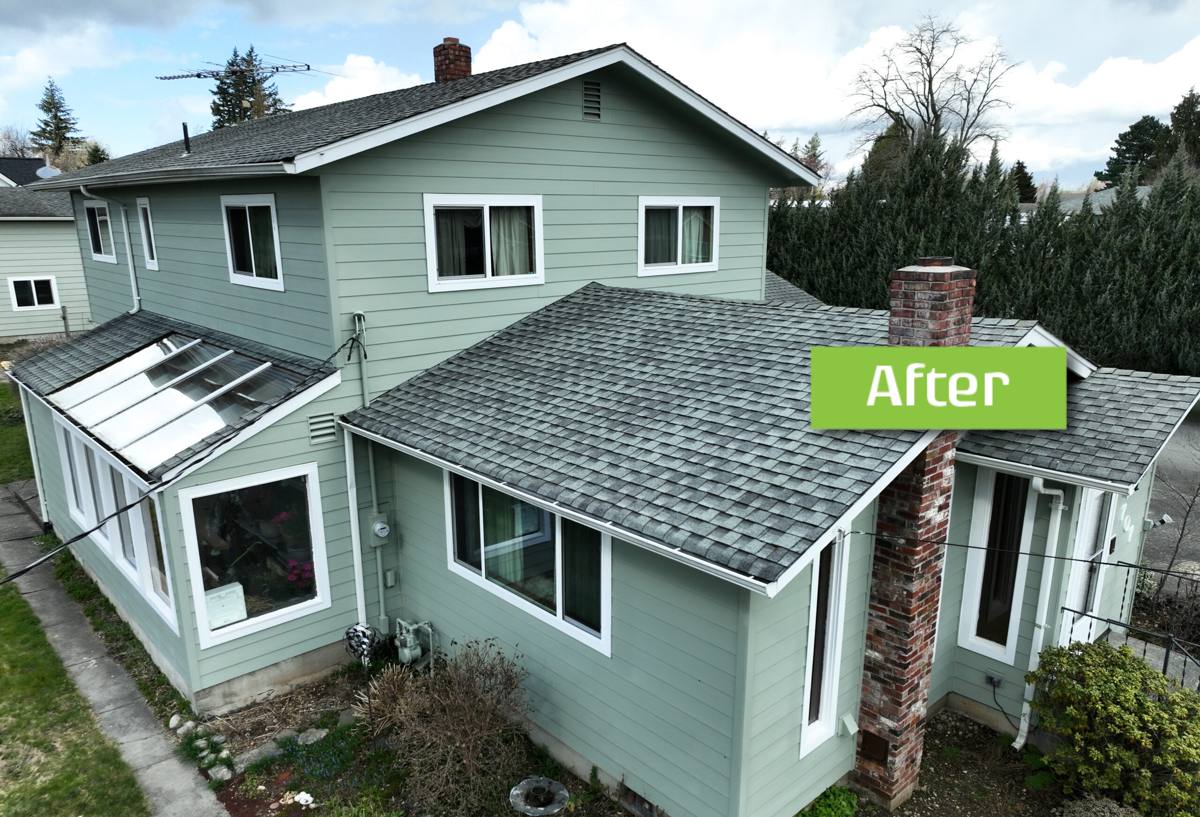
Signs Your Burlington Home Needs a Full Replacement, Not Another Patch
Repair makes sense when the problem is isolated — a damaged flashing detail, a section of blown-off shingles after a windstorm, a single failed boot around a vent pipe. Replacement becomes the honest recommendation when the damage is systemic across the roof, even if it doesn't look that way from the ground.
Ground-Level and Attic Clues Worth Taking Seriously
- Granule buildup in gutters and downspouts, or shingles that look "bald" in patches — a sign the protective surface layer is gone
- Moss or dark streaking that returns within a season or two of cleaning, even after treatment
- Shingle edges that are curling, cupping, or lifting, especially on north- and west-facing slopes
- Daylight visible through the roof deck from inside the attic, or damp insulation after a heavy rain event
- Soft or spongy decking underfoot when walking the roof for an inspection
- A roof that's already had two or more repair visits for the same recurring leak location
- Roofing material that is at or past its manufacturer-rated service life for this climate
If more than one or two of these show up together, patching usually just delays a bigger repair bill rather than solving the underlying problem.
Choosing a Roofing Material That Can Actually Handle This Climate
There isn't one "best" roofing material for every Burlington home — it depends on the roof's exposure, the home's structure, and the homeowner's budget and maintenance appetite. What matters is picking a system honestly, with the trade-offs laid out plainly instead of oversold.
| Material | How It Handles Salt Air & Rain | Moss Resistance | Typical Lifespan Here |
|---|---|---|---|
| Architectural asphalt shingle | Good when paired with proper underlayment and flashing; standard fasteners should be corrosion-resistant | Moderate — benefits from zinc/copper strips on shaded slopes | 20-30 years |
| Standing seam metal | Excellent water shedding on steep slopes; needs marine-grade or coated fasteners near salt exposure | Good — sheds moisture quickly, less surface for moss to grip | 40-50+ years |
| Synthetic/composite shingle | Good; consistent performance in wind-driven rain when installed to spec | Moderate to good, product-dependent | 30-50 years |
| Wood shake | Higher maintenance burden in this climate; absorbs and holds moisture longer | Poor without regular treatment and cleaning | Varies widely with upkeep |
We don't push wood shake on Burlington roofs as a first recommendation, not because it can't be made to work, but because the maintenance schedule required to keep it moss-free and moisture-tight in this climate is a real, ongoing cost that a lot of homeowners underestimate. If a homeowner wants that look and understands the upkeep, we'll install it correctly and explain the maintenance plan up front.
Underlayment Matters as Much as the Surface Material
In driving rain, water gets pushed under the primary roofing surface more often than people expect, especially at eaves, valleys, and low-slope transitions. A synthetic underlayment with taped seams, plus self-adhered ice-and-water membrane at eaves, valleys, and roof penetrations, is what actually keeps water out when wind pushes rain sideways under the shingles — the surface material alone can't do that job.
What a Correct Roof Replacement Actually Involves
Full Tear-Off and Deck Inspection
We remove the existing roofing down to the deck rather than layering over it. This lets us actually see the condition of the sheathing — soft, delaminated, or water-stained plywood gets replaced before new roofing goes down, not covered up. Skipping this step is one of the most common shortcuts that leads to premature failure.
Flashing and Penetration Details
Chimneys, skylights, vent pipes, and wall-to-roof transitions are where most leaks actually start, not in the open field of the roof. Correct step flashing, counter-flashing, and sealed penetrations matter more in a driving-rain climate than almost anything else in the job.
Ventilation
A roof deck that can't breathe traps moisture underneath the roofing material, which speeds up rot and gives moss and algae a damp surface to establish on. Balanced intake (soffit) and exhaust (ridge) ventilation keeps the deck drier year-round and is part of getting full service life out of whatever material is installed.
Our Roof Replacement Process
- On-site inspection of the roof, decking, flashing, and ventilation, with photos and a plain-language explanation of what we find
- Written estimate that separates material cost, labor, and any decking repair as a line item — no lump-sum guessing
- Material selection conversation based on the roof's exposure, the home's style, and the homeowner's budget and maintenance preference
- Scheduling around Whatcom County's weather windows so tear-off and dry-in happen with the roof never left exposed overnight
- Full tear-off, deck repair as needed, underlayment, flashing, and installation to manufacturer specification
- Site cleanup, including a magnetic sweep for stray fasteners, and a final walkthrough with the homeowner
- Warranty paperwork explained clearly — what's covered by the manufacturer versus what's covered by our workmanship warranty
Moss, Moisture, and Long-Term Roof Health
A new roof in Burlington isn't moss-proof on its own — moss is a function of shade, moisture, and organic debris (needles, leaves) sitting on the surface long enough to take root. What a correct installation can do is remove the conditions that let moss get a foothold fast: proper ventilation to keep the deck dry, zinc or copper strips near the ridge on shaded slopes where appropriate, and a roof design that sheds debris instead of trapping it in valleys and behind chimneys.
After installation, the biggest factor in long-term roof health is simple maintenance: keeping gutters clear so water doesn't back up under the roof edge, and keeping debris off the surface before it decomposes into the kind of organic mat moss thrives on. We'll walk through what that maintenance actually looks like for the specific roof we install, since it's different for a steep metal roof than it is for a low-slope shingle roof under trees.
Why Hiring a Crew That Already Works Burlington Matters
Roofing crews that mostly work inland or in drier parts of the state tend to under-detail for wind-driven rain, because it's not the condition they build for every day. A crew that regularly works roofs in and around Burlington and the broader Chuckanut area already knows which flashing details actually hold up here, which fastener grades resist corrosion near salt air, and where moss tends to establish first on local roof geometries — that's knowledge you only get from doing the work locally, season after season, not from a training manual written for a different climate.
There's also a practical side: local crews know local permitting requirements, have working relationships with area material suppliers so replacement jobs aren't held up waiting on special orders, and can respond quickly if weather changes mid-project — something that matters a lot when a roof is open during a tear-off.
Cost Factors for a Burlington Roof Replacement
Every roof is priced individually after an on-site inspection, but the factors below are what actually move the number up or down. We'd rather explain these honestly up front than hand over a number that doesn't hold up once we're on the roof.
| Factor | Why It Affects Cost |
|---|---|
| Roof pitch and complexity | Steep slopes and multiple valleys/dormers take more labor time and safety setup |
| Decking condition | Soft or water-damaged sheathing found during tear-off requires replacement before re-roofing |
| Material choice | Asphalt, synthetic, and metal systems carry different material and installation costs |
| Roof size and layout | Total square footage and the number of penetrations (chimneys, skylights, vents) affect labor |
| Ventilation upgrades | Adding or correcting intake/exhaust ventilation is often worth doing during a full tear-off |
| Access and site conditions | Steep lots, limited driveway access, or overhead lines can affect equipment and staging |
A Homeowner's Pre-Hire Checklist
Whoever you hire for a roof replacement in Burlington, these are reasonable things to ask for and expect before signing anything:
- A written estimate that itemizes material, labor, and any decking repair separately
- Proof of current licensing, bonding, and insurance for Washington State
- A clear explanation of what underlayment and flashing system will be used, not just the visible shingle or panel brand
- A plan for what happens if weather turns mid-project and the roof deck is exposed
- A written workmanship warranty in addition to the manufacturer's material warranty
- References or examples of similar roofs the crew has completed in the local area
- A clear cleanup and fastener-sweep commitment as part of the job, not an optional add-on
If your Burlington roof is showing its age or you just want an honest read on what shape it's really in, we're happy to take a look. Estimates are free, there's no pressure, and you'll get a plain-language explanation of what we find — use the form below to get started.