 Chuckanut Exterior
 Siding Built for the Mount Vernon Stretch of Whatcom County
Homes in the Mount Vernon area sit in one of the tougher climate zones for exterior materials in western Washington. You've got salt-laden air moving in off the water, driving rain that comes in sideways during fall and winter storms, and a moss season that can stretch for months where anything shaded or north-facing stays damp far longer than it should. None of that is dramatic on its own, but stacked together year after year, it's exactly the combination that wears out the wrong siding material faster than most homeowners expect.
We're a local crew that works this part of Whatcom County regularly, and Mount Vernon has its own personality when it comes to siding failure. We see it in the same spots on house after house: north walls that never fully dry out, lower courses that take the brunt of splashback and road spray, and trim details that were caulked instead of properly flashed. This page is about what siding replacement actually looks like for a home in this area — the real failure points, what correct work involves, and why the material choice matters as much as the installation.
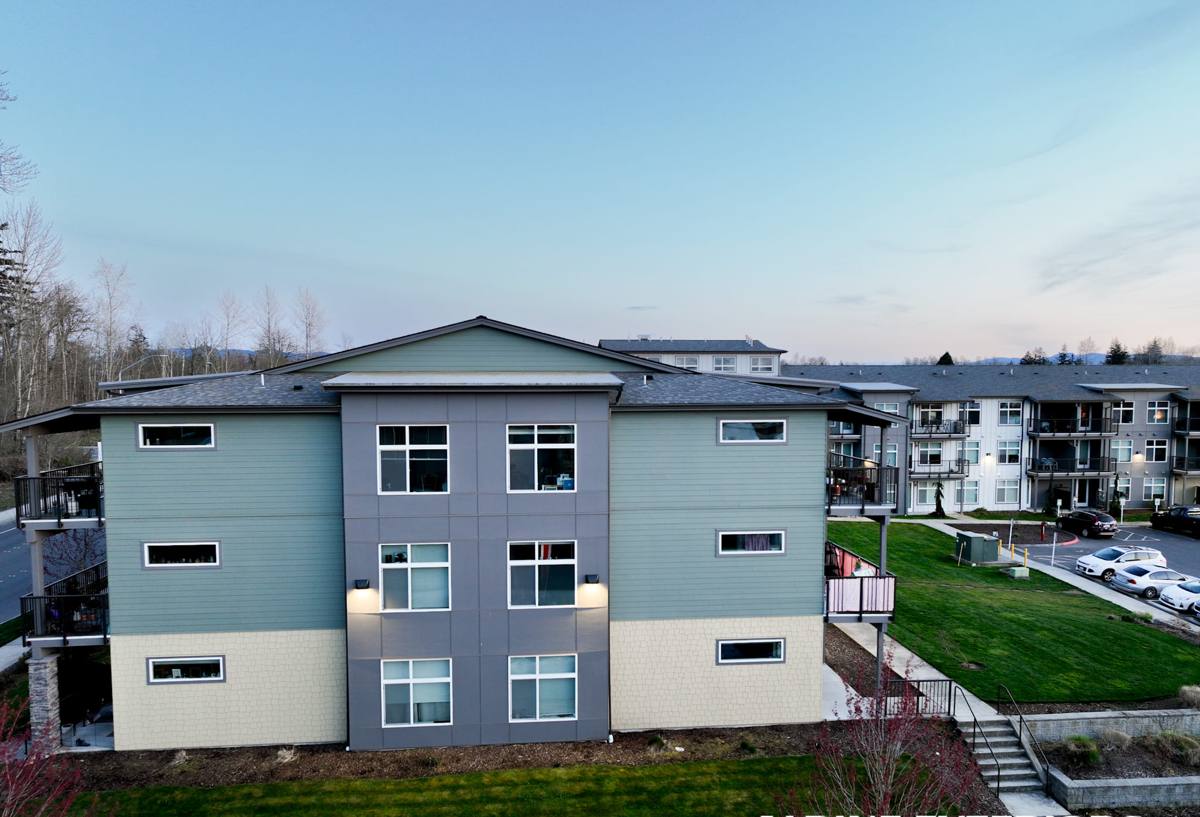
What Salt Air, Driving Rain, and Moss Season Actually Do to Siding
Salt Air
Salt-laden moisture is corrosive and hygroscopic — it pulls moisture out of the air and holds it against a surface longer than plain rain would. On metal fasteners, trim, and flashing, that means accelerated corrosion if the wrong hardware was used. On wood-based siding products, it means the surface stays wetter, longer, which speeds up swelling, checking, and paint failure.
Driving Rain
Wind-driven rain doesn't just wet a wall — it forces water sideways and upward, testing every seam, lap, and penetration on a home's exterior. A siding system with tight, well-lapped joints and correctly flashed windows and doors sheds that water. A system with gaps, caulk-only seams, or poor drainage behind the cladding lets water track behind the siding, where it can sit against sheathing for weeks between dry spells.
Moss Season
Shaded walls, roof lines that shed onto siding, and long stretches of overcast, damp weather all add up to extended moss and algae growth on anything that stays wet. Moss holds moisture against a surface almost like a sponge. On materials that absorb water or don't tolerate sustained dampness well, that's a slow, steady path to rot, delamination, or coating failure — usually starting on the north and west-facing walls first.
Signs a Mount Vernon Home Needs Siding Replacement, Not Another Repair
Not every siding problem means a full replacement, but in this climate, patch jobs on tired siding tend to be short-term fixes. Here's what tells us a home has crossed the line from "repairable" to "replace it right":
- Soft or spongy spots when you press on the siding, especially near the bottom courses or below window sills
- Paint that keeps failing in the same spots within a year or two of repainting
- Visible warping, buckling, or boards pulling away from the wall
- Persistent moss or dark staining that comes back within a season of cleaning
- Gaps or separation at seams and corners that let daylight or drafts through
- Multiple past repairs concentrated on the same wall or elevation
If you're seeing two or more of these on the same home, that's usually a sign the siding system itself — not just a section of it — has reached the end of its usable life for this climate.
Why We Only Install James Hardie Fiber Cement
We standardized on James Hardie siding and don't install vinyl, LP SmartSide, Cemplank, Allura, or primed wood products. That's not a marketing position — it's a decision based on what actually holds up under sustained coastal-adjacent moisture exposure without ongoing maintenance headaches.
Hardie's fiber cement is non-combustible and dimensionally stable, meaning it doesn't swell, split, or absorb water the way wood-based or wood-fiber composite products can. For a climate defined by driving rain and long damp stretches, that stability matters more than almost any other single property. Hardie also engineers specific product lines for different climate zones — the HZ5 formulation is built for regions with more freeze-thaw cycling and moisture exposure, which fits this part of Washington better than a generic, one-size-fits-all product.
The factory-applied ColorPlus finish is another piece of it. Instead of field-painted siding that's only as good as the prep and paint job on installation day, ColorPlus is baked on in a controlled environment and backed by its own finish warranty. In a climate where paint failure is one of the most common complaints we hear about older siding, that matters. Hardie also backs its products with a strong transferable warranty, which carries real value if the home is ever sold.
| Factor | James Hardie Fiber Cement | Vinyl | Wood / Engineered Wood |
|---|---|---|---|
| Moisture absorption | Very low, dimensionally stable | Doesn't absorb, but expands/contracts with heat | Absorbs moisture, prone to swelling |
| Performance in driving rain | Strong when correctly lapped and flashed | Adequate, but seams and panels can flex loose over time | Weak point if any coating or sealant fails |
| Moss / algae resistance | Doesn't feed growth; cleans without damage | Doesn't feed growth; can crack when cleaned aggressively | Can trap moisture under growth, accelerating rot |
| Finish longevity | Factory ColorPlus finish, long warranty | Color molded in, but fades and chalks over time | Field-applied paint, needs repainting cycles |
| Fire resistance | Non-combustible | Combustible, can melt/warp near heat sources | Combustible |
What a Correct Siding Replacement Involves
The material is only half the equation. We see plenty of Hardie siding installed poorly, and it fails in the same ways bad vinyl or wood siding does — just slower. A correct replacement in this climate means:
Water Management Behind the Siding
A proper weather-resistant barrier and drainage plane behind the cladding, so any moisture that does get past the siding has somewhere to go instead of sitting against the sheathing. This is the layer most homeowners never see and most corner-cutting crews skip or rush.
Flashing, Not Just Caulk
Windows, doors, and any wall penetrations need proper metal or membrane flashing that directs water outward and downward. Caulk is a supplement to good flashing, not a replacement for it — caulk-only details are one of the most common failure points we find on tear-offs.
Correct Fastening and Clearances
Hardie specifies fastener type, spacing, and minimum ground and roof clearances for a reason — get those wrong and you introduce moisture paths or premature corrosion, especially with salt air in the mix. We follow manufacturer installation specs, not shortcuts, because that's also what keeps the product warranty valid.
Proper Lap and Joint Treatment
Butt joints, corners, and laps all need to be treated correctly for both water shedding and long-term movement. Sloppy joint work is often invisible at first and shows up as staining or gaps a year or two later.
Our Process for Mount Vernon-Area Homes
- Walk-through and assessment — we look at every elevation, note moisture and moss patterns, and check for hidden damage around windows, corners, and the bottom courses
- Honest scope — we tell you what actually needs replacement versus what can wait, and explain any sheathing or framing repair needed underneath
- Product and color selection — matched to your home and the specific exposure of each wall, since north and south sides often face different conditions
- Tear-off and inspection — old siding comes off and we inspect the wall assembly before anything new goes up
- Water-resistant barrier and flashing installation — done to spec, not shortcuts, before a single piece of siding goes on
- Hardie installation — fastened, lapped, and clearanced per manufacturer specification
- Final walk-through — we go over the finished work with you before calling the job done
Why a Local Crew Matters for This Job
Siding replacement isn't just a product installed by any licensed contractor — the details that matter most are the ones tuned to the site conditions. A crew that regularly works homes in the Mount Vernon area already knows which walls in this region tend to hold moisture longest, how much rain-driving wind exposure to plan flashing for, and how aggressive the moss growth gets on shaded elevations. That's knowledge you don't get from a general spec sheet — it comes from doing the work here, repeatedly, and seeing what holds up and what doesn't over multiple seasons.
It also means we're not disappearing after the job is done. Warranty support, follow-up questions, and any future exterior work are easier with a contractor who's local and has a track record in the same neighborhoods, not a crew that drove in from out of the area for one job.
Questions to Ask Before Hiring a Siding Contractor
- Do they install to the manufacturer's written installation specifications, or their own shortcuts?
- Will they inspect and repair damaged sheathing before installing new siding, not just cover it up?
- Do they use proper flashing details at windows, doors, and penetrations — not caulk alone?
- Can they explain why they chose the specific product line and finish for your home's exposure?
- Is their work backed by both a manufacturer warranty and their own labor warranty?
- Do they have experience with homes in this specific climate and area, not just siding in general?
Cost Factors for Siding Replacement in This Area
Every home is different, but the same handful of factors tend to drive cost up or down on Mount Vernon-area siding projects:
| Factor | Why It Affects Cost |
|---|---|
| Extent of hidden sheathing/framing damage | Rot from long-term moisture intrusion often isn't visible until tear-off begins |
| Home size and wall complexity | More corners, gables, and trim details mean more labor and material |
| Number of stories and access | Second-story and steep-site work requires more staging and time |
| Product line and finish selection | Panel versus lap siding, and standard versus premium ColorPlus finishes, vary in cost |
| Trim and accessory scope | Fascia, soffit, and trim replacement alongside siding adds to the overall project |
We give straightforward, itemized estimates after an actual walk-through — not a phone-quoted number based on square footage alone, since the hidden condition of the wall assembly is often the biggest cost variable.
If your Mount Vernon-area home is showing signs of siding wear — soft spots, recurring moss, failing paint, or gaps at the seams — we're happy to take a look. We offer free, no-pressure estimates, and there's a form below to get started.