 Chuckanut Exterior
 Siding Installation Built for the Mount Vernon Climate
Mount Vernon sits in the Skagit Valley, close enough to Puget Sound and the surrounding wetlands that homes here deal with a specific combination of weather stress: salt-tinged marine air moving in off the water, long stretches of driving rain through fall and winter, and a moss season that can run most of the year on shaded or north-facing walls. None of these things are dramatic on their own. What they do over time, quietly, is find every weak point in a home's siding system — a gap in the caulking, a fastener that wasn't set right, a butt joint that wasn't flashed. A siding installation that's correct for a dry inland climate is not automatically correct for a house a few miles from tidal water in this valley.
When we install siding on a Mount Vernon home, we're not just attaching a new exterior finish. We're building a moisture-management system: a water-resistive barrier, flashing at every penetration and horizontal joint, correct fastening, and a cladding material that can take repeated wet-dry cycles without breaking down. Get any one of those wrong and the siding might look fine for a year or two before problems start showing up underneath, where you can't see them until they're expensive.
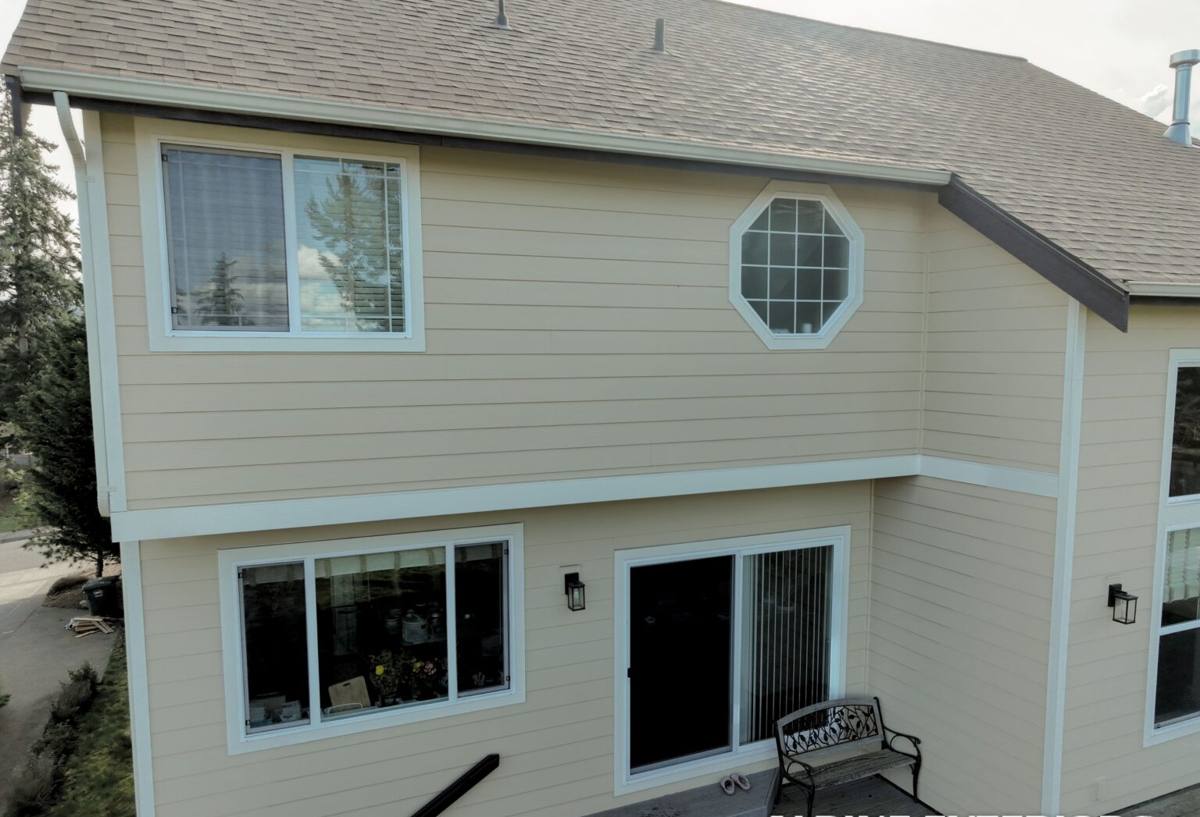
What Salt Air and Driving Rain Actually Do to Siding
It helps to understand the mechanics of what local homes are up against, because it explains why we make the material and installation choices we do.
Salt-laden air
Airborne salt is corrosive to exposed metal fasteners, trim flashing, and hardware. It also holds moisture against surfaces longer than dry inland air does, which slows drying time after every rain event. Siding materials and fasteners that aren't rated for coastal-adjacent exposure can corrode or fail years ahead of schedule.
Driving, wind-driven rain
Rain that comes in at an angle — common during Skagit Valley storm systems — doesn't just run down a wall, it pushes into laps, joints, and penetrations. A siding system depends on overlaps, flashing, and a drainage plane behind the cladding to handle that water. If the water-resistive barrier is torn, taped wrong, or missing behind a window or door, wind-driven rain will find that gap.
Extended moss and mildew season
Shaded walls, tree cover, and consistently damp conditions give moss, algae, and mildew a long runway to establish themselves on a home's exterior. Beyond looking bad, sustained organic growth holds moisture against the siding surface and can accelerate degradation of materials that aren't built to resist it.
Why We Install James Hardie Fiber Cement — and Nothing Else
We standardized on James Hardie fiber cement siding exclusively. We don't install vinyl, LP SmartSide, Cemplank, Allura, or unfinished cedar or spruce siding, and we're upfront about why: in a climate like this one, the material matters as much as the installation.
- Non-combustible core. Fiber cement doesn't feed a fire the way wood-based products can, which matters for insurance and long-term peace of mind.
- Engineered for wet climates. James Hardie makes climate-specific HZ5 product lines designed for regions with sustained moisture exposure, which fits the Pacific Northwest better than a one-size-fits-all product.
- Factory-applied ColorPlus finish. The finish is baked on at the factory under controlled conditions, which holds up better against UV and moisture cycling than field-applied paint, and it comes with its own finish warranty.
- Dimensionally stable. Fiber cement doesn't swell, warp, or rot the way wood-based siding can when it takes on repeated moisture.
- Strong transferable warranty. When installed to manufacturer spec, Hardie backs the product with a warranty that can transfer to a future homeowner — a real factor when it's time to sell.
We're not going to pretend other products don't have their place. Vinyl is inexpensive and low-maintenance in the right setting. Cedar has real curb appeal for the right buyer who's willing to keep up with staining and sealing. What we won't do is put a product on a Mount Vernon home that we don't believe holds up to salt air, driving rain, and a long moss season over the long haul — and cedar's ongoing maintenance burden and vinyl's seam and impact vulnerabilities are exactly the kind of trade-offs that don't show up until years two through ten.
What a Correct Installation Actually Involves
The siding material is only part of the equation. Most premature siding failures we've seen trace back to installation shortcuts, not the product itself. Here's what we consider non-negotiable on every job:
1. Tear-off and substrate inspection
We remove the old siding and inspect the sheathing underneath for rot, soft spots, or prior water damage before anything new goes on. Covering up a compromised substrate just hides the problem for a while.
2. Water-resistive barrier
A continuous, properly lapped and taped weather barrier goes on before the siding. This is the layer that actually keeps bulk water out if anything gets past the cladding — and it's the layer that's easiest to shortcut when a crew is moving fast.
3. Flashing at every penetration
Windows, doors, hose bibs, vents, light fixtures, and every horizontal trim board get flashed so water sheds outward instead of tracking behind the siding. This is the single most common failure point we find on older installations in this region.
4. Correct fastening
James Hardie specifies fastener type, spacing, and placement for a reason — proper fastening keeps panels performing as designed through wind events and temperature swings, and corrosion-resistant fasteners matter more here given the salt exposure.
5. Proper clearances
Siding needs a gap above roof lines, decks, and grade so it isn't sitting in standing water or snow. We follow manufacturer clearance specs even when it means a little extra trim work.
6. Caulking and joint treatment
Butt joints, corners, and trim transitions get sealed with the right products in the right places — not everywhere, since over-caulking can trap moisture just as easily as under-caulking can let it in.
Our Process for Mount Vernon Homes
| Stage | What Happens |
|---|---|
| Estimate & Inspection | We walk the exterior, check existing siding and trim condition, and talk through material and color options. |
| Detailed Scope | Written scope covering tear-off, substrate repair allowances, flashing details, and the specific Hardie product line and color. |
| Prep & Protection | Landscaping, windows, and walkways are protected before tear-off begins. |
| Tear-Off & Substrate Check | Old siding comes off; sheathing is inspected and any damage is addressed before moving forward. |
| Weather Barrier & Flashing | Continuous water-resistive barrier and flashing installed at every penetration and joint. |
| Siding Installation | Hardie panels or lap siding installed to manufacturer fastening and clearance specs. |
| Trim, Caulk & Paint Touch-Up | Trim details finished, joints sealed appropriately, factory finish inspected and touched up where needed. |
| Final Walkthrough | We walk the finished exterior with the homeowner before calling the job done. |
Why Local Experience Matters for This Job
Siding installation isn't a job you can do the same way everywhere and expect the same result. A crew that mostly works dry, low-moisture regions may not think twice about flashing details that are critical here, or may not be as careful about fastener corrosion resistance because it's never bitten them before. A crew that already works Mount Vernon and the surrounding Skagit Valley knows which walls take the worst wind-driven rain, understands how much shade and moss exposure a given lot is likely to get, and builds those realities into the installation from the start rather than learning them the hard way on your house.
There's also a practical service side to this. A local crew is easier to reach for a warranty question, a follow-up caulking touch-up, or a look at a trim detail a few years down the road. That kind of accountability matters more with an exterior product that's meant to last decades.
Signs Your Current Siding Is Struggling With This Climate
If you're weighing whether it's time to replace rather than repair, these are the signs worth taking seriously in this climate:
- Persistent moss or algae growth that returns quickly after cleaning
- Soft or spongy spots when you press on the siding, especially near the bottom courses
- Paint that's peeling, bubbling, or failing faster than it should
- Visible gaps, warping, or cupping in boards or panels
- Staining or discoloration around window and door trim
- Corroded or rust-streaked fasteners visible on the surface
- A musty smell near exterior walls inside the home
Any one of these on its own might just need a repair. Several together, or signs that keep coming back after cleaning and touch-up, usually mean the underlying system — not just the surface — is losing the fight against the climate.
Cost Factors Homeowners Should Understand
We don't post fixed prices because every home is different, but the factors that actually move the number are consistent. Understanding them helps you evaluate any estimate you get, including ours.
| Factor | Why It Matters |
|---|---|
| Home size and wall complexity | More square footage and more corners, gables, and dormers mean more material and labor time. |
| Substrate condition | Rot or water damage found during tear-off adds repair scope that can't always be predicted until the old siding is off. |
| Hardie product line and profile | Lap siding, panel siding, and shingle-style profiles carry different material and labor costs. |
| Trim scope | Full trim replacement versus reusing sound existing trim changes both cost and long-term performance. |
| Access and site conditions | Steep lots, tight setbacks, or limited equipment access can affect labor time. |
We walk through all of this during the estimate so you understand exactly what's driving the number before you commit to anything.
What to Expect During the Estimate Visit
When we come out to look at a Mount Vernon home, we're checking more than just square footage. We look at how much sun and shade each wall gets, whether there's existing moss or moisture staining, the condition of the trim and existing flashing, and any drainage issues around the foundation that could affect the new siding's performance. We'll talk through Hardie product options, colors, and profiles that fit both the home's style and its actual sun and weather exposure, and we'll give you a straightforward, written scope — not a vague ballpark.
If you're weighing a siding replacement for a home in the Mount Vernon area, we're happy to come take a look and give you an honest read on what your exterior actually needs. Reach out for a free, no-pressure estimate using the form below.