 Chuckanut Exterior
 New-Construction Windows Are a Different Job Than Replacement
Installing windows into a home that's still under frame is not the same trade as swapping out an old window in a finished wall. On a new build, the window is going into a rough opening that hasn't been tested by weather yet, there's no old flashing to learn from or correct, and every layer — sheathing, weather-resistive barrier, flashing, window, trim — has to be built up in the right order the first time. Get that sequence wrong on a new-construction project and you don't find out until years later, when water has already worked its way behind the siding.
For homes going up in and around Mount Vernon, that sequencing matters more than in drier parts of the state. This is a wet corner of Washington, with long stretches of driving rain, persistent damp air, and a moss season that runs most of the year on anything shaded or north-facing. A window install that's "close enough" in a dry climate is a callback waiting to happen here.
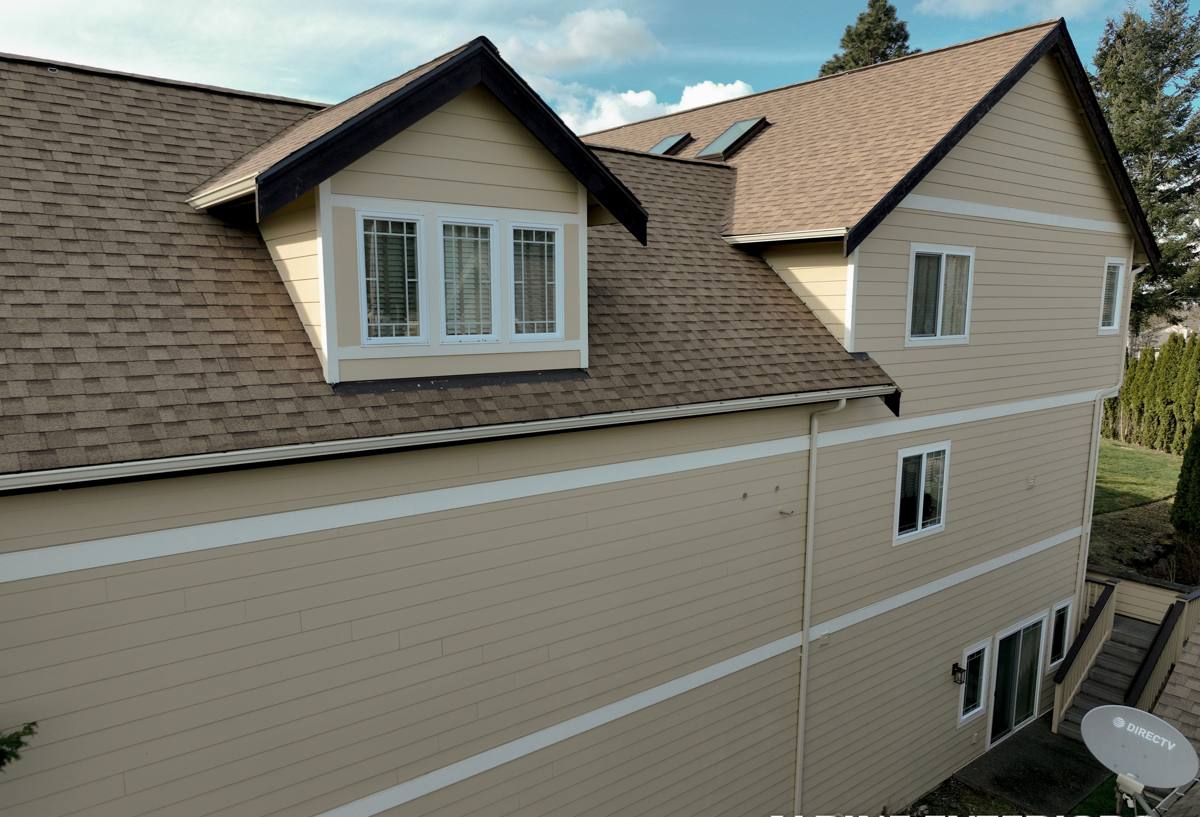
What This Climate Demands From a Window Install
Three things define window performance in this region, and all three trace back to how the window is installed, not just what brand it is.
Driving rain
Wind-driven rain doesn't just hit a window head-on — it gets pushed sideways and upward under trim, behind casing, and into any gap in the water-resistive barrier. A window that's flashed correctly sheds that water back out. One that isn't will let it track down inside the wall cavity, often silently, for months before anyone notices a stain or soft spot.
Sustained dampness and moss
Even when it's not actively raining, the air here stays damp for long stretches, and anything shaded — a north wall, an eave overhang, a fence line — grows moss and algae faster than in sunnier climates. That growth holds moisture against wood trim and caulked joints, which accelerates rot at exactly the seams a window depends on to stay sealed.
Salt-tinged coastal air
Being close to Puget Sound and the Salish Sea means fasteners, hinges, and exposed hardware corrode faster than they would inland. That's a material-selection issue as much as an installation one — the right window and the right fastener spec save a homeowner a hardware replacement job a decade down the road.
Window Materials We Work With
There's no single "best" window material — the right call depends on budget, the home's design, and how exposed the elevation is to weather. Here's how the common options stack up for a new build in this climate:
| Material | Moisture/rot resistance | Coastal air performance | Typical cost position |
|---|---|---|---|
| Vinyl | Very good — won't rot, some flex in temperature swings | Good; no corrosion on the frame itself | Lower to mid |
| Fiberglass | Excellent — dimensionally stable, doesn't absorb moisture | Excellent; holds up well near salt air | Mid to upper |
| Wood-clad (aluminum or vinyl exterior cladding) | Good if cladding and flashing details are correct; interior wood needs protection from condensation | Good on the exterior face; interior wood is the vulnerable point | Upper |
| Aluminum | Fair — conducts cold, prone to condensation without thermal breaks | Needs a good finish system to resist salt corrosion long-term | Varies widely |
Whatever material a homeowner or builder chooses, we'll flag when a product isn't a great fit for a given elevation — for example, a heavily shaded north wall that stays damp most of the year is not where we'd push a bare-wood interior finish without a solid vapor and condensation control plan.
The Flashing and Moisture Barrier Work That Actually Determines Longevity
The window itself is often the easy part. What separates a window that lasts decades from one that causes a rot problem is the sequence of materials around it:
- A sloped sill pan flashing under the window, so any water that gets past the frame drains back out instead of sitting on the rough sill
- Proper shingle-lap order — sill pan first, then jamb flashing, then the window, then head flashing last, so every layer overlaps the one below it the way water actually flows
- Continuous, correctly lapped weather-resistive barrier tied into the flashing, not just stapled around the opening
- Sealant used only where it belongs — at the right joints, not as a substitute for correct flashing order
- Backer rod and sealant at the interior air seal, separate from the exterior water management layer
- Corrosion-resistant fasteners at every point exposed to the exterior, given the coastal air here
None of this is visible once siding and trim go on. It's also exactly what an inspector, an insurance adjuster, or a future buyer's inspector will never fully verify — which is why the installing crew's discipline matters more than any warranty paperwork.
How Our Process Works With Your Builder
On new construction, we're one trade in a sequence, and timing matters. Our typical process:
- Plan review — we look at window schedules, rough opening sizes, and elevations before framing is finalized, so any sizing or product conflicts get caught early.
- Rough opening check — we verify openings are square, plumb, and sized correctly before we ever set a window, and flag framing issues back to the GC rather than forcing a window into a bad opening.
- Flashing and WRB integration — we install sill pans, jamb flashing, and tie the window into the weather-resistive barrier in the correct order, coordinating with whoever is running house wrap so there's no gap in responsibility.
- Window set and air seal — windows are set plumb, level, and square, shimmed correctly, and air-sealed at the interior before insulation and drywall close the wall up.
- Final trim and exterior detailing — head flashing, trim, and any exterior caulking go in last, over a wall that's already protected underneath.
Because this happens mid-construction, scheduling flexibility matters — framing crews run behind or ahead of plan constantly, and we build that into how we book new-construction work rather than treating it like a fixed-date service call.
Energy Code and Performance Considerations
Washington's energy code sets minimum performance requirements for new-construction windows, and in a marine climate like this one, U-factor (how well the window resists heat loss) tends to matter more day-to-day than solar heat gain coefficient, since sunny, high-heat-gain days are the exception here rather than the rule. We help builders and homeowners pick glass packages that meet code without over-specifying (and over-paying) for solar control performance the climate doesn't demand.
Condensation resistance is the other practical factor. Cold, damp winters push interior humidity to condense on window glass and frames if the window's thermal performance or the home's ventilation isn't matched well — something to plan for at the design stage, not after move-in.
Mistakes We See on New Builds in This Area
Most window problems we're called back to fix on newer homes trace to a handful of recurring issues: sill pans skipped or installed flat instead of sloped, house wrap taped over the flashing instead of under it, reversing the correct shingle-lap order, sealant used to "fix" a gap that should have been flashed instead, and standard fasteners used where corrosion-resistant ones were needed. None of these show up on a walkthrough. All of them show up in a wall five or ten years later.
Why a Crew That Already Works Mount Vernon Matters
A window crew that mostly works drier inland areas will often default to a lighter flashing detail than this climate needs, because it's what usually gets by elsewhere. A crew that regularly works Mount Vernon builds already knows which elevations catch the worst of the driving rain, which details actually hold up through a full wet season, and where moss and algae growth on shaded walls tends to accelerate wear on trim and seals. That local pattern recognition is hard to replace with a spec sheet, and it's the difference between a window install that's technically to code and one that's actually built for how this area weathers.
What to Check After Move-In
- Inspect exterior caulking and trim seams once a year, especially before the wet season
- Watch for moss or algae buildup on sills and trim, and clean it off before it holds moisture against wood or paint
- Check interior sills and frames for condensation buildup during cold snaps
- Make sure gutters and downspouts near window headers are draining away from the wall, not overflowing onto it
- Report any soft spots, staining, or peeling paint around a window promptly — early moisture problems are cheap to fix, late ones aren't
If you're building or framing a home in the Mount Vernon area and want windows installed the way this climate actually requires, we're happy to walk the plans with you and give a free, no-pressure estimate — just fill out the form below.