 Chuckanut Exterior
 Mount Vernon sits in the Skagit Valley, low and open to the weather systems that move in off Puget Sound and Skagit Bay. Homes here take a steady beating from three things at once: salt-tinged marine air working on any exposed metal, wind-driven rain that gets pushed under roof edges instead of just running off, and a moss season that runs long because the valley doesn't dry out between storms the way an inland area would. Metal roofing is one of the better answers to that combination, but only when it's specified and installed correctly for this specific climate. This page covers what that actually looks like for a Mount Vernon home.
Why Metal Roofing Fits Mount Vernon's Climate
A metal roof's biggest advantage in this part of Skagit County isn't really about metal being a modern or premium material — it's about physics. A smooth, continuous metal surface with steep-enough pitch sheds wind-driven rain far more aggressively than a layered, granular surface does, and it gives moss spores much less to grab onto than a porous shingle or shake surface offers. In a valley climate where a roof rarely gets a long stretch of dry, sunny weather to fully dry out between storms, that difference compounds year after year. A shingle roof depends on its surface holding up under repeated wetting and drying; a correctly installed metal roof mostly just sheds the water and moves on.
That doesn't make metal roofing the automatic right answer for every Mount Vernon home. It costs more upfront than architectural asphalt shingle, it has its own installation sensitivities, and the payoff is a long-term one rather than an immediate one. We'll walk through both sides honestly, because a homeowner deciding between materials deserves the real trade-offs, not a sales pitch for whichever product happens to be more profitable to install.
What Local Weather Specifically Demands of a Metal Roof
- Coastal-rated finish and fastener hardware: Standard, unprotected fasteners and lower-grade coatings corrode faster in salt-laden marine air than most homeowners expect.
- Concealed-fastener panel systems where the budget allows: Fewer exposed penetrations means fewer places for wind-driven rain to find a way in over time.
- Correct underlayment beneath the panels: Metal panels are only one layer of the system — what's underneath matters just as much when rain is being pushed sideways and upward, not just falling straight down.
- Proper allowance for thermal movement: Metal expands and contracts with temperature swings more than shingles do, and panels that aren't fastened to allow for that movement will eventually stress at the seams.
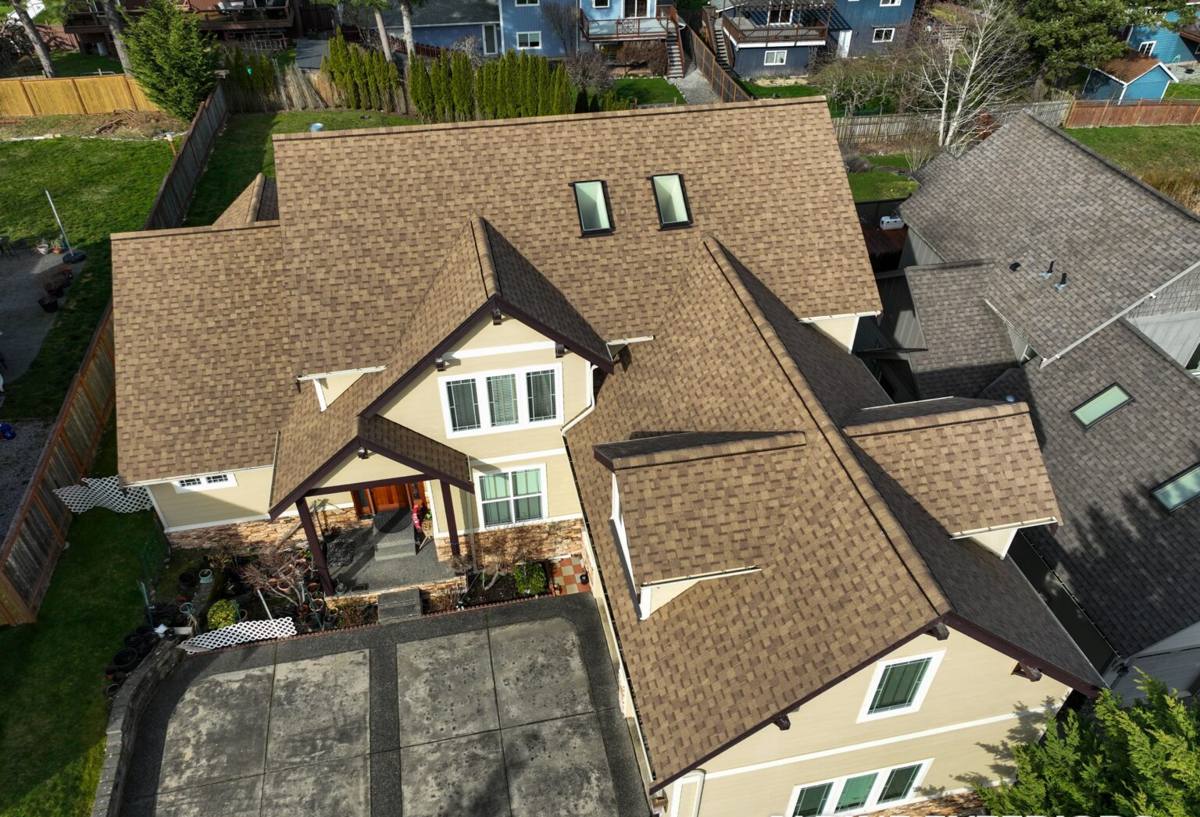
Panel Types: What Actually Gets Installed on Mount Vernon Homes
"Metal roofing" covers a range of products, and the differences between them matter more than most marketing material lets on. The two broad categories homeowners run into are standing seam and exposed-fastener panel systems.
Standing seam panels use raised, interlocking vertical seams with fasteners concealed underneath the panel edges rather than driven through the face of the metal. That means no exposed screw heads for sealant to eventually fail around, and it's the system we recommend for most Mount Vernon roofs given the sustained wind-driven rain this valley sees. Exposed-fastener panels — sometimes called corrugated or ag-panel style roofing — cost less upfront and install faster, but every fastener penetration is a point that depends on a rubber washer staying sealed for the life of the roof. Those washers do wear out, typically well before the metal itself does, which turns an exposed-fastener roof into one that needs periodic fastener inspection and eventual re-torquing or replacement to keep performing.
Material and Finish Options
| Option | What It Means for a Mount Vernon Roof |
|---|---|
| Galvanized steel | Zinc coating protects the steel base; a solid, cost-effective choice when paired with a quality topcoat |
| Galvalume steel | Zinc-aluminum coating generally outperforms plain galvanized for long-term corrosion resistance in marine air |
| Aluminum | Naturally corrosion-resistant without relying on a coating layer; a strong fit for salt-exposed sites, at a higher material cost |
| PVDF (Kynar-type) finish | Premium factory finish with strong fade and chalk resistance; holds color longest under sustained UV and salt exposure |
| SMP finish | A more budget-friendly factory finish; reasonable performance but fades and chalks sooner than PVDF over a long ownership window |
For most Mount Vernon homes, we point people toward Galvalume or aluminum panels with a PVDF finish when the budget supports it. The upcharge over a base steel-and-SMP package is real, but so is the difference in how the roof looks and performs fifteen and twenty years out, which is most of the reason someone chooses metal roofing in the first place.
What a Correct Metal Roof Installation Involves
Metal roofing has a longer track record of failing from installation shortcuts than from the material itself wearing out. A handful of details separate a metal roof that lasts decades from one that develops leaks, streaking, or panel movement within a few years.
Deck Inspection and Underlayment
Just like any roof replacement, a metal roof install should start with a full tear-off and deck inspection, not a layover. Hidden moisture damage under old roofing doesn't go away because new metal panels are covering it — it keeps working on the deck underneath. Once the deck is confirmed sound, a synthetic or self-adhered underlayment goes down as the actual water barrier, with additional protection at eaves and valleys where wind-driven rain is most likely to be forced upward under the panel edge.
Fastening and Panel Layout
Panels need to be laid out and fastened to manufacturer specification, including the clip spacing and fastener pattern that allows the metal room to expand and contract with temperature changes. Fastened too rigidly, panels can buckle or oil-can — a visible wavy distortion in the flat part of the panel — as the metal moves with the weather. This is one of the most common cosmetic complaints on poorly installed metal roofs, and it's avoidable with correct panel spec and installation technique.
Flashing at Valleys, Chimneys, and Wall Transitions
As with any roofing material, most leaks on a metal roof start at the transitions, not in the open field of panels. Valleys, chimney and skylight penetrations, and wall-to-roof intersections all need flashing that's correctly lapped and integrated with both the underlayment and the panel system, not just caulked as an afterthought. On a metal roof, this flashing work is also where dissimilar-metal contact needs to be avoided or properly isolated — mixing certain metals in direct contact can accelerate corrosion at exactly the joints that matter most.
Fastener and Sealant Details
On exposed-fastener systems, every screw needs a corrosion-resistant coating rated for the panel material and a rubber washer sized and torqued correctly — overtightened washers crack and undertightened ones leak. On standing seam systems, the seam and clip hardware need to match the panel metal to avoid galvanic corrosion between dissimilar metals over time.
Metal Roofing vs. Asphalt Shingle for a Mount Vernon Home
| Factor | Metal Roofing (Standing Seam) | Architectural Asphalt Shingle |
|---|---|---|
| Upfront cost | Higher | Lower |
| Typical service life here | 40-60 years with correct install and coastal-rated materials | 25-30 years with correct install |
| Moss and moisture resistance | High — smooth, non-porous surface sheds water and discourages moss | Moderate — algae-resistant granules help but the surface still holds moisture |
| Wind-driven rain performance | Strong when panels and underlayment are correctly specified | Good with proper underlayment and flashing; more dependent on installation quality |
| Maintenance | Low; periodic fastener and sealant checks | Periodic moss removal, granule loss monitoring, and gutter checks |
| Noise in heavy rain | Can be more noticeable without proper decking and insulation; largely a non-issue with solid sheathing underneath | Typically quieter by default |
| Repair approach | Panel or section replacement; matching an aged finish exactly can be harder | Individual shingle replacement is straightforward and widely available |
Neither material is a wrong answer for a Mount Vernon home. Metal is the stronger long-term play for a homeowner planning to stay in the house for decades and who wants the lowest possible moss and maintenance burden. A well-installed architectural shingle roof remains a reasonable, proven choice for a lower upfront cost, particularly on a home where the roof orientation isn't especially shaded or moss-prone.
Cost Factors for a Metal Roofing Project
We don't publish blanket pricing because it wouldn't be an honest answer — the real cost drivers are specific to the roof. The factors that consistently move a metal roofing bid up or down are worth understanding before you compare estimates.
| Factor | How It Affects Cost |
|---|---|
| Panel system type | Standing seam concealed-fastener systems cost more than exposed-fastener panel roofing |
| Material and finish | Aluminum and PVDF finishes cost more upfront than steel and SMP, with a longer service life to offset it |
| Roof complexity | More valleys, hips, dormers, and penetrations mean more custom flashing and labor time |
| Existing deck condition | Hidden rot or moisture damage found at tear-off adds repair scope before new roofing goes on |
| Roof pitch and access | Steeper or harder-to-access roofs increase labor time and staging requirements |
| Underlayment and ice/water shield scope | Fuller coverage at eaves and valleys adds material cost but reduces leak risk directly |
How Our Process Works
- In-person inspection: We walk the roof and attic in person and document the existing deck and roofing condition before quoting anything.
- Written estimate: You get an itemized bid covering panel system, underlayment, flashing scope, and finish selection — not a single vague line item.
- Scheduling around weather: We build realistic flexibility into the timeline, since wet-season delays are a normal part of roofing work in this valley, not an excuse.
- Tear-off and deck repair: Old roofing comes off completely and any deck damage found is repaired before new roofing goes down.
- Underlayment, flashing, and panel installation: Each layer goes on to manufacturer specification, with particular attention to fastening pattern, thermal movement allowance, and flashing at every transition.
- Final walkthrough: We review the completed roof with you, confirm fastener and seam details, and do a full site cleanup before calling the job done.
Why Hiring a Crew That Already Works in Mount Vernon Matters
Metal roofing rewards experience in a way that's easy to underestimate. A crew that regularly works roofs around Mount Vernon has already seen which fastener grades hold up against Skagit Valley's marine air and which don't, how much thermal movement allowance a given panel run actually needs, and which roof orientations in this specific low-lying, damp valley hold moss longest if a design detail gets overlooked. That's practical judgment built from doing this work repeatedly in this exact climate, not from a spec sheet written for a national average.
It also matters after the job is done. A workmanship warranty is only as good as the contractor standing behind it, and a company with an established, ongoing presence in the Skagit Valley is one you can actually reach years later if a fastener needs attention or a flashing detail needs a second look — rather than chasing down a crew that moved on to another region once the job was finished.
A Practical Checklist Before You Choose a Metal Roofing Contractor
- Do they specify standing seam vs. exposed-fastener panels clearly, and explain why one fits your roof better?
- Does the estimate name the panel material, gauge, and finish, not just "metal roofing"?
- Is flashing work at valleys, chimneys, and walls explicitly scoped in the bid?
- Do they carry current WA contractor licensing, liability insurance, and workers' compensation?
- Can they point to real, recent metal roofing work in or near Mount Vernon or the wider Skagit Valley?
- Does the bid separate the panel manufacturer's finish warranty from their own workmanship warranty?
Signs a Mount Vernon Metal Roof Needs Attention
Even a well-installed metal roof benefits from periodic attention, and a few warning signs are worth catching early rather than waiting on.
- Visible oil-canning or panel movement that's worsened since installation
- Rust streaking or discoloration around fastener heads or cut edges
- Loose, cracked, or missing fastener washers on exposed-fastener systems
- Water staining on interior ceilings near valleys, penetrations, or wall transitions
- Moss or organic buildup collecting at panel laps or low-slope sections despite metal's general resistance
If you're seeing any of these on a Mount Vernon roof, it's worth having it looked at before the next stretch of heavy weather rather than waiting for a leak to force the timeline.
If you're weighing a metal roof for a Mount Vernon home, we're glad to come take a look, walk you through panel and finish options for your specific roof, and give you a straight, itemized estimate to compare against anything else you've received. Use the form below to request a free, no-pressure estimate.