 Chuckanut Exterior
 Why Decks Age Faster on the Larrabee Side of Chuckanut
Homes tucked into the hillsides and tree cover around Larrabee deal with a combination of conditions that most inland Whatcom County properties never see. You're close enough to the water that salt-laden air reaches railings, fasteners, and framing hardware. You're exposed to the kind of driving, wind-pushed rain that comes off Chuckanut Bay and Samish Bay during winter storms, which drives moisture into places a calm, straight-down rain never reaches. And because so many Larrabee lots sit under mature fir and cedar canopy, decks here spend a good chunk of the year shaded, damp, and slow to dry — which is exactly what moss and algae need to take hold.
None of that means a deck can't last. It means the deck has to be built and replaced with those three factors in mind, not with a generic approach that would work fine in a dry, sunny yard on the other side of Bellingham. That's the difference between a deck replacement that holds up for decades and one that starts showing soft spots and corroded hardware in five or six years.
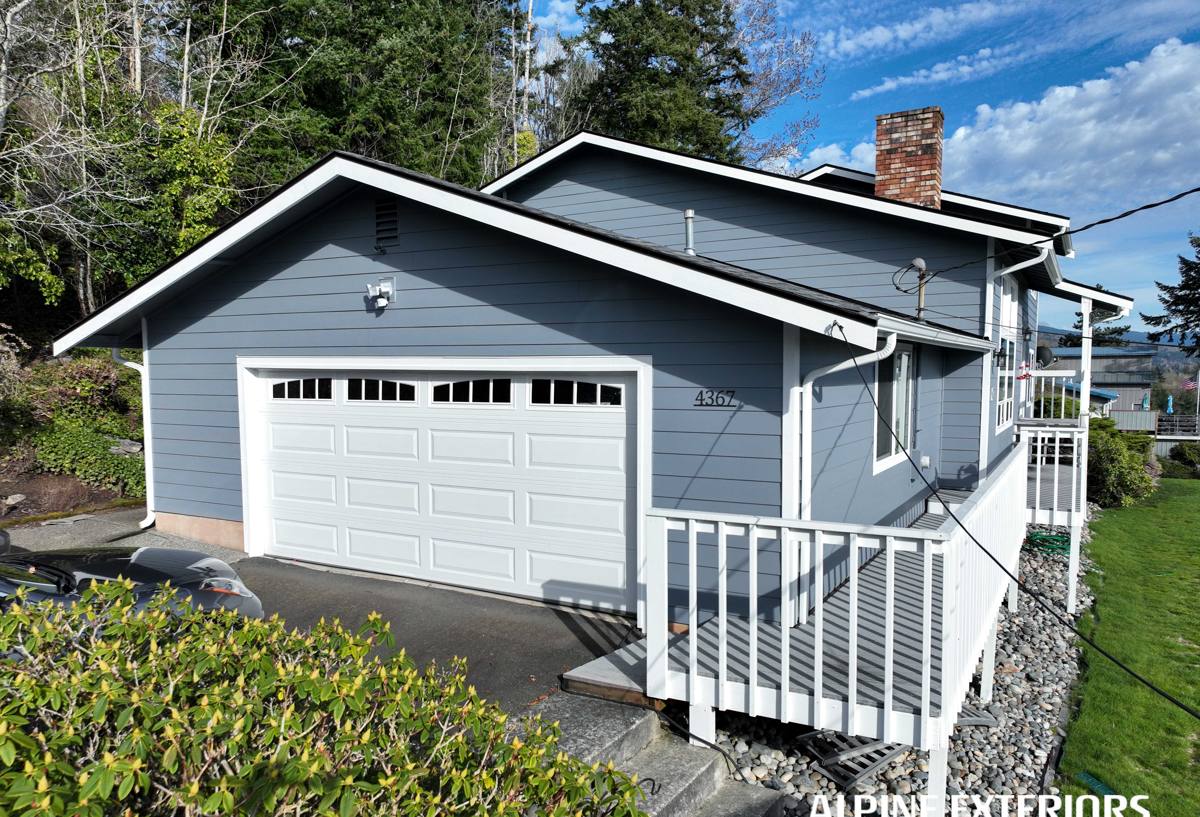
Signs a Larrabee Deck Needs Replacement, Not Another Repair
Repair makes sense when the problem is isolated — a cracked board, a loose railing baluster, a single failed fastener. Replacement becomes the honest recommendation when the damage is systemic or when the structure underneath the deck boards is no longer trustworthy. Signs we look for include:
- Soft, spongy, or springy decking when you walk across it, especially near the house or in shaded corners
- Rust streaking or bleeding around fastener heads and joist hangers
- Gaps or separation where the deck's ledger board meets the house siding or foundation wall
- Persistent black or green staining that returns within weeks of cleaning, even after pressure washing
- Wobble or movement in the railing posts, which often signals rot at the post base rather than a loose bolt
- Visible daylight or crumbling wood where support posts meet footings or concrete piers
- A deck more than 15–20 years old built with older fastening methods that predate current flashing and connector standards
If you're seeing two or more of these, the framing underneath has usually been compromised long enough that patching the surface boards would just be cosmetic. A proper inspection tells us whether the substructure — ledger, joists, beams, posts, footings — is still sound, because that's the part that actually determines whether replacement is the right call.
What a Correct Deck Replacement Actually Involves
A deck replacement done right isn't just swapping old boards for new ones on the same frame. The framing is where almost every deck failure in this region actually starts, so that's where the real work happens.
Ledger Board and Flashing
The ledger board — the piece that attaches the deck to your house — is the single most common failure point on decks exposed to driving rain. If it isn't properly flashed with the right lap sequence over the house's water-resistive barrier, wind-driven rain works its way behind the ledger and rots both the ledger and the rim joist or wall framing behind it. On a replacement, we remove the ledger entirely, inspect and repair whatever sheathing or framing is exposed, and reinstall with correct flashing, that is, step flashing over housewrap, not caulk alone. Caulk is a maintenance item, not a waterproofing strategy.
Framing, Joists, and Fasteners
Given the salt exposure common to Larrabee properties, hardware selection matters more here than it would a few miles inland. Standard galvanized fasteners and joist hangers can start showing corrosion well before the wood around them fails, especially at cut ends and in joist hanger pockets where moisture sits. We spec fasteners and connectors rated for coastal exposure and make sure joist hangers, screws, and structural connectors are all compatible metals, since mixing incompatible metals accelerates corrosion through galvanic reaction.
Footings and Support Posts
Whatcom County's building code sets minimum footing depth and sizing requirements, and on sloped Larrabee lots those footings often need to account for the site's grade and soil conditions. Replacement is the point where we confirm footings meet current code, are free of the cracking or heaving that shows up over years of freeze-thaw cycles, and that posts are properly based above grade instead of sitting in standing water or buried soil, which is one of the fastest ways to rot a post from the bottom up.
Choosing Decking Material for Salt Air, Rain, and Shade
There's no single "best" decking material for every home — the right choice depends on how much sun the deck gets, how close it is to salt air, and how much upkeep you actually want to do. Here's how the common options perform under Larrabee's conditions specifically:
| Material | Behavior in Salt Air & Rain | Behavior in Shade & Moss | Maintenance Load |
|---|---|---|---|
| Pressure-treated wood | Holds up well if sealed and fasteners are corrosion-rated | Prone to moss and mildew without regular cleaning | Annual cleaning, periodic re-sealing |
| Cedar | Naturally rot-resistant but still needs sealing near the coast | Grays and can host moss if left unsealed in deep shade | Moderate; sealing every 1–2 years |
| Composite decking | Very stable in salt air; won't rust or corrode itself | Can still get slick with algae film in shaded, damp spots | Low; periodic washing |
| PVC / capped polymer | Excellent moisture and salt resistance, no absorption | Same algae-film consideration as composite, but resists staining | Lowest; occasional washing |
We're honest with clients that no decking surface is immune to moss and algae in a heavily shaded Larrabee yard — that's a function of sunlight and airflow, not just the material. What changes by material is how the surface handles standing moisture underneath that film, and whether the boards themselves can absorb and hold water long-term. That's why material choice is a conversation, not a default recommendation, and we'll walk you through the honest trade-offs of each rather than push whatever happens to be in stock.
The Substructure Work Homeowners Rarely See
The parts of a deck that fail first are almost never the parts you look at from your patio chair. Drainage and airflow underneath the deck matter as much as the decking on top, especially on a shaded, damp lot. A deck built low to the ground with poor airflow underneath traps moisture against the joists and posts year-round, which is a major driver of premature rot in this climate. During replacement, we look at grading and clearance under the deck, joist spacing and ventilation, and whether ground-contact moisture is able to escape rather than sit and soak into the framing from below.
We also pay attention to how deck boards are spaced and fastened. Boards installed too tight, or fastened with hidden clip systems not rated for wet climates, can trap water between boards instead of shedding it — a small detail that has an outsized effect on how fast moss and rot set in on a shaded deck.
Our Deck Replacement Process, Step by Step
- On-site assessment. We inspect the existing deck's framing, ledger connection, footings, and posts to confirm replacement is the right call and to scope what's actually needed.
- Demolition and disposal. Old decking, railings, and compromised framing are removed and hauled off; anything still sound gets evaluated for reuse rather than replaced automatically.
- Structural inspection behind the ledger. Once the ledger is off, we check the wall framing and sheathing behind it for hidden rot before closing anything back up.
- Framing rebuild. New ledger flashing, joists, beams, and corrosion-rated hardware go in to current code, sized for your deck's actual span and load.
- Footings and posts. Existing footings are reused if they meet code and are structurally sound; anything undersized or damaged is replaced or supplemented.
- Decking and railing installation. Your chosen material goes down with attention to drainage gaps and fastening method, followed by code-compliant railings and stairs.
- Final walkthrough. We go over the finished deck with you, including what maintenance it actually needs given its sun and shade exposure.
What Drives the Cost of a Deck Replacement in Larrabee
Every deck is different, and we won't quote a number without seeing the site, but these are the factors that move the price up or down on most Larrabee projects:
| Factor | Why It Matters Here |
|---|---|
| Framing condition | Rotted joists, beams, or ledger connections found once demo starts add rebuild work beyond surface-level replacement |
| Footing access and slope | Sloped Larrabee lots can require additional footing work or engineered support compared to a flat yard |
| Decking material | Composite and PVC cost more upfront than wood but reduce long-term maintenance and repainting/sealing costs |
| Hardware specification | Corrosion-rated fasteners and connectors cost more than standard galvanized but hold up far longer this close to salt air |
| Size and layout | Multi-level decks, built-in stairs, and custom railings add labor and material beyond a simple rectangular deck |
| Removal and disposal | Older decks with buried or extensive footings can add demo time and disposal cost |
Broadly speaking, a straightforward single-level deck replacement runs toward the lower end of typical regional pricing, while multi-level decks, extensive framing repair, or premium composite/PVC materials push toward the higher end. We'll give you a clear, itemized number after we've actually seen your deck — not a guess based on square footage alone.
Maintenance That Actually Extends Deck Life Here
A new deck's lifespan depends heavily on what happens after installation, particularly in a shaded, damp, salt-exposed setting like Larrabee. This is the maintenance rhythm we recommend to clients in this area:
- Sweep debris and fallen needles off the deck regularly — trapped organic matter holds moisture and feeds moss growth
- Wash the deck surface at least once a year, more often in heavily shaded areas, to knock back algae and moss before it takes hold
- Check fastener heads and visible hardware annually for early rust or corrosion, especially near the outer edges closest to open air
- Reseal wood decking on the manufacturer's recommended schedule rather than waiting until it visibly grays or cracks
- Keep gutters and downspouts near the deck clear so roof runoff isn't dumping extra water onto or under the deck structure
- Trim back overhanging branches where practical to improve airflow and sun exposure on chronically damp sections
- Inspect underneath the deck once a year for standing water, soft framing, or signs of pest activity
Why Hiring a Crew That Already Works Larrabee Matters
Deck replacement isn't a one-size-fits-all job, and a crew that mostly works drier, sunnier neighborhoods can make reasonable-sounding decisions that don't hold up under Larrabee's specific mix of salt exposure, driving rain, and shade. Knowing to spec corrosion-rated hardware instead of standard galvanized, knowing how much drainage clearance a shaded deck actually needs, and knowing how Whatcom County's footing and flashing requirements apply on sloped, wooded lots — that's the kind of judgment that comes from working this specific area repeatedly, not from a general decking checklist.
We're a Chuckanut-based crew, and Larrabee is part of our regular service area, not a special trip. That means we already understand the conditions your deck is up against before we ever set foot on your property.
Get an Honest Look at Your Deck
If your deck is showing soft spots, rust, persistent moss, or is simply old enough that you're wondering whether it's still safe, we're happy to come take a look. We'll give you a straight assessment of whether repair or replacement makes sense, walk you through material options suited to your yard's sun and shade, and provide a free, no-pressure estimate using the form below.