 Chuckanut Exterior
 Windows Built for the Lake Samish Climate
Lake Samish sits in a pocket of Whatcom County where the weather does more work on a house than most homeowners realize. Moist air moving inland off the bay, dense tree cover around the lake, and long stretches of low-angle rain put a different kind of stress on windows than you'd see on a dry side of the state. Add a moss season that can run half the year, and it's easy to end up with windows that look fine from the driveway but are quietly losing heat, fogging between the panes, or letting moisture creep into the framing.
Energy-efficient windows done right in this area aren't just about a lower utility bill, though that matters. They're about keeping water out of wall cavities, keeping frames from swelling or rotting, and keeping the glass performing the way it's rated to for the full life of the product — not just the first two or three winters.
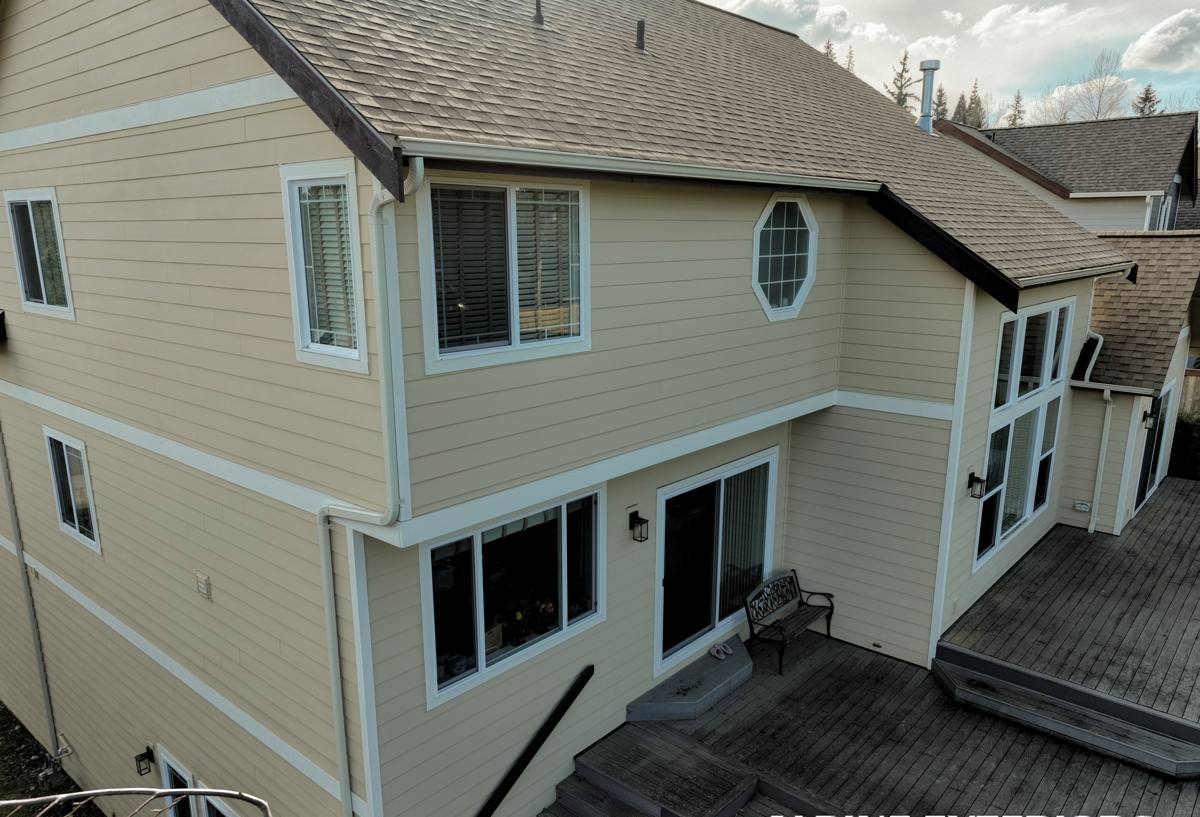
What Salt Air, Driving Rain, and Moss Do to Windows Over Time
None of these factors are dramatic on their own. The damage is cumulative, and it shows up in predictable places if you know what to look for.
- Driving rain pushed by wind off the water finds any weak point in flashing or sealant, especially on west- and south-facing walls. Once water gets behind a window frame, it doesn't leave quickly — it sits against sheathing and framing until it either dries slowly or starts rot.
- Salt-tinged, moist air accelerates corrosion on hardware — hinges, locks, balance mechanisms, and screws — well before the glass or frame itself would normally need attention. Cheaper hardware finishes fail first.
- Moss and algae thrive in the shaded, damp conditions common around tree-lined lake properties. They hold moisture against sills, tracks, and trim, which softens wood, stains vinyl and fiberglass, and clogs weep holes that windows rely on to drain.
- Extended damp seasons mean any gap in the seal between the sash and frame stays wet longer, which is exactly the condition that breaks down weatherstripping and lets cold, moist air infiltrate.
A window that's a poor fit for this climate doesn't usually fail all at once. It fails a little at a time — a soft spot in the sill, a draft you can feel with your hand, a faint mildew smell after a wet week — until one day the discomfort or the damage is hard to ignore.
What "Energy-Efficient" Actually Means Here
Energy efficiency in a window comes down to a handful of measurable factors, but in a climate like ours, how well a window resists moisture matters just as much as its insulating numbers. A window with excellent glass performance and a weak seal or poor flashing detail will still let in cold, damp air — and eventually water.
The core performance factors
For Lake Samish homes, we generally look at:
- U-factor — how well the window resists heat transfer. Lower is better for our heating-dominated climate.
- Solar heat gain coefficient (SHGC) — how much solar heat passes through the glass. Matters more on windows with lake or open-sky exposure.
- Air leakage rating — how tightly the window seals against wind-driven air, which is directly relevant given how much wind-driven rain this area sees.
- Condensation resistance — how well the window resists interior fogging during cold, humid stretches, which is common lakeside.
Frame material trade-offs
There's no single "best" frame material for every home — it depends on exposure, budget, and how the house is built. Here's how the common options generally compare in a wet, moss-prone, semi-coastal climate like ours:
| Frame Material | Moisture & Rot Resistance | Maintenance | Typical Cost |
|---|---|---|---|
| Vinyl | Very good — won't rot; can discolor over many years | Low — occasional cleaning | $ |
| Fiberglass | Excellent — very stable in wet/temperature swings | Low | $$$ |
| Wood (unclad) | Poor without diligent upkeep — needs sealing/painting | High | $$–$$$ |
| Wood-clad (aluminum or vinyl exterior) | Good — exterior protected, interior stays wood | Moderate | $$$ |
| Aluminum | Good moisture resistance, poor insulating value unless thermally broken | Low | $$ |
We don't push one material on every job. A shaded, moss-heavy lot with heavy tree drip calls for a different recommendation than an open, sun-exposed wall on the same street. We'll walk you through what fits your home's actual exposure rather than a one-size answer.
Signs Your Current Windows Are Working Against You
Most homeowners don't call about windows until something is visibly wrong, but there are earlier signs worth acting on before they turn into bigger repairs.
- Visible fogging or moisture trapped between panes of double- or triple-glazed units — a sign the seal has failed
- Soft, spongy, or discolored wood at the sill or bottom corners of the frame
- Moss or dark staining building up on sills, tracks, or exterior trim
- A noticeable draft near the window even when it's fully latched
- Difficulty opening, closing, or locking — often a sign of a warped frame or corroded hardware
- Higher heating bills in rooms with older or single-pane windows compared to the rest of the house
- Condensation forming on the inside of the glass regularly during cold snaps
Any one of these on its own isn't an emergency. Several of them together, or one paired with visible rot, usually means it's time to have someone look before the surrounding wall framing gets involved.
What a Correct Installation Actually Involves
The window unit itself is only part of the job. In a climate that throws this much water at a house, the installation details are what determine whether a window performs for 20+ years or starts leaking within a few winters.
Before the new window goes in
We check the condition of the rough opening, sheathing, and sill for any hidden moisture damage from the old window. A new window installed over a compromised opening just hides the problem — it doesn't fix it.
Flashing and drainage
Proper flashing directs water down and out and away from the wall assembly, not into it. This includes sill pan flashing, correctly lapped house wrap, and drainage paths that don't trap water against the frame — details that matter far more here than in a drier climate.
Sealing without trapping moisture
Sealant belongs in specific places — not everywhere. Over-sealing a window can trap moisture inside the wall instead of letting it drain and dry, which causes worse problems than a small gap would. We seal where it keeps water out and leave drainage paths where the window needs to breathe.
Fit and squareness
A window that isn't shimmed and set square will bind, won't seal evenly, and will stress the frame over time — accelerating exactly the kind of wear this climate already causes.
Our Process for Lake Samish Projects
- On-site assessment — we look at each window's exposure, current condition, and any signs of existing moisture or rot damage, not just measure for a replacement.
- Straightforward recommendation — we explain what frame material and glass package fit your home's exposure and budget, and why, including trade-offs, not just the upsell option.
- Written estimate — clear scope, materials, and timeline before any work starts.
- Careful removal — old windows come out without unnecessary damage to surrounding siding or trim, and we check the opening underneath before anything new goes in.
- Correct installation — proper flashing, drainage, sealing, and squaring, done to hold up through the wet season, not just look good on install day.
- Final walkthrough — we test operation, check seals, and make sure everything is clean and finished before we consider the job done.
Why Hiring a Crew That Already Works This Area Matters
Window installation isn't identical everywhere in Whatcom County. A crew that mostly works drier, more sheltered neighborhoods may not think twice about flashing details or drainage paths that are non-negotiable on a shaded, moss-prone lake lot. Working around Chuckanut and Lake Samish regularly means we already know what wind-driven rain does to a poorly flashed window, what a few seasons of moss buildup looks like on a neglected sill, and which frame materials hold up versus which ones need constant upkeep on properties like these.
That familiarity shows up in small decisions — how we sequence flashing on a shaded north wall, how much drainage capacity we build in near heavy tree cover, which hardware finishes we steer you away from because they corrode fast in this air. Those are the details that separate a window job that lasts from one that needs revisiting in a few years.
Living With Energy-Efficient Windows in a Moss Climate
Even a correctly installed, high-performing window benefits from a little seasonal attention here:
- Clear moss, leaves, and debris from sills and tracks a couple of times a year, especially on shaded sides of the house
- Keep weep holes clear so water can drain instead of pooling
- Wipe down and lightly lubricate hardware annually to slow salt-air corrosion
- Check exterior caulking lines yearly and have any cracked or missing sealant addressed before the wet season sets in
- Trim back tree branches or vegetation holding moisture against window frames
None of this is heavy maintenance — it's the kind of upkeep that keeps a well-installed window performing at its rated efficiency instead of slowly losing ground to the climate.
Get a Straightforward Estimate
If your windows are drafty, fogged, showing moss staining, or just older than the rest of the house's recent updates, it's worth having a local set of eyes look at them before winter puts more strain on them. We offer free, no-pressure estimates for Lake Samish homeowners — use the form below to get started.