 Chuckanut Exterior
 Why Silver Beach Siding Has to Work Harder
Homes in the Silver Beach area near Chuckanut sit in one of the more demanding exterior climates in Whatcom County. You've got salt-laden air moving in off the water, long stretches of driving rain that hit siding sideways rather than straight down, and a shoulder season every year where shade, humidity, and standing moisture combine to grow moss on anything that holds water against its surface. None of these factors are dramatic on their own. Together, over years, they're what separate siding that looks good at year fifteen from siding that's cupping, staining, or rotting at year eight.
That's the lens we use on every Silver Beach project: not "what siding looks good going up," but "what siding is still doing its job after twenty Whatcom County winters." For us, that answer is James Hardie fiber cement, installed the way Hardie's own specifications call for — not a shortcut version of it.
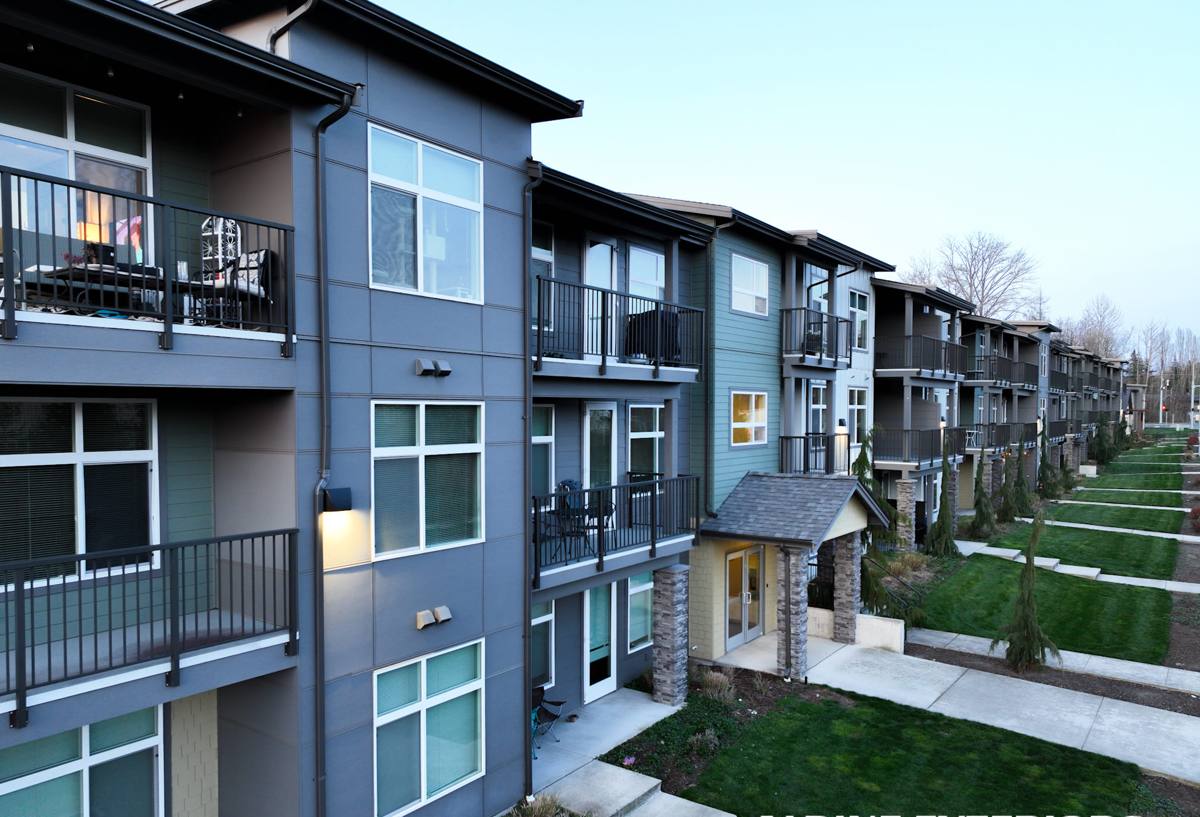
What This Climate Actually Does to Siding
Salt air
Airborne salt is corrosive to exposed metal fasteners and hardware, and it accelerates the breakdown of finishes that aren't formulated to resist it. Cheaper paint systems chalk and fade faster in a salt-air environment; fastener heads that aren't corrosion-resistant can bleed rust streaks down the face of a wall within a few seasons.
Driving rain
Wind-driven rain doesn't just wet the surface of a wall — it pushes moisture into every gap, seam, and fastener penetration it can find. Siding systems live or die on how well they manage that water once it's past the surface: does it drain and dry out, or does it get trapped behind the cladding where it can soak sheathing and framing?
Moss season
Shaded walls, north-facing elevations, and anywhere air can't circulate freely are prone to moss and algae growth for a good chunk of the year here. Moss holds moisture directly against a wall surface far longer than open air would, which is exactly the condition that rots wood-based siding and delaminates lower-grade composite products.
Individually, salt air, driving rain, and moss pressure are manageable. Stacked on top of each other year after year, they're a real test of both the material and the installation.
Why We Install Only James Hardie
James Hardie fiber cement is engineered specifically for the kind of exposure Silver Beach gets. It's non-combustible, dimensionally stable in wet climates, and manufactured with a factory-applied ColorPlus finish rather than relying on field-applied paint to do the protecting.
Climate-engineered product lines
Hardie manufactures its siding in different formulations tuned to different regional conditions — a version built for damp, wet climates like ours is a different product than one built for hot, dry regions. That's a meaningful distinction: it means the board itself is formulated with this kind of weather in mind, not just marketed generically.
Factory-applied ColorPlus finish
ColorPlus finish is baked on in a controlled factory environment, which gives it more consistent coverage and better long-term color retention than field-painted siding — especially useful in a salt-air environment where finish breakdown is accelerated. It also carries its own finish warranty separate from the substrate warranty.
Non-combustible, moisture-resistant substrate
Fiber cement doesn't rot, and it doesn't provide moss or algae the organic food source that wood-based products do. It's not moss-proof — nothing fully is — but it doesn't break down structurally the way wood or wood-composite siding can when moss sits on it for months at a time.
We don't install LP SmartSide, vinyl, Cemplank, Allura, or primed wood siding. That's not a knock on every homeowner who has one of those products on their house — it's a standard we've set for what we're willing to warranty our labor against, in this specific climate.
What a Correct Installation Involves
The product is only half the equation. Fiber cement siding installed wrong — even top-tier fiber cement — will still fail early in a wet, wind-driven climate. A correct job on a Silver Beach home includes:
Water management behind the cladding
A drainage plane and, in most cases, a rainscreen gap so that any water that does get past the siding face has somewhere to go and can dry out, rather than sitting against the sheathing.
Flashing at every transition
Windows, doors, roof lines, and deck ledgers are where water intrusion actually starts. Flashing has to be layered correctly — upper courses overlapping lower ones, kick-out flashing where rooflines meet walls — so water is always directed outward, never behind the plane.
Correct fastening
Hardie specifies fastener type, placement, and penetration depth for a reason — get it wrong and you either compromise the material's warranty or open a path for water at every nail hole. In a salt-air environment, corrosion-resistant fasteners aren't optional.
Proper joints and clearances
Board-to-trim gaps, caulked versus flashed joints, and ground clearance all matter more here than in a dry climate, because every gap is a place moss, standing water, or driving rain can exploit over time.
Comparing the Realistic Options
Homeowners in Silver Beach usually compare a handful of siding paths when it's time to re-side. Here's how they actually hold up against this specific climate — salt air, wind-driven rain, and heavy moss pressure.
| Material | Moisture behavior | Moss/algae resistance | Finish durability in salt air |
|---|---|---|---|
| James Hardie fiber cement | Dimensionally stable, doesn't rot | No organic food source; still needs periodic cleaning | Factory ColorPlus finish holds up well |
| Vinyl siding | Doesn't rot, but can warp/deform with heat cycling and doesn't manage trapped moisture behind it | Grows moss/algae readily on shaded runs | Color fades and chalks over time; can't be repainted easily |
| LP SmartSide / wood composite | Engineered wood core is vulnerable if the finish is breached | Organic material — moss and rot risk higher if maintenance lapses | Field or factory finish, shorter repaint cycles |
| Primed cedar / spruce | Natural wood movement; rot risk highest of the group | Highest — untreated wood is moss's preferred surface | Requires the most frequent repainting/resealing |
This is why we standardized on one product instead of offering all of them. We'd rather install one system correctly and stand behind it than offer a menu of products we know perform unevenly in this exact climate.
Cost Factors on a Silver Beach Project
Every home is different, so we won't quote a number without seeing the house, but the main variables that move price on a local Hardie project are usually the same:
- How much of the existing siding and sheathing needs to come off versus what can stay
- Whether hidden water damage is found once the old siding is removed
- Home size, wall complexity, and number of trim/window transitions
- Plank style and profile chosen (lap, shingle, panel) and ColorPlus color selection
- Site access — some Silver Beach lots have tighter access or steep grades that affect staging
We walk every one of these with the homeowner before work starts, so there are no surprise change orders mid-project.
Our Process
- On-site assessment — we look at current siding condition, moisture exposure by elevation, and any signs of existing water damage or moss buildup.
- Scope and product selection — profile, color, and trim details are finalized based on the home and the homeowner's preference.
- Tear-off and inspection — old siding comes off and sheathing is inspected before anything new goes up. This is where hidden problems, if any, get caught early rather than sealed behind new siding.
- Water management installation — drainage plane, flashing, and rainscreen components go in first.
- Hardie installation to spec — correct fastening, joints, and clearances throughout.
- Final walkthrough — we go over the finished work with the homeowner before calling the job done.
Why Local Experience Matters Here
A crew that only occasionally works in Whatcom County will treat this as a standard siding job. A crew that regularly works Silver Beach and the surrounding Chuckanut area knows which elevations on a typical local lot take the worst of the driving rain, where moss tends to establish first, and how much the salt-air exposure varies depending on how close and how exposed a property is to the water. That local pattern recognition shows up in small decisions — where to add extra flashing attention, which side of the house needs the most ventilation — that don't show up in a generic installation checklist.
Maintenance After Installation
Correctly installed Hardie siding is low-maintenance, not no-maintenance. In this climate, a simple annual routine keeps it performing the way it's designed to:
- Rinse the exterior annually, focusing on shaded or north-facing walls where moss is most likely to start
- Keep gutters clear so overflow isn't running down the wall face during heavy rain
- Trim back vegetation and landscaping that keeps a wall section shaded and damp
- Watch caulked joints around trim and openings for cracking or separation over time
- Address any moss growth promptly rather than letting it establish and hold moisture long-term
If you're weighing a re-side in Silver Beach or elsewhere around Chuckanut, we're happy to take a look at your home, walk you through what we're seeing, and put together a free, no-pressure estimate — no obligation either way.