 Chuckanut Exterior
 Mount Vernon's Climate Is Harder on Siding Than It Looks
Homes in the Mount Vernon area sit in a stretch of Western Washington where the weather never really lets up. Moist air moves in off the Sound and settles into low-lying yards and tree-shaded lots for months at a time. Add wind-driven rain that hits west- and southwest-facing walls hardest, plus a moss season that can run from fall through spring, and you have a set of conditions that will find every weakness in a siding system. It's not one dramatic event that causes problems here — it's the slow, repeated cycle of wet, damp, wet again.
Salt-laden air is part of that equation too. Even homes that aren't waterfront still pick up airborne salt on breezy days, and over years that accelerates corrosion on fasteners, staples, and any exposed metal trim. Siding that isn't built with that in mind — or wasn't installed with the right hardware and clearances — tends to show it first at the fastener heads, the butt joints, and the bottom courses closest to grade.
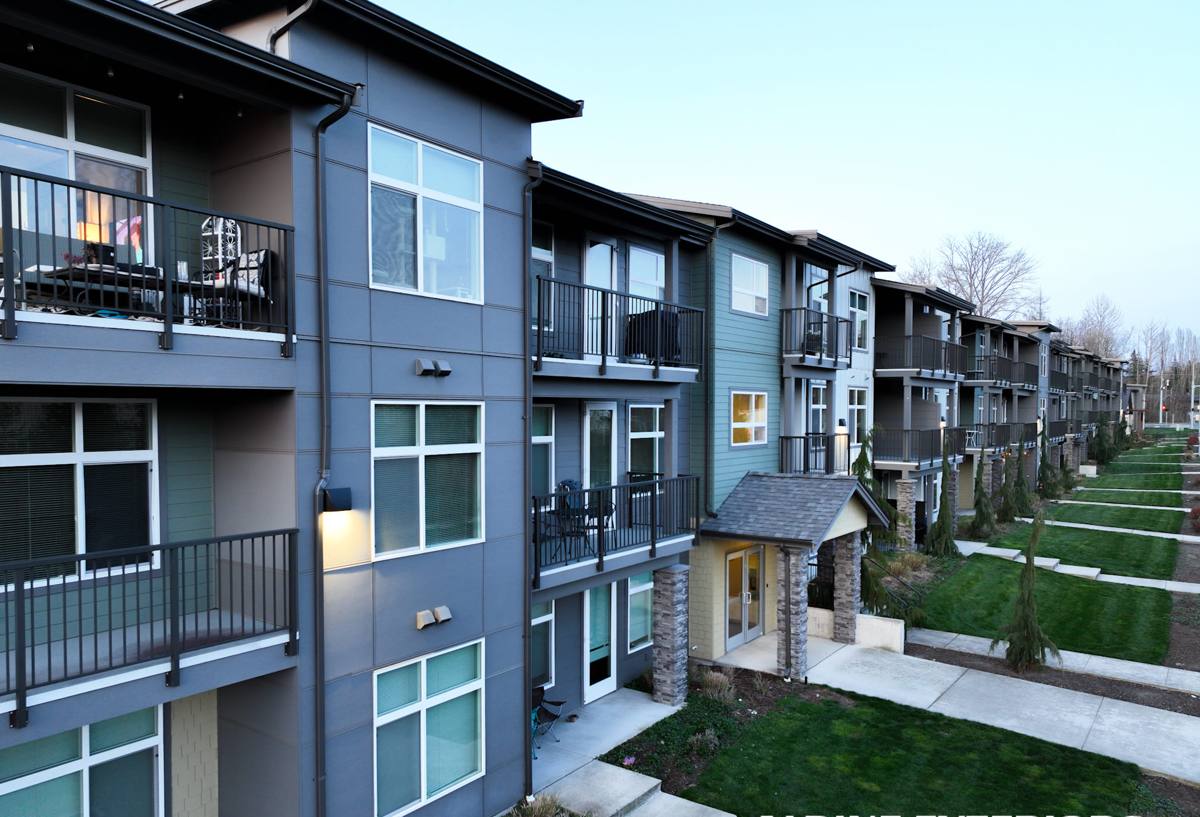
Why We Only Install James Hardie
We standardized on James Hardie fiber cement because it's engineered to handle exactly this kind of climate, and because it gives us a consistent, well-documented system to install correctly every time — not a patchwork of different products with different rules. Hardie siding is non-combustible, it doesn't absorb and swell with moisture the way wood-based products can, and its ColorPlus factory finish is baked on and warrantied against fading, chipping, and peeling in a way field-applied paint can't match.
The HZ5 Engineering
James Hardie makes region-specific formulations under its HZ (HardieZone) system, and the Pacific Northwest falls into the HZ5 category — the line engineered for consistently wet, humid climates rather than dry or freeze-heavy ones. That matters in Mount Vernon specifically: a product formulated for a dry southwestern climate zone will behave differently here over a ten- or twenty-year span than one built for exactly this kind of moisture exposure. We install the HZ5 product line for that reason, not because it's the only option James Hardie sells, but because it's the right one for this address.
What a Correct Installation Actually Involves
Fiber cement siding is only as good as its installation. James Hardie's own warranty is conditioned on following their fastening, clearance, and flashing specifications — and in a climate like ours, skipping any of those steps is where problems start. A correct install isn't complicated, but it is exacting.
The Details That Matter Most Here
- Minimum clearance from grade, roofing, and decking so splash-back and standing water can't wick into the bottom edge of the siding
- Corrosion-resistant, stainless or hot-dip galvanized fasteners driven at the correct depth — not overdriven, not underdriven
- A drainage plane or rainscreen behind the siding so any moisture that gets past the surface has somewhere to go
- Flashing integrated at every window, door, and roof-to-wall intersection, not caulk used as a substitute for flashing
- Butt joints backed with flashing or shimmed, never just caulked and hoped for
- Field-cut edges sealed or back-primed so raw fiber cement isn't left exposed to weather
- Manufacturer-specified nailing patterns and fastener spacing, especially at corners and around penetrations
Any one of these done wrong won't necessarily show up in year one. It shows up in year six or year ten, as a soft spot, a stain, or a section that's failing while the rest of the wall looks fine. That's the gap between siding that's installed and siding that's installed correctly.
Our Process on a Mount Vernon Home
We approach every project the same structured way, adjusted for what we find once the old siding comes off.
Assessment First
Before we quote a job, we look at exposure — which walls take the brunt of the weather, how much tree cover shades the roof and siding, and how the existing drainage and gutters are handling water. That tells us where extra attention to flashing and drainage detail will matter most.
What's Behind the Old Siding
Once removal starts, we check the sheathing and framing underneath for moisture damage. In a climate that stays damp this long, it's common to find soft spots behind old siding that was caulked at the joints or installed too close to grade. We address what we find before anything new goes up — new siding over damaged sheathing just hides the problem.
Installation to Spec
We install the HZ5 product line with the clearances, fastening, and flashing detail described above, and we don't shortcut the drainage plane to save time. Trim, corners, and butt joints get the same attention as the field of the wall — those are the spots that fail first if they're rushed.
Final Walkthrough
We walk the finished job with the homeowner, checking sightlines, caulking at true penetrations (not at siding joints), and touch-up paint where a factory-finished piece was field-cut. Any questions about maintenance going forward get answered on-site, not in a follow-up email.
Choosing the Right Product Line
James Hardie makes several product lines, and the right one depends on the home's style and exposure, not just personal preference.
| Product | Look | Best suited for |
|---|---|---|
| HardiePlank lap siding | Traditional horizontal lap, smooth or woodgrain texture | Most home styles; the most common choice for full re-sides |
| HardiePanel vertical siding | Clean vertical lines, often paired with battens | Modern or farmhouse-style homes, accent walls and gables |
| HardieShingle siding | Staggered or straight-edge shingle profile | Craftsman and cottage-style homes wanting a shingle look without cedar's maintenance |
| HardieTrim boards | Smooth or textured trim stock | Corners, window and door surrounds, fascia |
Most Mount Vernon homes we work on end up on HardiePlank for the field of the house, with HardieTrim at corners and openings — but we'll walk through the options relevant to your home's architecture during the estimate rather than defaulting to one answer.
What Drives Cost on a Project Like This
Every home is different, so we don't quote off square footage alone. The factors below are what actually move a number up or down.
| Factor | Why it matters |
|---|---|
| Condition of existing sheathing | Moisture-damaged sheathing found during tear-off has to be repaired or replaced before new siding goes on |
| Home size and number of stories | More wall area and higher work means more material, labor, and equipment time |
| Trim and architectural detail | Homes with more corners, dormers, and window surrounds take more precision and time per square foot |
| Siding profile chosen | Shingle and vertical panel installations generally take longer than straightforward lap siding |
| Color and finish | Factory ColorPlus finishes cost more up front than primed-for-paint but eliminate a repaint cycle |
| Access and site conditions | Tight lots, mature landscaping, and steep grades affect staging and labor time |
We give a firm, itemized quote after the on-site assessment — not a ballpark over the phone — because the sheathing condition and trim complexity genuinely change the number.
Living With Hardie Siding in This Climate
One of the reasons we recommend James Hardie for homes here is how little ongoing maintenance a correctly installed system needs — but "little" isn't "none." In a salt air, moss-prone climate, a few habits go a long way:
- Rinse siding periodically to clear salt residue and airborne grime, especially on walls facing open exposure
- Keep shrubs and trees trimmed back from the walls so siding can dry out between rain events instead of staying damp
- Clean and maintain gutters so water sheets off the roof correctly instead of running down the face of the siding
- Watch north-facing and shaded walls for early moss or algae growth, since they dry slowest
- Re-caulk at true penetrations (not siding joints) as part of normal home upkeep, the same as any exterior
The ColorPlus factory finish is warrantied against fading and peeling, which takes repainting off the maintenance list for most homeowners for a long stretch of ownership — a real advantage in a climate where field-applied paint tends to need attention sooner.
Why It Matters That We Already Work in Mount Vernon
Installation manuals cover the general rules, but a crew that's worked this area knows the local pattern on top of them — which exposures take the worst wind-driven rain, which lots hold moisture longest under tree cover, and how moss tends to establish on shaded roof and wall lines through the wet months. That local knowledge doesn't change the manufacturer's specifications, but it does change where we pay extra attention on a given home, and it's the difference between a generic install and one that's actually built for the address it's on.
If you're weighing a siding replacement or repair in Mount Vernon, we're happy to walk the property, look at what your home is actually dealing with, and give you a straight, no-pressure estimate — no obligation, no pressure to decide on the spot.