 Chuckanut Exterior
 Why Happy Valley Homes Take a Different Kind of Beating
Homes in the Happy Valley area don't fail the same way houses do fifty miles inland. Sitting close to the water in Chuckanut means siding is dealing with three things at once, year-round: salt-laden air that corrodes fasteners and finishes faster than fresh air ever would, driving rain that gets pushed sideways by wind off the water instead of falling straight down, and a moss season that, in Whatcom County, isn't really a season at all — it's most of the year. Any one of those is manageable. All three together, hitting the same wall assembly month after month, is what separates siding that looks good for five years from siding that looks good for twenty-five.
That's the lens we use on every Happy Valley job. It's not about picking a product off a shelf — it's about matching the material, the detailing, and the installation sequence to what this specific stretch of coastline actually does to a house.
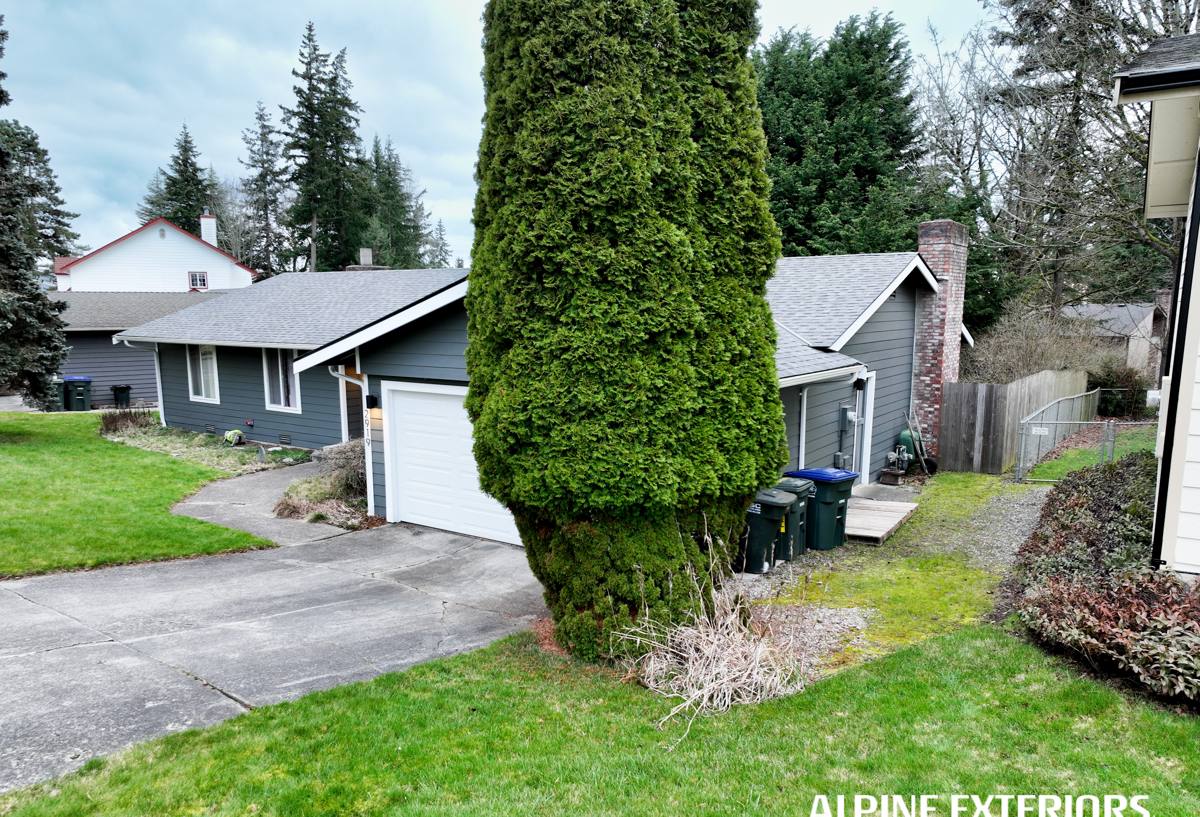
What Salt Air, Driving Rain, and Moss Actually Do to Siding
Salt Air
Airborne salt is corrosive and it doesn't need direct ocean spray to do damage — it travels on wind and settles into anything porous or metallic. Over years, it accelerates the breakdown of cheap fasteners, degrades certain paint films, and works into seams and end cuts that weren't properly sealed. Siding that isn't engineered to resist it will chalk, fade, and lose its factory finish well ahead of schedule.
Driving Rain
Wind-driven rain doesn't just wet a wall's surface — it gets forced up and under laps, into fastener holes, and behind trim if those details weren't built correctly. Once water gets behind the siding, the problem stops being cosmetic and becomes structural: sheathing rot, framing damage, and mold, all hidden until the siding is pulled off or the damage finally shows through paint.
Moss and Sustained Moisture
Moss doesn't attack siding directly, but it holds moisture against the surface far longer than open air would, and it thrives in shaded, north-facing, and tree-covered spots that are common throughout Happy Valley's wooded lots. Wood-based products are the most vulnerable here, because sustained dampness is exactly what triggers rot in wood fiber. The longer moss sits, the longer that surface stays wet, and the more that shortens the siding's useful life.
Why James Hardie Fiber Cement Is Built for This Environment
James Hardie siding is a fiber cement product — cellulose fiber, sand, and cement engineered under pressure into a material that behaves nothing like wood or vinyl. It doesn't rot, it doesn't feed moss the way wood fiber does, and it's non-combustible. For a marine climate like Chuckanut's, three things about the system matter most:
- HZ5 engineering — Hardie's HZ5 product line is formulated specifically for climates with freeze-thaw cycles and sustained moisture exposure, which describes the Pacific Northwest coast well.
- ColorPlus factory finish — a baked-on finish applied under controlled conditions, which holds up to UV and salt exposure far better than field-applied paint, and doesn't require repainting on the same cycle a painted wood or fiber cement product would.
- Dimensional stability — fiber cement doesn't swell, cup, or crack the way wood-based sidings can when they take on and release moisture repeatedly, which is exactly what a rainy, humid coastal climate puts a wall through all year.
None of that means Hardie siding is maintenance-free or installation-proof. It means the material itself isn't the weak link — the installation is where correct or incorrect work shows up over time.
James Hardie Product Lines We Install
| Product | Typical Use | Why It Fits Happy Valley Homes |
|---|---|---|
| HardiePlank lap siding | Primary wall cladding | Most common profile; factory-finished laps shed driving rain when installed with correct overlap and gapping |
| HardiePanel vertical siding | Modern facades, accent walls, gable ends | Fewer horizontal laps means fewer water entry points on wind-exposed elevations |
| HardieShingle siding | Accent gables, dormers, Craftsman-style details | Traditional look without the moisture vulnerability of real wood shingles in a moss-heavy environment |
| HardieTrim boards | Corners, window and door surrounds, fascia | Pairs with the cladding so trim doesn't rot out years before the siding does |
How Siding Materials Compare in This Climate
Homeowners in Happy Valley often ask us to explain, plainly, why we standardized on one product instead of offering several. Here's the honest comparison, based on how these materials actually behave in sustained coastal moisture and moss exposure:
| Material | Moisture & Salt Behavior | Moss/Mildew Vulnerability | Finish Longevity | Maintenance Burden |
|---|---|---|---|---|
| James Hardie fiber cement | Does not rot; dimensionally stable when installed to spec | Low — cement substrate doesn't feed organic growth like wood fiber does | Factory ColorPlus finish rated for years without repaint | Occasional wash; repaint only if ever desired, not required on a fixed schedule |
| Cedar / natural wood | Absorbs moisture; prone to swelling and rot at end cuts and laps | High, especially in shaded, damp spots common on wooded lots | Stain or paint needs regular reapplication | High — recurring sealing, staining, and rot repair |
| Vinyl siding | Sheds water on the surface but seams and J-channels can trap moisture behind the panel | Moderate — moss grows on the surface in shaded areas and is harder to remove without damaging panels | Color is molded-through but can fade and become brittle with UV and salt exposure | Low day-to-day, but panels crack in cold and are difficult to patch invisibly |
| Engineered wood (LP-type products) | Wood-based substrate; vulnerable to swelling if the factory seal is compromised at a cut or fastener hole | Higher than fiber cement due to wood fiber content | Depends on factory treatment and field sealing quality | Moderate to high — every cut and penetration must be re-sealed correctly or moisture gets in |
This is exactly why our company installs James Hardie exclusively. We're not saying the alternatives are junk — cedar has real appeal, vinyl is inexpensive, and engineered wood has improved over the years. But for a marine climate with sustained moss exposure, we'd rather stand behind one product we trust completely than split our attention — and our warranty confidence — across several.
What a Correct Installation Actually Involves
Fiber cement siding fails prematurely almost exclusively because of installation mistakes, not the material itself. On Happy Valley homes, where wind-driven rain is a real factor, these details aren't optional extras — they're the difference between siding that performs for decades and siding that traps water behind it from year one.
The Water Management Layer Comes First
Before a single piece of Hardie board goes up, the wall needs a functioning drainage plane — house wrap or building paper installed correctly, lapped in the right direction, with flashing at every window, door, and horizontal transition. In a driving-rain climate, this layer does more long-term work than the siding itself; the siding's job is to shed the bulk of the water, but the drainage plane handles what gets past it.
Gapping, Fastening, and Clearances
James Hardie's installation specifications call for specific fastener types, spacing, and clearances above rooflines, decks, and grade. Skipping these — using the wrong nail, over-driving fasteners, or butting siding tight to a roofline with no clearance — is exactly what voids Hardie's warranty and invites the moisture intrusion the product was designed to resist.
Caulking and Joint Treatment
Every seam, corner, and trim joint is a potential entry point. Correct work means the right sealant, applied at the right joints — and just as important, knowing which joints Hardie's own details say should not be caulked, because sealing the wrong seam traps water instead of letting it drain.
Painting Cut Edges
Every field cut exposes raw fiber cement that isn't covered by the factory ColorPlus finish. Sealing those cut edges with the manufacturer-approved product is a small step that's easy to skip and expensive to ignore — an unsealed cut edge is a moisture entry point on day one.
Our Process, Start to Finish
- On-site assessment — we walk the home, check existing siding and sheathing condition, and look specifically at moss-prone areas, shaded elevations, and anywhere water has historically pooled or run.
- Product and detail plan — we specify which Hardie products fit each elevation, plus flashing and drainage details for that specific roofline and wall configuration.
- Tear-off and substrate check — old siding comes off and sheathing is inspected before anything new goes up; hidden rot gets addressed, not covered.
- Water management installation — house wrap, flashing, and drainage details go in first, following manufacturer specs, not shortcuts.
- Siding installation — Hardie boards installed to spec: correct fasteners, gapping, clearances, and cut-edge sealing throughout.
- Trim, caulking, and final detail — corners, trim boards, and joint sealing completed per Hardie's guidelines.
- Final walkthrough — we review the finished work with the homeowner before calling the job done.
Living With Moss: Maintenance That Actually Matters
Even a correctly installed Hardie exterior benefits from basic upkeep in a moss-heavy climate like Whatcom County's. The good news is that maintenance on fiber cement is far simpler than on wood:
- Rinse shaded and north-facing walls periodically to keep moss and algae from establishing — a garden hose and soft brush is usually enough; avoid high-pressure washing directly into seams.
- Keep vegetation and tree cover trimmed back from the siding so walls get some airflow and sun exposure, which slows moss growth naturally.
- Check gutters and downspouts each fall — clogged gutters overflow directly onto siding and accelerate the exact moisture exposure Hardie is engineered to resist, but shouldn't have to fight constantly.
- Inspect caulked joints every year or two and have any cracked or missing sealant redone before wet season sets in.
- Watch for any siding pulled away from the wall after storms — wind-driven rain events are when a fastening or clearance problem, if one exists, tends to show itself first.
Before You Hire: A Happy Valley Homeowner's Checklist
Because installation quality matters more than the product label, vetting the crew matters as much as choosing the material. Before signing a contract for siding work in this area, ask:
- Are you a certified or factory-trained James Hardie installer, and can you explain the fastening and clearance specs for this product?
- How will you handle flashing and drainage detailing around windows, doors, and rooflines specific to my house?
- What's your plan for sealing field-cut edges before they're installed?
- Have you worked on homes in this neighborhood or similarly exposed coastal areas before, and what did that job teach you about this climate?
- What does the manufacturer's warranty actually cover, and what installation mistakes would void it?
- Will you inspect and address sheathing condition before installing new siding, not just cover over what's there?
Why Local Experience in Happy Valley Specifically Matters
A crew that only occasionally works this stretch of Whatcom County treats every job as a generic install. A crew that regularly works Happy Valley and the surrounding Chuckanut area already knows which elevations on a typical lot face the worst wind-driven rain, where moss tends to establish fastest, and which detailing mistakes show up first when a house sits this close to the water. That familiarity doesn't replace following manufacturer specs — it means the specs get applied with the right priorities for the conditions this particular property actually faces, instead of a one-size-fits-all approach.
Warranty and Long-Term Value
James Hardie backs its siding with a strong, transferable limited warranty, and ColorPlus finishes carry their own separate finish warranty — both structured around the product being installed to Hardie's specifications. That's precisely why installation detail gets so much attention in this article: a warranty is only as good as the installation behind it. Done correctly, a James Hardie exterior in a marine climate like this one is built to perform for decades with minimal upkeep, holding its factory finish and structural integrity far longer than wood-based alternatives exposed to the same salt air, rain, and moss.
If you're weighing a siding replacement or repair on a Happy Valley home, we're glad to take a look and talk through what your specific house needs — no pressure, no obligation. Reach out below for a free estimate.