 Chuckanut Exterior
 Why Happy Valley Homes Need Siding That's Built for This Climate
Homes in Happy Valley sit close enough to open water and low-lying, tree-shaded terrain that they get hit with a combination most siding products were never engineered to handle well: salt-laden air, wind-driven rain that finds its way sideways under eaves and around trim, and a moss season that can stretch from late fall clear into spring. None of these things alone is unusual for Whatcom County. Together, on the same wall assembly, year after year, they separate siding that holds up for decades from siding that starts failing in five to ten years.
Salt air is corrosive to exposed metal fasteners and can accelerate the breakdown of some coatings and adhesives over time. Driving rain doesn't just wet a wall's surface — it tests every seam, joint, and penetration, and it's the number one reason poorly flashed siding jobs develop hidden rot long before anything looks wrong from the curb. And moss, which thrives in the shaded, damp microclimates common around Chuckanut, holds moisture against a wall far longer than open sun and wind would allow, which matters enormously depending on what the siding itself is made of and how it was installed.
This page is about one product, installed correctly, for one kind of home: a Happy Valley property dealing with all three of those pressures at once. It's not a general overview of siding options — it's what we've learned works, and why.
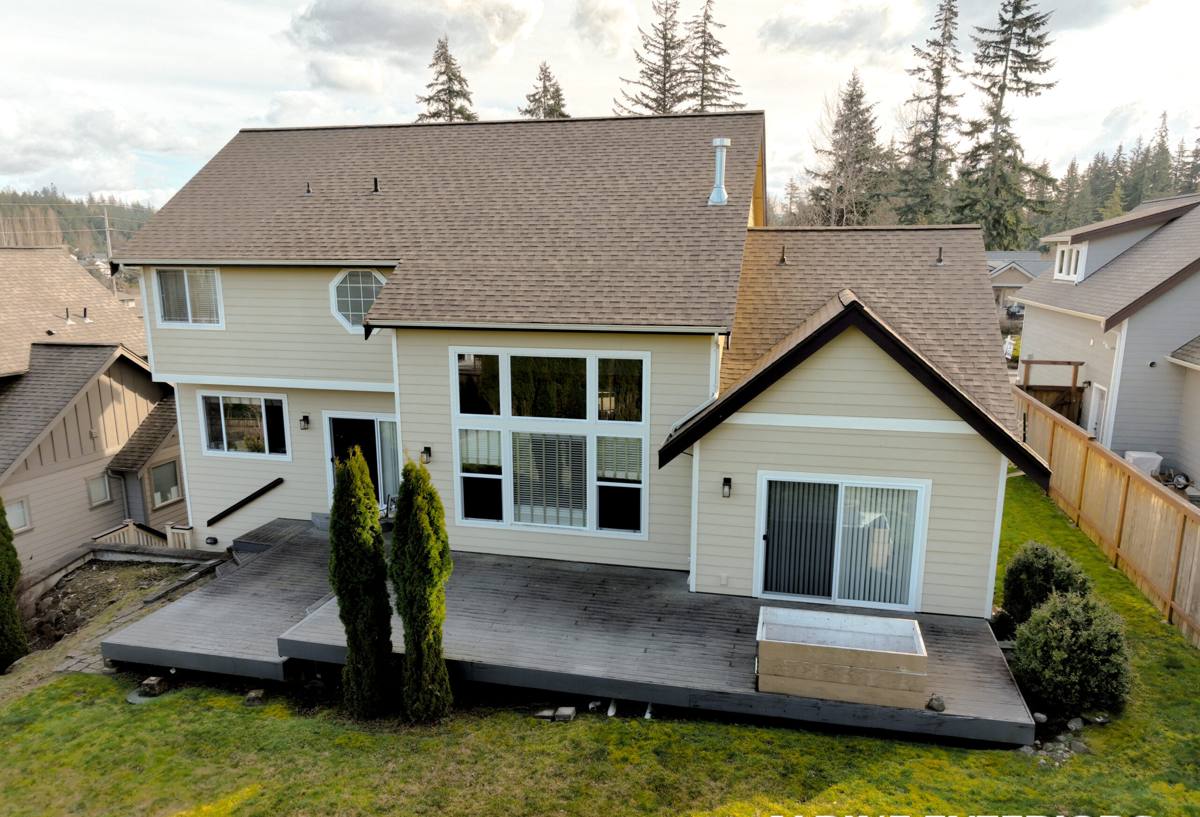
What Fiber Cement Actually Brings to a Job Like This
We install James Hardie fiber cement siding exclusively, and on a site like Happy Valley the reasons are practical, not brand loyalty. Fiber cement is made from cement, sand, and cellulose fiber, which makes it dimensionally stable — it doesn't swell, cup, or warp the way wood-based products can when they take on moisture repeatedly. That matters directly here: a product that stays flat and tight against the wall assembly year after year is a product that keeps water where it belongs, on the outside.
Hardie's ColorPlus factory-applied finish is baked on under controlled conditions, which gives it better adhesion and UV resistance than field-applied paint. In a salt-air environment, where finishes take more of a beating than they do further inland, that difference shows up over time in fewer chalking, fading, and peeling call-backs. Hardie also engineers its siding by climate zone — HZ5 and HZ10 formulations are built with different moisture and freeze-thaw performance targets, and product selection for a Whatcom County coastal-influenced site should reflect that, not just whatever's on the truck.
What it doesn't solve on its own
No siding material, including fiber cement, fixes a bad water-management plan. Fiber cement is highly resistant to moisture damage compared to wood or wood-composite products, but it still needs a correctly built assembly behind it — house wrap, flashing, proper clearances — to perform the way it's designed to. We'll get into what that actually looks like below, because it's the part that determines whether a siding job lasts 30 years or leaks in year six.
What a Correct Fiber Cement Installation Involves
A lot of siding problems we get called out to inspect in this area aren't siding problems at all — they're installation problems wearing siding as a symptom. Getting a fiber cement job right in a wet, salt-exposed, moss-prone setting comes down to details that are easy to skip and expensive to fix later.
- Water-resistive barrier: A continuous, properly lapped weather barrier behind the siding, with all seams taped and every penetration sealed, is the actual first line of defense — the siding is the second.
- Flashing at every horizontal transition: Windows, doors, decks, roof-to-wall intersections, and any horizontal trim need step or head flashing that directs water back out, not into the wall cavity.
- Correct fastening: Hardie specifies fastener type, spacing, and placement by product and by exposure zone. Under-fastening or face-nailing where blind-nailing is called for shortens the life of the installation, sometimes dramatically.
- Proper clearances: Siding needs a minimum gap above roof lines, decks, patios, and grade, and a gap at the bottom of the wall assembly, so it can drain and dry instead of sitting in standing water or snow.
- Caulking only where Hardie's specs call for it: Over-caulking seams that are designed to be gapped for drainage traps water instead of releasing it — one of the more common mistakes we see from crews unfamiliar with the product.
- Ventilation behind the cladding: A drainage plane that lets bulk water escape and airflow dry out any incidental moisture is what keeps a damp climate from becoming a rot problem.
Every one of these steps is documented in Hardie's own installation manual. None of them are optional if you want the product's warranty to actually mean something, and none of them are visible once the job is finished — which is exactly why the crew's experience and discipline matter more than the brand name on the boards.
Our Process on a Happy Valley Job
Assessment and moisture check
Before we talk products or pricing, we look at the existing wall assembly. On homes with driving-rain exposure, we're specifically checking for hidden moisture damage around windows, at wall-to-roof transitions, and behind any trim or corner boards — areas that fail quietly long before paint or old siding shows visible signs.
Tear-off and substrate repair
We remove the old siding down to the sheathing, repair or replace any water-damaged framing or sheathing we find, and confirm the wall is sound before anything new goes on. Covering over rot with new siding just hides the problem for another owner to find later.
Weather barrier and flashing
We install a continuous water-resistive barrier with taped seams, and flash every window, door, and horizontal intersection before a single piece of siding goes up. This is the step that determines how the house performs in a wind-driven rain event, which is a normal weather pattern for this part of Whatcom County, not a rare one.
Installation to Hardie's specification
Siding, trim, and accessories go on according to Hardie's fastening schedule, clearance requirements, and joint details, matched to the correct climate-engineered product line for a Chuckanut coastal-influenced site.
Final walkthrough
We walk the finished job with the homeowner, check caulking and paint touch-up at cut edges, and confirm clearances at grade, decks, and roof lines are correct before calling it done.
Choosing the Right Hardie Product for a Site Like This
Not every Hardie product line is the right fit for every wall on every home, and a home in Happy Valley with mixed sun and shade exposure often benefits from different products on different elevations. Lap siding is the most common choice for full walls, panel products work well for accent areas or gable ends, and trim boards need to be matched to the same moisture-resistance standard as the field siding — mixing in a lesser trim product undermines the whole system.
| Consideration | Why it matters in Happy Valley |
|---|---|
| Climate-engineered formulation (HZ5 / HZ10) | Matches the product's moisture and freeze-thaw resistance to actual Pacific Northwest coastal-influenced conditions rather than a generic national spec |
| Lap vs. panel profile | Lap siding sheds driving rain well on full walls; panel siding suits accent areas but needs the same disciplined flashing detail |
| ColorPlus finish vs. primed-for-paint | Factory-applied finish holds up better against salt air and UV exposure than field-applied paint, and reduces repaint cycles |
| Trim and fascia matching | Using Hardie trim throughout, not just on the field wall, keeps moisture performance consistent at every joint |
| Shaded vs. sun-exposed elevations | North- and tree-shaded walls hold moisture and moss longer and may benefit from different detailing than south-facing walls |
What Drives the Cost of a Job Like This
Every home is different, and we won't quote a number without seeing the site, but the factors that move the price on a Happy Valley fiber cement job are fairly consistent. Broad ranges for a full residential re-side vary widely depending on these, so treat any number you see online without a site visit as a rough guess at best.
| Cost factor | Why it matters |
|---|---|
| Square footage and wall complexity | More corners, dormers, and roof-to-wall intersections mean more cutting, flashing, and labor time |
| Condition of the substrate | Hidden rot or water damage found during tear-off adds repair scope before new siding can go on |
| Tear-off vs. install over existing | We generally don't recommend installing over old siding on homes with this exposure profile — proper tear-off lets us verify and fix the wall assembly |
| Trim and accessory scope | Corner boards, window trim, fascia, and soffit work add material and labor beyond the flat wall areas |
| Product line and finish | ColorPlus finishes and certain profiles carry different material costs than base products |
| Access and site conditions | Sloped lots, limited staging area, or landscaping close to the house can add time |
Living With Fiber Cement in a Moss-Prone, Salt-Air Climate
One advantage of fiber cement over wood-based siding in this environment is how little routine maintenance it actually asks for once it's installed correctly. It won't rot, and it isn't a food source for the organic growth that colonizes wood siding in shaded, damp spots. That said, "low maintenance" doesn't mean "no maintenance," and a few habits go a long way toward protecting the investment.
- Rinse the siding annually with a garden hose to clear salt residue and organic buildup, especially on shaded or north-facing walls
- Keep gutters clean and downspouts directed away from the foundation so bulk water isn't running down or pooling against the wall
- Trim back vegetation and tree limbs that keep a wall section shaded and damp longer than the rest of the house
- Inspect caulking at trim joints and penetrations every year or two, and re-caulk where it's cracked or pulled away
- Touch up any cut edges or nicks in the factory finish promptly to prevent moisture from reaching the substrate at that point
- Watch for moss or algae starting to establish on shaded siding and address it early with a gentle wash rather than letting it build up
None of this is heavy work, but skipping it is how a well-installed job starts to look tired years before it should.
Why a Crew That Already Works Happy Valley Matters
Coastal-influenced, moss-heavy, high-rainfall sites like the ones we see throughout the Chuckanut area reward experience in ways that aren't obvious until something goes wrong. A crew that's worked this specific microclimate knows which elevations on a typical Happy Valley lot need extra flashing attention, understands how the local permitting process handles exterior re-siding work, and has already made — and fixed — the mistakes that come from treating this like a generic siding job. That's a meaningfully different starting point than a crew installing their first job in this kind of exposure.
It also means fewer surprises during the job itself. Knowing what typical wall assemblies in older Whatcom County homes look like, what substrate condition to expect once old siding comes off, and how local weather windows affect scheduling all come from having done this work here before, not from a manual.
Get a Straight Answer for Your Home
If you're dealing with aging siding, hidden moisture damage, or moss buildup on a Happy Valley home, we're happy to take a look and walk you through what we'd actually recommend — no pressure, no upsell to a product we don't believe in. Fill out the form below to schedule a free estimate.