 Chuckanut Exterior
Windows Built for What Happy Valley Actually Deals With
Happy Valley sits close enough to the water that salt air is part of daily life, and Chuckanut's weather doesn't do half measures — driving rain comes in sideways for days at a stretch, and by late fall a lot of homes have a green film creeping across siding, trim, and window frames. None of that is unusual for Whatcom County. It's just the baseline your windows have to survive, year after year, for as long as you own the house.
Older windows in this neighborhood tend to fail in predictable ways: seals give out first, then frames start absorbing moisture at the corners, then hardware corrodes from salt exposure faster than the manufacturer's spec sheet ever accounted for. A window that would last three decades in a dry inland climate might start showing real problems in half that time here. Custom window work in Happy Valley isn't about upgrading for looks — it's about matching the product and the installation to the conditions the house actually sits in.
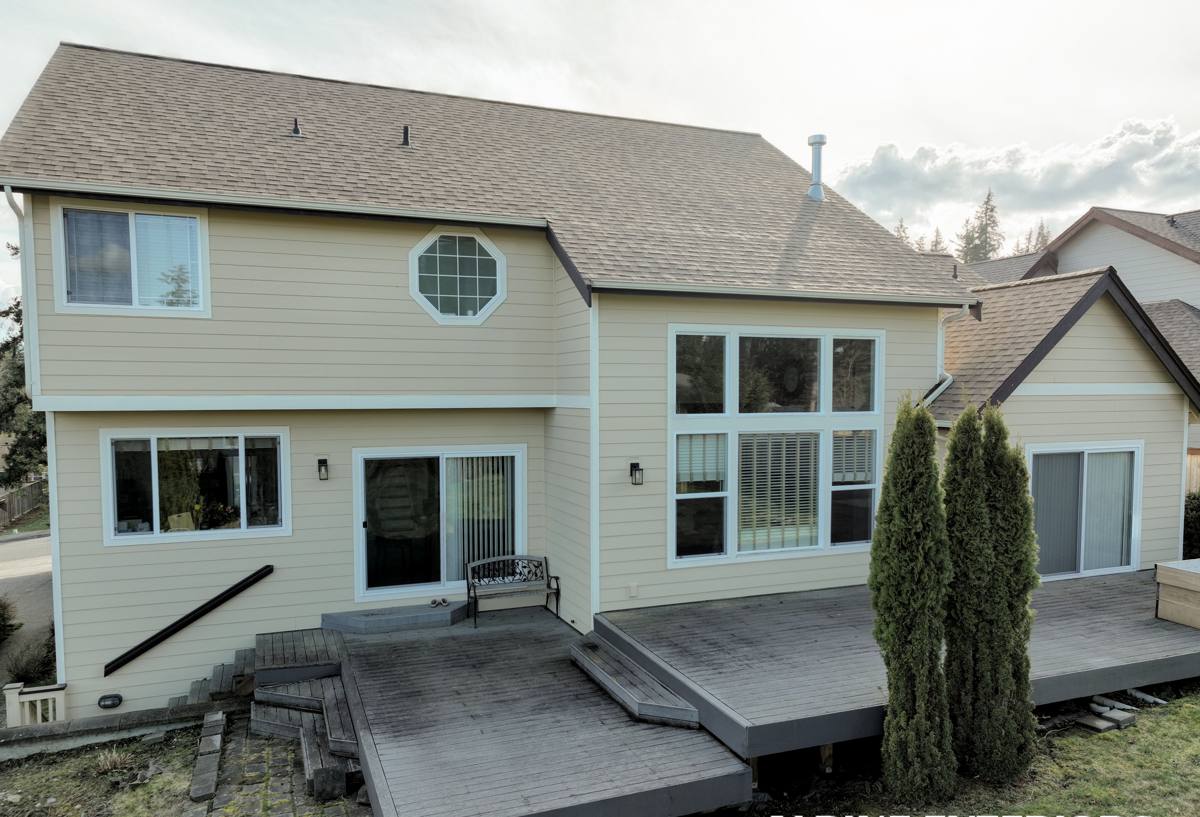
What "Custom" Means on a Job Like This
Custom doesn't mean unusual shapes or premium upgrades for their own sake. On most Happy Valley homes it means the window openings were framed decades ago to dimensions that don't match anything sold off the shelf today, and it means the replacement has to account for how this specific house handles wind-driven rain and salt-laden air.
Matching Existing Openings
Many homes in this area have settled slightly over the years, so openings are rarely perfectly square anymore. A correct custom job measures each opening individually rather than assuming they match the original blueprints, then builds or orders windows sized to what's actually there — not what should theoretically be there.
Choosing the Right Frame for the Exposure
A window on a wall that takes direct weather off the water needs different hardware and sealant detailing than one on a sheltered side of the same house. Custom work accounts for orientation and exposure, not just style or size.
Frame Material Comparison for Salt-Air, High-Rain Conditions
There's no single "best" window material — each has trade-offs that matter more or less depending on exposure. Here's how the common options generally hold up under the conditions Happy Valley homes actually face:
| Material | Moisture & Salt Resistance | Maintenance | Typical Lifespan Here |
|---|---|---|---|
| Vinyl | Good — won't corrode or rot, but seams can fail at frame joints if not fabricated well | Low | 20-30 years |
| Fiberglass | Very good — dimensionally stable, doesn't expand and contract much through wet-dry cycles | Low | 30-40 years |
| Wood-clad | Fair — cladding protects the exterior face, but any breach lets moisture into the wood core | Moderate to high | 20-30 years with upkeep |
| Aluminum | Poor to fair near salt air unless marine-grade and properly finished — prone to pitting and corrosion | Moderate | Often shorter in this exposure |
We steer most Happy Valley clients away from bare aluminum and unclad wood on exposed elevations — not because those materials are inherently bad products, but because the maintenance burden they create in this specific climate usually isn't worth it for most homeowners. That's a judgment call based on exposure and upkeep, not a knock on any manufacturer.
Glass and Hardware Choices That Matter Here
Glazing for Wind-Driven Rain
Casement and awning-style windows seal tighter against wind-driven rain than sliding or single-hung styles, because the sash compresses against the frame rather than riding in a track. On elevations that catch the worst of Chuckanut's weather, that difference shows up over time as fewer callbacks for water intrusion. Sliding and hung windows still have their place — they often fit tight budgets or a particular architectural style — but we'll flag where a casement makes more sense given the exposure.
Coatings and Condensation
Low-E coatings and argon or krypton gas fills matter here less for extreme wind load and more for condensation control. Cold, wet winters combined with warm, humid interiors create real condensation pressure on glass, and a poorly specified unit will fog or sweat well before the seal actually fails. Dual-pane units with a warm-edge spacer perform noticeably better against that kind of condensation over the long run than older aluminum-spacer designs.
Hardware Grade
Locks, hinges, and balances see constant moisture exposure, and salt air accelerates corrosion on anything that isn't rated for it. We spec corrosion-resistant hardware as a default on homes with direct or partial water exposure, since replacing a corroded lock set later is a minor cost compared to water finding its way in around a failed hardware fitting.
Where Coastal Whatcom County Windows Actually Fail
After years of replacement and repair work in this area, the failure points are consistent:
- Flashing installed flat instead of shingle-lapped, letting wind-driven rain work behind the trim
- Sealant joints that were never designed to flex with wood movement, cracking within a few wet seasons
- Weep holes clogged with moss and debris, trapping water inside the frame instead of letting it drain
- Hardware and fasteners that weren't rated for salt exposure, corroding and seizing years before the glass unit fails
- Sills without enough slope to shed water, so it sits and works into end grain or seams over time
Almost none of these are defects in the window itself. They're installation details — the kind that get skipped when a crew treats window replacement as a drop-in swap instead of a weatherproofing job.
Our Process for a Happy Valley Window Project
Assessment and Measurement
We walk the exterior first, not just the window openings — checking siding condition, existing flashing, and any signs of past water intrusion around trim and sills. Every opening gets measured individually rather than assumed.
Removal and Opening Prep
Once old windows come out, we inspect the rough opening for rot or moisture damage before anything new goes in. Framing problems found at this stage get fixed before installation continues — covering them up only guarantees a repeat failure a few years down the road.
Flashing and Weatherproofing
This step determines whether the window survives a Whatcom County winter. Flashing gets layered correctly, with each piece overlapping the one below it, and sealant goes where it needs to flex — not just wherever it's easiest to apply.
Installation and Finish
Windows get shimmed level and square, fastened per manufacturer specification, insulated around the frame without over-packing it (which can bow the frame), and trimmed out to match the home. We test operation on every window before we consider the job finished.
What a Correct Installation Includes
If you're comparing quotes or checking a contractor's work, this is the short version of what should happen on every window:
- Individual measurement of each opening — no assuming they're all identical
- Inspection of the rough opening for rot or moisture damage before the new window goes in
- Properly lapped flashing integrated with the existing weather-resistive barrier
- Sealant applied at joints designed to move, not used as a substitute for correct flashing
- Clear, unobstructed weep holes so any water that gets in can drain back out
- Corrosion-resistant fasteners and hardware appropriate for salt-air exposure
- Level, square, properly shimmed installation with insulation that doesn't distort the frame
- A final operational check on locks, latches, and smooth open-and-close movement
What Drives Cost on a Custom Window Job
Every house is different, so we won't quote a number without seeing the openings, but a few factors consistently move the price on jobs like this in Happy Valley:
| Factor | Why It Matters |
|---|---|
| Opening condition | Rot or moisture damage found during removal adds repair work before the new window can go in correctly |
| Frame material | Fiberglass and quality vinyl cost more up front than bare aluminum, but usually cost less over the life of the window in this climate |
| Exposure | Elevations facing direct wind and rain off the water often call for more detailed flashing and better hardware |
| Opening size and count | Larger or non-standard openings may need to be special ordered rather than pulled from stock sizes |
| Access and site conditions | Second-story work, tight lot lines, or landscaping in the way can add labor time |
Why a Crew That Already Works Happy Valley Makes a Difference
A contractor who's worked this neighborhood before already knows which elevations take the worst weather, which older homes tend to have settled openings, and what kind of flashing detail actually holds up through a Chuckanut winter instead of just looking right on installation day. That's not something you can fully substitute with a generic spec sheet — it comes from having done the work here before, seen what failed on older jobs, and adjusted the approach accordingly.
It also matters for permitting and code questions specific to Whatcom County, and for being reachable afterward if a question comes up during the first wet season in the new windows. Window replacement is a job you want done once, correctly — not revisited every couple of years because shortcuts were taken the first time around.
Living With Moss Season After Installation
New windows still need basic upkeep in this climate. A little seasonal attention goes a long way toward getting the full lifespan out of them:
- Clear moss and debris from sills and weep holes at least once before winter sets in
- Rinse salt residue off frames and glass periodically if the home faces open water or direct coastal wind
- Check exterior caulking annually for cracking or separation, especially after the first year of settling
- Keep gutters and downspouts clear so runoff isn't sheeting directly across window heads
None of this is heavy maintenance — it's the same kind of seasonal check most Chuckanut homeowners already do for the rest of the exterior.
If you're weighing a window project for a Happy Valley home, we're glad to take a look and give you an honest read on what your openings actually need — no pressure, no obligation. Use the form below to request a free estimate.