 Chuckanut Exterior
 Why Silver Beach Windows Take More Punishment Than Most
Homes in the Silver Beach area near Chuckanut don't deal with average Pacific Northwest weather — they deal with a sharper version of it. Sitting close to the water in Whatcom County means more airborne salt reaching siding and window hardware, more wind-driven rain hitting walls at an angle instead of falling straight down, and a moss season that can stretch from fall well into spring. Any one of these would be manageable on its own. Together, they wear out an average window faster than most manufacturers' warranties account for.
This page focuses on one job, done right, for one area: energy-efficient window replacement for Silver Beach homes. Not a national buying guide, not a generic "why windows matter" pitch — the specific decisions that make sense given what this stretch of Chuckanut throws at a house.
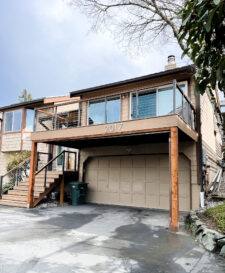
What Salt Air, Driving Rain, and Moss Actually Do to a Window
It helps to understand the failure points before talking about solutions, because each one points to a different fix.
Salt Air
Airborne salt is corrosive to unprotected metal. On windows, that shows up first in the small parts homeowners rarely think about: crank mechanisms on casement windows, hinges, screen frames, and weep hole covers. Once those start to corrode, a window that used to open smoothly starts to stick, and drainage paths that are supposed to move water back outside can clog or seize.
Driving Rain
Rain that comes in sideways behaves differently than rain that falls straight down. It gets pushed into gaps around trim, up under poorly lapped flashing, and into the meeting rail of an older single-hung or double-hung window. A window can look intact and still leak during a hard blow if the flashing and sealant details behind the trim weren't done correctly — the visible caulk line is not what actually keeps water out.
Moss Season
Extended damp, shaded conditions are exactly what moss and mildew need. On windows, that moisture shows up as black growth on sills and bottom trim, softening of wood components that stay wet too long, and — on older double-pane units — fogging between the panes, which means the seal has already failed and moisture is trapped where it can't be wiped away.
What "Energy-Efficient" Should Actually Mean Here
Energy-efficient windows get marketed with a lot of numbers. For a Whatcom County home near Chuckanut, two of them matter more than the rest:
- U-factor — how much heat escapes through the window. This region is heating-dominated far more than cooling-dominated, so a low U-factor (meaning better insulation) is the number to prioritize over solar heat gain figures aimed at hot, sunny climates.
- Warm-edge spacers — the material separating the panes of glass. Older aluminum spacers conduct cold straight through, which is exactly where interior condensation and mold tend to start on a humid coastline. Warm-edge (non-metal or thermally broken) spacers reduce that cold bridge significantly.
Argon gas fill between panes and a quality low-E coating both help with year-round comfort, but they don't compensate for a poor spacer or sloppy installation. A high-spec window installed carelessly will still leak and fog. A modest window installed correctly, with the right flashing and sealing, will often outperform it.
Frame Material: What Actually Holds Up Near the Water
Every frame material has trade-offs. None of them is "bad" — the right choice depends on how exposed a given wall of the house is and how much upkeep the homeowner wants to take on.
| Material | Salt Air / Corrosion Resistance | Moisture & Rot Resistance | Maintenance | Typical Cost Range |
|---|---|---|---|---|
| Vinyl | Good — no metal to corrode | Good, doesn't absorb water | Low | Lower |
| Fiberglass | Very good, dimensionally stable | Very good | Low | Mid to upper |
| Aluminum-clad wood | Good on the exterior face if properly sealed at joints | Good exterior, interior wood still needs protection | Moderate | Upper |
| Bare wood | Depends entirely on finish upkeep | Requires diligent maintenance in this climate | High | Upper |
Our general standard for exposed elevations in a coastal-influenced area like this: vinyl or fiberglass for most replacement jobs, because both shrug off salt-laden air with minimal upkeep. Wood and clad-wood still have a place where the look matters and the owner is committed to the maintenance schedule — we'll walk through that trade-off honestly rather than push one product for every wall of the house.
The Installation Details That Matter More Than the Window Itself
Most window failures we see in this area aren't product failures — they're installation shortcuts. The window itself is only as good as what's behind the trim.
Sill Pan Flashing
A sloped sill pan under the window opening gives any water that gets past the sash a way to drain back outside instead of soaking into the framing. Skipping this is one of the most common ways a "new" window ends up with hidden rot within a few years.
Proper Lapping with the Weather Barrier
Flashing tape and building paper need to be lapped in the correct order — top piece over the one below it — so water is always directed down and out, never trapped behind a seam. In a driving-rain environment, this detail is not optional.
Weep Holes Kept Clear
Weep holes let water that collects in the frame's drainage channels escape. In salt air, the small screens and covers over these openings can corrode and clog faster than inland installations, which is one more reason to check them during any service call, not just at install.
Insulation, Not Just Caulk
The gap between the window frame and the rough opening needs low-expansion foam or backer rod and sealant — not just a bead of caulk around the trim. Caulk alone hides gaps without actually stopping air movement or insulating the space.
Our Process for a Silver Beach Window Job
- On-site assessment. We look at which walls of your home take the brunt of the weather — usually whichever faces the water and the prevailing wind — and note existing damage, rot, or corrosion before quoting anything.
- Product selection matched to exposure. The most exposed side of the house may warrant a different frame material or glazing spec than a sheltered side. We'll explain why rather than sell a one-size package.
- Removal and hidden-damage check. Once the old window is out, we inspect the framing and sheathing underneath. This is often the first time hidden moss-season moisture damage becomes visible, and it needs to be addressed before the new window goes in, not after.
- Correct flashing and sealing. Sill pan, proper lapping, backer rod and sealant, weep holes clear — every time, not as an upsell.
- Cleanup and walkthrough. We show you the finished work and explain any maintenance points specific to the product installed.
Signs Your Current Windows Are Losing the Battle
A quick self-check before calling anyone:
- Fogging or a hazy film between the panes of glass (seal failure — this cannot be cleaned away)
- A draft you can feel near the frame edges during a windy, rainy day
- Black or green growth building up on sills or bottom trim faster than you can keep up with cleaning
- Windows that stick, or hardware that feels gritty or corroded when you open and close them
- Condensation forming on the inside of the glass through the winter months
- Heating bills that feel high relative to the size of the house, with no other obvious cause
Any one of these on its own might just need a repair. Several at once, especially on the side of the house facing the water, usually points to windows that have reached the end of their useful life in this climate.
Why a Crew That Already Works Silver Beach Is Worth Choosing
Window installation looks similar on paper everywhere. What's different here is knowing, before the truck even shows up, which elevations of a Silver Beach home are going to see the worst of the driving rain, how much salt exposure to plan for based on proximity to the water, and how long moss and moisture problems typically take to show up on homes in this part of Chuckanut. That's not something a crew picks up on their first job in the area — it's built from doing this work locally, repeatedly, on houses that face the same conditions yours does.
It also means fewer surprises during the job. A crew unfamiliar with this specific coastal environment may not think to check for corrosion in hardware that looks fine on the surface, or may not budget time to properly inspect framing for moss-season moisture damage before closing everything up.
Getting Started
If your windows are original to the house, showing fog between the panes, or just feel like they're losing the fight against the weather off the water, we're happy to take a look. We'll give you an honest read on what's actually needed — sometimes that's a full replacement, sometimes it's targeted repair — with a free, no-pressure estimate using the form below.