 Chuckanut Exterior
 Windows in Edison Take a Different Kind of Beating
Edison sits close enough to the water and open farmland that its windows deal with a mix most inland homes never see: salt-tinged air that corrodes hardware and finishes faster than the manufacturer's warranty assumes, driving rain that gets pushed sideways into any gap the flashing missed, and a long stretch of the year where moisture just sits against the building instead of drying off. Add in moss and algae growth on north-facing walls and trim during the wet months, and you've got a climate that will find every weak point in a window system — not just the glass, but the frame material, the sealant, and the flashing detail behind it.
Homeowners in Edison usually come to us for one of two reasons: their existing windows are fogging, sticking, or letting in drafts, or they're doing a broader exterior update and want the windows to actually match the performance of new siding or roofing rather than being the weak link. Either way, the fix is the same — pick a window built for this climate, and install it correctly the first time.
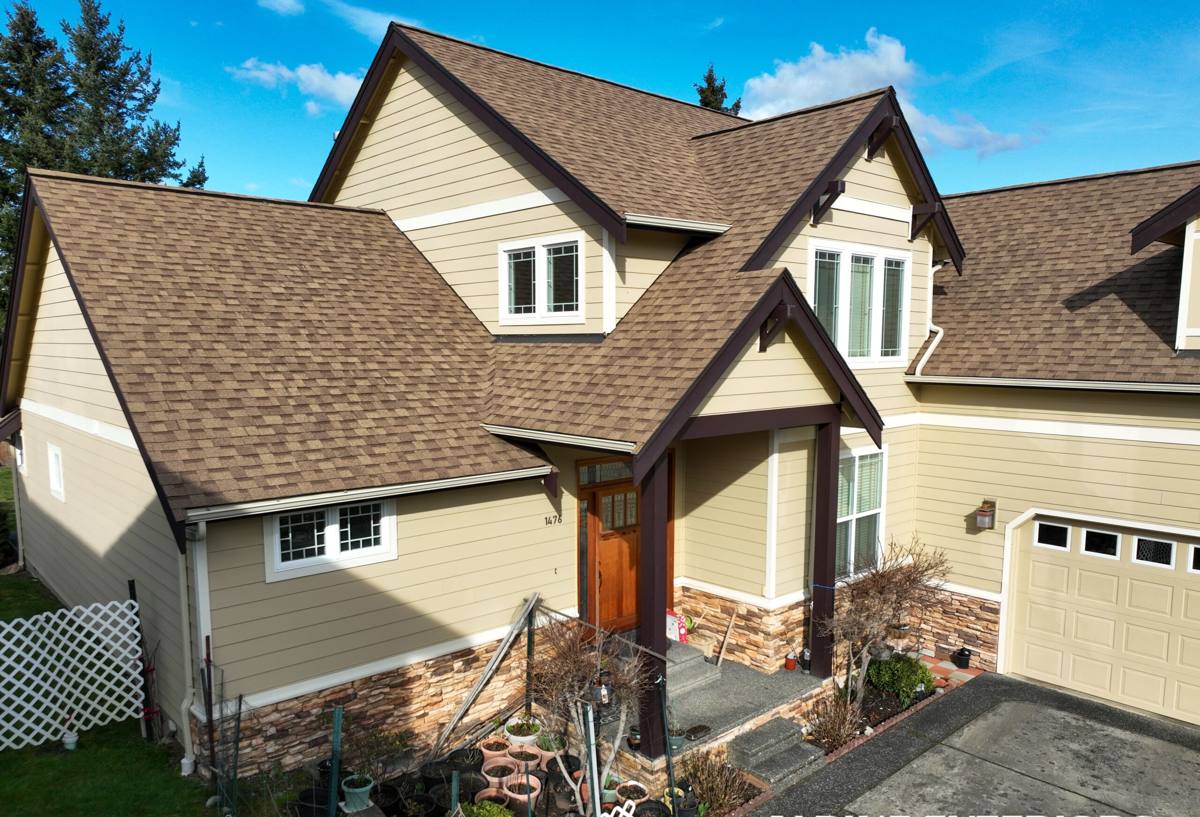
What "Energy-Efficient" Actually Means Here
Energy-efficient is a real, measurable spec, not a marketing word. For a window sold in Washington, the numbers that matter are U-factor (how much heat escapes through the window — lower is better) and Solar Heat Gain Coefficient, or SHGC (how much solar heat passes through — you want this moderate, not maximized, on a cloudy climate like ours). A window carrying the ENERGY STAR Northern Climate Zone rating is a reasonable baseline for this part of Washington, but the rating alone doesn't tell you whether the window will hold up to salt air and constant moisture — that comes down to frame material and how it's installed.
Frame Material Trade-offs
| Frame Type | How It Handles This Climate | Trade-off |
|---|---|---|
| Vinyl | Resists corrosion and rot; performs well in salt air; low maintenance | Can't be repainted; lower-end vinyl can warp under strong afternoon sun exposure |
| Fiberglass | Very stable dimensionally, holds paint well, strong moisture resistance | Higher upfront cost than vinyl |
| Wood / Wood-Clad | Traditional look, good insulator | Exterior wood needs regular maintenance to resist rot in a wet, salt-air climate — we're honest with clients about this upkeep before they commit |
| Aluminum | Strong and slim sightlines | Conducts heat and cold readily unless thermally broken; more prone to condensation in our damp winters |
For most Edison homes, we steer clients toward vinyl or fiberglass because they shed moisture, resist salt corrosion, and don't ask for the kind of exterior repainting schedule that wood does. That's a maintenance-and-durability call, not a knock on wood windows as a product — some homeowners want the look and are fine with the upkeep, and that's a reasonable choice too.
Glass Packages and Coatings
Double-pane, argon-filled glass with a low-E coating is the standard we install on most Edison replacement jobs. Low-E coatings reflect radiant heat while still letting daylight through, which helps in both directions — keeping heat in during our cold, wet winters and reducing solar gain on the rare hot summer afternoon. Triple-pane glass adds another layer of insulation and sound dampening, which is worth discussing for homes closer to the road or with rooms that run consistently cold, but it's a real cost jump and isn't always the right call for every room in the house.
Signs Your Current Windows Are Losing You Money
Most homeowners don't replace windows until something forces the issue, but the earlier you catch these signs, the more options you have:
- Fogging or a visible haze between the panes — the seal has failed and the insulating gas is gone
- Visible condensation on the inside of the glass during cold mornings
- A window that's hard to open, close, or lock — frames can swell or warp from repeated moisture exposure
- Noticeable draft near the frame even when the window is shut
- Soft or discolored trim, sill, or wall area around the window — a sign moisture is getting behind the frame
- Moss or dark staining building up on the frame or sill faster than on the rest of the exterior
- A jump in heating costs with no other explanation
Any one of these on its own might just mean a repair. Several together, especially on the same window, usually means the unit and its flashing are done and it's time to replace rather than patch.
What a Correct Installation Actually Involves
The window unit itself is maybe half the job. The other half — the part that determines whether the window still performs in five or fifteen years — is what happens at the rough opening before the new window ever goes in.
In a climate that pushes rain sideways into wall assemblies, flashing detail is what keeps water out of the wall cavity. That means proper sill pan flashing so any water that does get past the window sheds back outward instead of pooling on the sill, correctly lapped house wrap or weather-resistive barrier around the opening, and sealant used in the right places — not everywhere, since sealing the wrong spot can trap moisture instead of releasing it. We also check insulation around the window frame itself; a poorly insulated gap between the frame and the rough opening is a common source of the draft complaints homeowners describe as "the window feels leaky" even when the window unit is fine.
This is the step that gets skipped when a job is priced too low or rushed, and it's also the step that doesn't show up in a walkthrough — it's only visible once something goes wrong, usually a year or two later when moisture has already gotten into the wall.
Our Process for an Edison Window Project
- On-site assessment. We look at each window individually — not every window in a house needs replacing on the same timeline, and we'll tell you honestly which ones are still doing their job.
- Product selection. We walk through frame material, glass package, and grille or style options based on your home, your budget, and how exposed that side of the house is to weather.
- Written estimate. Clear scope, product spec, and price before anything is scheduled — no surprise add-ons once work starts.
- Removal and opening prep. Old units come out carefully to protect interior and exterior finishes; the opening is inspected for hidden rot or moisture damage before the new window goes in.
- Flashing and installation. Sill pan, house wrap integration, and air sealing done to manufacturer spec — this is the part that actually determines long-term performance.
- Final check and cleanup. Every window is opened, closed, and locked to confirm smooth operation, and the site is left clean.
What Drives the Cost
| Factor | Why It Matters |
|---|---|
| Frame material | Vinyl is generally the most budget-friendly; fiberglass and wood cost more upfront |
| Glass package | Triple-pane and specialty coatings add cost but also add performance |
| Window size and configuration | Large picture windows, bays, or custom shapes cost more than standard double-hung sizes |
| Condition of the existing opening | Hidden rot or moisture damage found during removal adds repair scope |
| Number of windows done at once | Bundling a full-house replacement typically brings a better per-window cost than doing them one at a time |
We don't quote a number until we've actually seen the windows and the openings — anyone giving a firm price over the phone for a house they haven't looked at is guessing.
Why It Matters That We Already Work This Area
A crew that regularly works Edison and the surrounding Chuckanut area already knows what this coastline does to a building envelope over time — where moss tends to build up, which wall orientations take the worst of the driving rain, and how salt air shortens the working life of cheap hardware and finishes. That's not something you can fully account for with a generic install checklist written for a drier climate. It also means we're not learning on your house — we're applying what we've already seen hold up, and what we've seen fail, on homes like yours in this exact area.
After Installation: Keeping Windows Performing
New windows still need a little attention in this climate to get their full lifespan:
- Rinse salt residue and grime off frames and glass periodically, especially on sides facing open air or water
- Keep weep holes (the small drainage openings on the exterior sill track) clear of debris and moss so water can drain out
- Check exterior caulking annually for cracking or gaps, particularly after a hard winter
- Operate locks and hardware a few times through the wet season so mechanisms don't seize up
None of this is heavy maintenance — it's the same kind of upkeep any exterior feature needs in a coastal climate, and it goes a long way toward protecting the investment.
If your windows in Edison are drafty, fogged, or just due for an honest look, we're happy to come out, assess what you actually have, and give you a straightforward, no-pressure estimate. Use the form below to get started.