 Chuckanut Exterior
 Why Siding Repair in Edison Isn't a Generic Job
Edison sits close to the water in the Chuckanut area of Whatcom County, and that location shapes what actually goes wrong with siding here. Homes in this pocket of the county deal with a specific combination of stresses that a house twenty miles inland simply doesn't see to the same degree: salt-laden air working at fasteners and finishes, storms that push rain sideways into wall assemblies instead of straight down, and a moss season that can stretch across most of the year on shaded walls. Siding repair that ignores any one of those three factors tends to look fine for a season or two and then fail again in the same spot.
This page is about one service, in one place: repairing siding on homes in and around Edison. Not a general siding overview, not a replacement pitch — what actually damages siding out here, how we tell a cosmetic issue from one that's spreading, and what a repair has to include to actually hold up through the next several wet seasons rather than just through the next dry one.
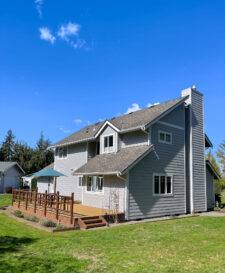
What the Local Climate Actually Does to Siding
Salt Air and Fastener Corrosion
Salt in the air off the water doesn't just affect homes with a direct view of it — it travels, settling on siding, trim, and every exposed fastener within reach of the wind. Over time it accelerates corrosion at nail heads and metal flashing, and it breaks down lower-grade finishes faster than a dry inland climate ever would. A lot of the repair calls we get in this area trace back to a fastener or a piece of flashing that gave out years before it should have, simply because of steady salt exposure nobody was watching for.
Wind-Driven Rain Into Wall Assemblies
Storms that come through the Chuckanut area rarely drop rain straight down. Wind pushes it sideways into south- and west-facing walls, forcing moisture into seams, butt joints, and any gap around a window or door that isn't sealed and flashed correctly. That's a different kind of stress than ordinary rainfall, and it's often the real explanation behind a soft spot or staining that shows up nowhere near where the water actually got in.
Moss, Shade, and Sustained Moisture
Edison's tree cover and mild, damp weather add up to a moss season that can run most of the year on north-facing or shaded walls. Moss and mildew hold moisture directly against siding longer than an open, sun-exposed wall ever experiences, which speeds up whatever damage is already underway underneath. It's also one of the most visible early warning signs — dark streaking or moss buildup on siding is often the first thing a homeowner notices, even when the more serious issue is happening a few inches away, out of sight.
Signs an Edison Home Needs Siding Repair
Some of these are obvious from the ground. Others take a closer look, which is part of why a real inspection matters more than a drive-by estimate.
- Soft or spongy siding when pressed, especially low on the wall or around window and door trim
- Dark staining or moss that returns quickly after cleaning, particularly on shaded or north-facing walls
- Cracked, buckled, or separating boards, or gaps opening up at butt joints
- Rust streaking below fasteners or visibly corroded nail heads and trim
- Paint or finish that's peeling, bubbling, or chalking well ahead of schedule
- Warping or bowing panels, which usually points to moisture already trapped behind the surface
- Interior signs — a musty smell, a damp patch on an inside wall, or peeling interior paint near an exterior corner
Cosmetic Wear vs. Damage That's Actually Spreading
Not every mark on a wall means the same thing, and telling the difference correctly is the first real job of an honest repair estimate.
| What You See | Usually Cosmetic | Often a Sign of Spreading Damage |
|---|---|---|
| Surface dirt or light moss film | Yes — cleans off, no softness underneath | Only if moss has been there long enough to hold sustained moisture |
| Faded or chalking paint | Yes, if the board underneath is still firm | Watch for it if paired with any softness or gapping |
| Hairline cracking at a butt joint | Sometimes, if caught early | Often — an open path for wind-driven rain to get behind the wall |
| Soft or spongy board | No | Yes — moisture has already reached the substrate |
| Bulging or warped panel | No | Yes — usually trapped moisture behind the siding |
| Rust staining around fasteners | Cosmetic if isolated and shallow | Can mean the fastener has already lost holding strength |
The cosmetic column can generally wait for routine maintenance. The right-hand column shouldn't sit on a to-do list, because moisture that's already behind the siding doesn't stay contained to the spot where it's visible — it spreads along sheathing and framing while the surface still looks manageable.
What a Correct Siding Repair Actually Involves
Diagnosing the Cause, Not Just the Symptom
A damaged board is a symptom. The cause is almost always something else — a failed piece of flashing, a gap in the house wrap, a joint that was never sealed correctly, or years of moss holding moisture against one section of wall. Replacing the visible damage without finding and correcting the cause is the most common reason a repair fails again in the same spot, often faster the second time because the underlying problem was never touched.
Matching Material and Finish
A repair that doesn't match the existing siding's profile, reveal, and finish reads as a patch job from the curb, even when the work underneath is solid. On a home with a factory-finished product, matching color and sheen correctly matters as much as matching the board profile — a mismatched patch is often the first thing a homeowner notices, and the last thing they wanted to see after paying for a repair.
Flashing and Sealing Done Right
Every repair that touches a window, door, or wall penetration is also a flashing job, whether it's treated that way or not. Flashing has to lap correctly to shed water downward and outward, and butt joints and trim transitions need to be sealed in a way that actually holds up against wind-driven rain rather than just looking sealed on installation day. This is where a rushed repair and a correct one look identical for the first year and very different by the third.
Repair or Replace? How We Actually Make That Call
Not every damaged section of siding means a full re-side, and not every repair is the cheaper, smarter option either. A few honest factors drive that decision:
- How far the damage has spread. A few isolated boards or a single wall section is usually a straightforward repair. Moisture damage that's tracked across multiple walls or into the sheathing often isn't worth chasing board by board.
- The age and condition of the rest of the siding. Repairing a section on siding that's near the end of its service life buys limited time before the same conversation happens again elsewhere on the house.
- Whether the original installation was the real problem. If missing flashing or poor sealing at the original install is what caused the damage, repairing that one spot without addressing the same detail elsewhere on the house just delays the next repair call.
- Availability of a matching product. Discontinued colors or profiles can make an invisible patch difficult, which sometimes shifts the math toward replacing a full wall or elevation instead of one section.
We'll give a straight answer on which category a given repair falls into, including when a targeted repair is genuinely the right call and full replacement isn't necessary.
Why We Repair With James Hardie
We install James Hardie fiber cement exclusively, and that standard carries through to repair work as well. When a repair calls for new boards or trim, we're matching into and backing the work with a non-combustible product that doesn't have an organic core for salt air, wind-driven rain, or a long moss season to work into over time. Hardie's factory-applied ColorPlus finish is built to hold color and resist moisture far better than field-applied paint, which matters on a repaired section that needs to match and perform right alongside older factory-finished boards. And because Hardie backs the product with a strong transferable warranty, a repair done to spec doesn't create a gap in that coverage the way an off-brand patch material could.
We won't repair a damaged wall with LP SmartSide, vinyl, Cemplank, Allura, primed spruce, or cedar, even as a quick patch. Mixing products on a wall creates its own long-term problems — different expansion behavior, different moisture handling, different maintenance schedules — and we'd rather do a repair once, correctly, than create a second issue while fixing the first.
Our Process for an Edison Siding Repair Call
- Inspection first. We look at the visible damage and probe the surrounding area, because the boundary of a repair is rarely exactly where the damage is easiest to see.
- Find the cause. Before quoting anything, we identify what let moisture in — flashing, a sealant failure, a grade or clearance issue — so the repair addresses the source, not just the symptom.
- Honest scope and options. We explain what needs fixing now, what can be monitored, and whether a targeted repair or a broader scope makes more sense, in plain terms.
- Correct execution. Matching material, proper flashing and sealing, and fastening to spec — the same standard we hold on a full installation, applied to a repair.
- A clear look at what was fixed. We walk through what we found and what we did, so you know exactly what's now protecting that section of wall.
Why Hiring a Crew That Already Works Edison Matters
A contractor who occasionally passes through the Chuckanut area can still do competent repair work, but a crew that's regularly out on Edison homes has already seen how salt air, driving rain, and moss actually behave on houses like yours — not just how a product performs on a spec sheet. That shows up in practical decisions on a repair call: which walls stay wet the longest, where the original flashing details on homes of a certain age and style tend to fall short, and which fastener and sealing choices are worth the extra time so the repair doesn't turn into a callback after the next storm off the water. It also means a more accurate estimate the first time, because the inspection accounts for how this specific stretch of coastline behaves rather than applying a generic checklist built for a drier, more sheltered part of the county.
If you've got a section of siding on your Edison home that's soft, stained, cracked, or just doesn't look right, we're glad to take a look and give you a straight answer — what's causing it, what it actually needs, and what it doesn't. Reach out using the form below for a free, no-pressure estimate.