 Chuckanut Exterior
 Why Decks in Columbia Wear Out Faster Than the Brochure Says
If you live in the Columbia area of Chuckanut, you already know your deck takes more punishment than a deck the same age would in a drier inland town. Whatcom County's marine climate means salt-tinged air drifting off the water, long stretches of driving rain in fall and winter, and a moss season that can run from October well into spring. None of that is dramatic on any single day, but it adds up year after year in ways that are easy to miss until the structure underneath is already compromised.
Salt air accelerates corrosion on fasteners, joist hangers, and any exposed metal hardware. Driving rain doesn't just fall straight down here — wind pushes it sideways under railings, into end grain, and along ledger boards where the deck meets the house. And moss doesn't just look bad on decking boards; it holds moisture against wood and composite surfaces far longer than plain rain does, which is exactly the condition that rot, mildew, and slow structural decay need to take hold. A deck built without those three factors in mind will often look fine on the surface for a few years while the framing underneath quietly loses integrity.
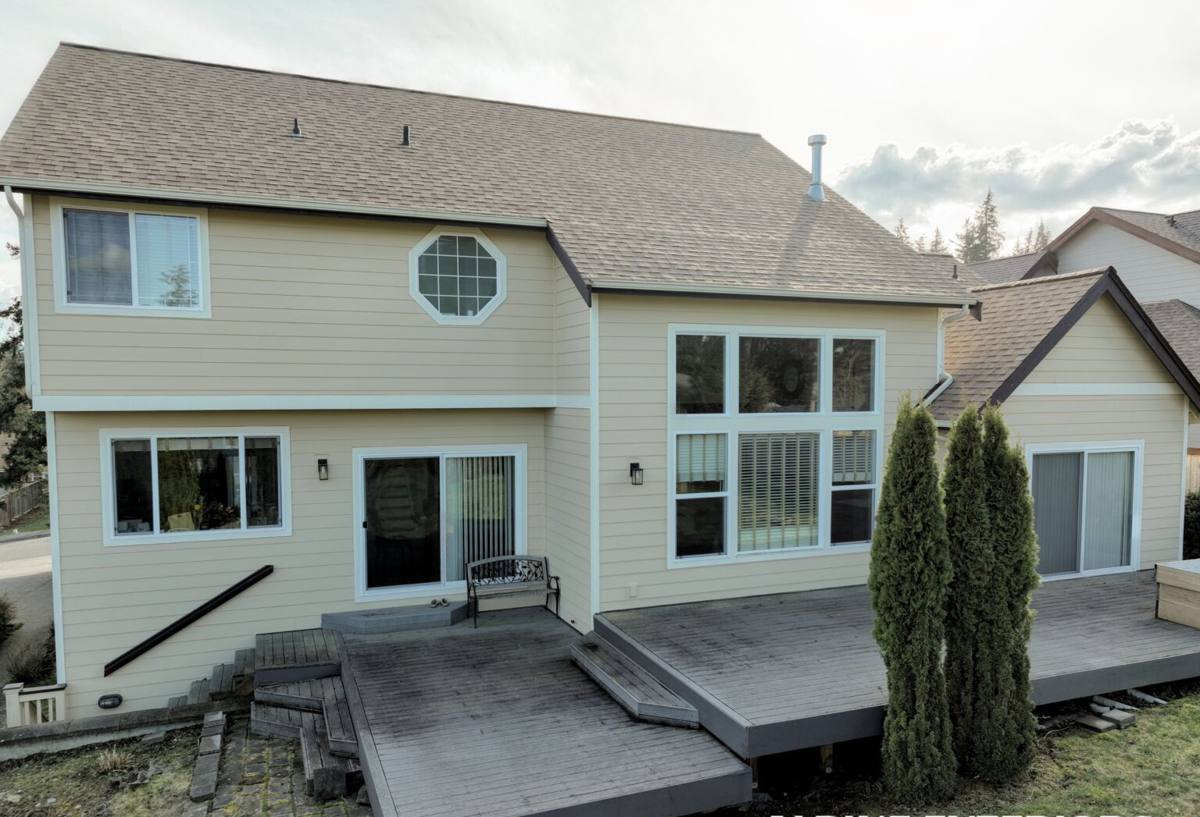
Signs a Columbia Deck Needs Replacement, Not Just Repair
Not every tired-looking deck needs a full replacement. But there's a point where patching individual boards is throwing good money after bad, and pushing past that point is a safety issue, not just a cosmetic one. We look for a specific set of warning signs before recommending replacement over repair.
- Soft, spongy, or bouncy spots in the decking or framing when you walk across it
- Visible rot or dark staining at the ledger board where the deck attaches to the house
- Persistent moss or algae growth that returns within weeks of cleaning
- Rust streaking from fasteners, joist hangers, or post bases
- Railings that flex or feel loose when leaned on
- Gaps opening up between deck boards or around posts that weren't there a year or two ago
- A deck more than 15-20 years old that was built to older code, especially around ledger attachment and railing spacing
Any one of these on its own might be a repair. Two or three together, especially involving the ledger or the framing, usually means the deck has reached the end of its useful life and rebuilding is the honest recommendation.
What a Correct Deck Replacement Actually Involves
A deck replacement done right is mostly invisible once it's finished — the parts that matter most are underneath the decking boards. Skipping steps here is how homeowners end up replacing a "brand new" deck again in eight years instead of twenty-five.
Ledger and Flashing
The ledger board is where most deck failures start, especially in a climate with this much sideways rain. Proper flashing at the ledger-to-house connection keeps water from tracking behind the siding and into the wall framing. We treat this connection as the single most important detail on the job, not an afterthought.
Footings and Posts
Footings need to sit below the frost line and bear on undisturbed, well-compacted soil. In areas with poor drainage, we look at whether existing footings have settled or heaved before deciding whether they can be reused or need to be replaced entirely.
Framing and Fasteners
Given the salt air in this area, we favor corrosion-resistant fasteners and hardware rated for exterior, coastal-adjacent use rather than standard galvanized products that break down faster here than they would further inland. Joist hangers, structural screws, and post connectors all get the same consideration.
Drainage Under the Deck
Water needs somewhere to go. Proper decking gaps, sloped ledger flashing, and grading beneath the deck all matter more here than in a dry climate, because standing or slow-draining water is what feeds moss and rot in the first place.
Decking Material Options for a Marine Climate
There's no single "best" decking material — there's a best fit for how you use the deck, your budget, and how much upkeep you're willing to do. Here's how the common options actually perform under Columbia's rain-and-moss conditions.
| Material | Moisture & Moss Resistance | Maintenance | Typical Lifespan |
|---|---|---|---|
| Pressure-treated wood | Moderate — needs sealing to perform well | Annual cleaning and periodic re-sealing | 10-15 years |
| Cedar | Good natural resistance, but surface still holds moss if not maintained | Regular cleaning, occasional oiling | 15-20 years |
| Composite decking | Very good — doesn't absorb moisture like wood | Periodic washing to prevent surface algae/moss film | 25-30 years |
| PVC/capped polymer | Excellent — fully sealed surface | Occasional rinsing | 25-30+ years |
We don't push one product on every homeowner. Wood has a warmer, natural look many people want and costs less upfront, but it asks for more of your time every year. Composite and PVC cost more initially but shed moisture better and hold up longer against the moss cycles this area sees. We'll walk through the honest trade-offs for your specific deck and budget rather than defaulting to whatever's easiest for us to install.
Our Deck Replacement Process, Step by Step
- On-site assessment — we inspect the existing structure, ledger connection, footings, and drainage before quoting anything
- Material and design walkthrough — we go over decking, railing, and fastener options based on your budget and how the deck gets used
- Permit and code check — we confirm what Whatcom County requires for your specific project before work starts
- Demolition and disposal — the old deck comes out, including any compromised framing or footings, not just the surface boards
- Framing rebuild — footings, posts, ledger flashing, and joists go in to current code, sized for the decking material chosen
- Decking, railing, and stairs installation
- Final walkthrough — we check gaps, drainage, railing stability, and finish details with you before calling the job done
We don't skip the framing rebuild step just because the old footings "look fine." A deck's framing is the part you'll never see again once the decking boards go down, which is exactly why it's the part worth doing right the first time.
Permits and Local Code Considerations
Most deck replacements in Whatcom County require a permit, particularly when the ledger attachment, footings, or railing height and spacing are being changed or rebuilt. Requirements can vary based on deck height, size, and proximity to property lines. We handle the permit process as part of the job rather than leaving it for the homeowner to sort out, and we build to current code even when replacing a deck that was originally grandfathered under older rules — that protects you if you ever sell the home or have it inspected later.
What Deck Replacement Typically Costs — and Why
Every deck is different, and giving a single number without seeing the site would be misleading. What we can offer is a clear picture of what actually drives the price up or down.
| Cost Factor | Why It Matters |
|---|---|
| Deck size and layout | More square footage and multi-level designs mean more material and labor |
| Decking material choice | Wood costs less upfront; composite and PVC cost more but reduce long-term maintenance |
| Footing and framing condition | Rotted footings or undersized framing add rebuild cost beyond surface-level work |
| Railing style | Cable, glass, and custom railings cost more than standard baluster designs |
| Site access | Steep lots or tight access can add labor time for material handling and demolition |
| Permit requirements | Larger or higher decks may require engineering review, adding time and fees |
Broadly, a straightforward deck replacement with standard materials tends to fall in a moderate range, while larger decks, upgraded railing, or premium composite/PVC decking push toward the higher end. We'll give you a firm, itemized quote after seeing the site — not a ballpark number that changes once demolition starts.
Maintaining a New Deck Through Columbia's Moss Season
A new deck still needs seasonal attention here, even with a lower-maintenance material. A few habits go a long way toward protecting the investment:
- Sweep debris and standing leaves off the deck surface regularly through fall
- Wash the deck surface at least once before winter to remove early moss growth before it establishes
- Keep gutters and downspouts near the deck clear so water isn't funneling directly onto or under it
- Check railing connections and fastener heads once a year for early rust or looseness
- Re-seal wood decking on the manufacturer's recommended schedule — don't wait until it looks dry and gray
None of this is a huge time commitment, but skipping it is how a well-built deck starts showing the same problems as the one you just replaced, just a few years sooner than it should.
Why Hiring a Crew That Already Works in Columbia Matters
Deck-building fundamentals don't change from town to town, but the details that determine whether a deck lasts 10 years or 25 do change with the climate it's sitting in. A crew that regularly works decks in the Columbia area already knows which fastener grades hold up against the salt air here, how much slope a ledger flashing detail needs to shed this area's driving rain, and which decking materials actually resist the moss cycle instead of just looking good in a showroom. That local pattern recognition is the difference between a deck built to a generic spec sheet and one built for the conditions it will actually face every winter.
Getting Started
If your deck in the Columbia area is showing soft spots, rust, persistent moss, or is simply past its reasonable service life, we're happy to take a look and give you an honest read on repair versus replacement — no pressure, no upsell. Fill out the form below for a free estimate, and we'll walk the site with you and talk through what your deck actually needs.