 Chuckanut Exterior
 Siding Replacement in Burlington: Built for What This Climate Actually Does to a House
Homes in and around Burlington sit in one of the more demanding exterior environments in Whatcom County. You've got salt-laden air moving in off the water, long stretches of driving rain that push moisture sideways into wall assemblies, and a moss season that seems to stretch a little longer every year. None of that is dramatic on its own — it's the cumulative effect that wears siding down. A house that looked fine five years ago can suddenly show cracked caulk lines, soft trim, or streaking that won't scrub off. That's usually the siding telling you it's done absorbing the punishment.
Siding replacement isn't just a cosmetic upgrade here. It's the single biggest factor in whether your walls stay dry, whether your paint holds its color, and whether moisture stays out of your framing. We do this work specifically for homes in the Burlington area, and the material and installation choices we make are shaped by what this specific climate does over time — not by what works in a drier, calmer region.
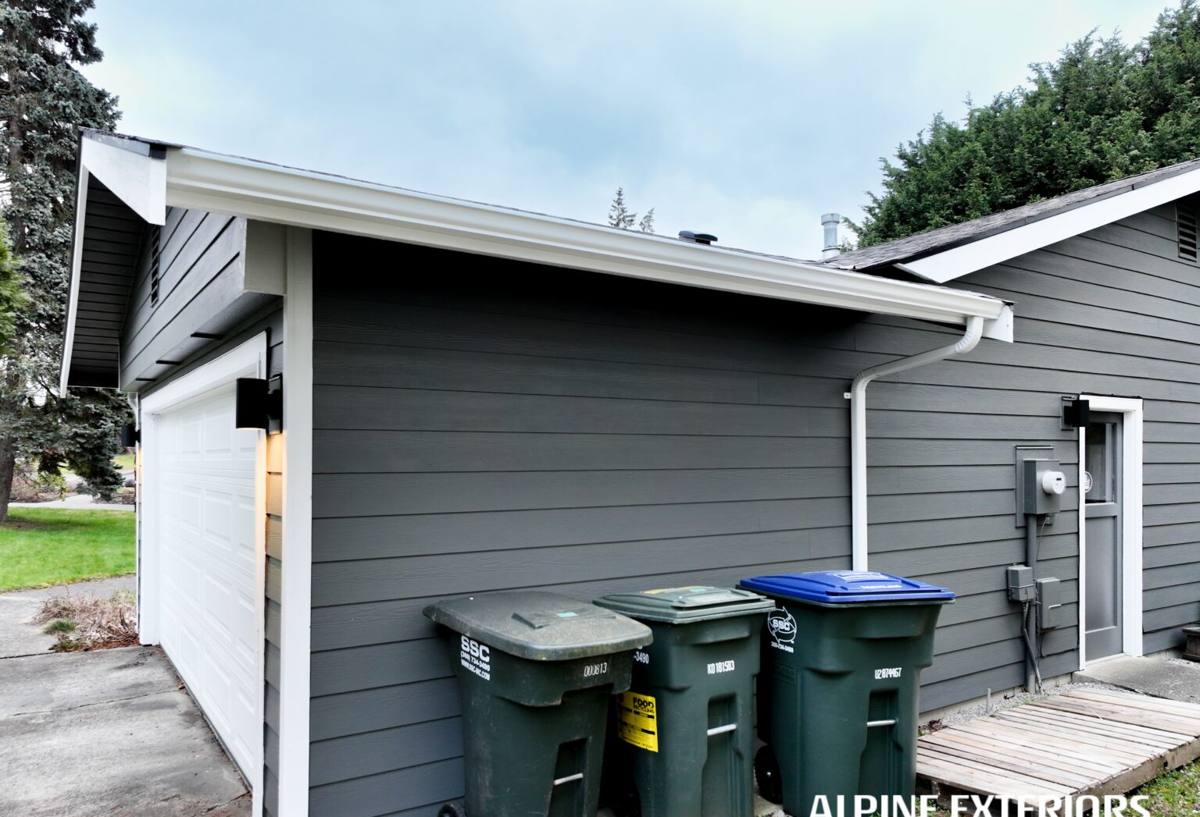
What Burlington's Climate Does to Siding Over Time
Salt Air
Proximity to Puget Sound air means airborne salt is a constant, low-level presence on exterior surfaces. Salt accelerates the breakdown of paint film, corrodes exposed fasteners, and speeds up the failure of caulking at joints and seams. Materials that rely on a factory finish or a protective coating need that coating to actually hold up under salt exposure — not just look good on a spec sheet.
Driving Rain
Wind-driven rain doesn't just fall on a wall, it gets pushed into it — into laps, seams, butt joints, and anywhere the water-resistive barrier and flashing details aren't doing their job. Siding that swells, wicks moisture, or delaminates when saturated will eventually let that water find a path inward. The material matters, but so does the installation: correct flashing, proper lap, and the right gap and clearance details are what actually keep driving rain from becoming a wall problem.
Moss and Prolonged Dampness
Long wet seasons mean siding surfaces — especially north-facing walls and anything shaded by trees — stay damp for extended stretches. That's exactly the environment moss and algae need to take hold. Once moss establishes on a siding surface, it holds moisture against the material even longer, which compounds the problem. Siding that can't shed water quickly or that has a porous surface gives moss more to grab onto.
Signs a Burlington Home Needs Siding Replacement, Not Just a Patch
- Cracked, brittle, or peeling caulk at panel joints and trim that keeps failing no matter how often it's redone
- Soft or spongy spots when you press on the siding, especially near the bottom courses or around windows
- Persistent moss or algae growth that returns quickly after cleaning
- Visible warping, buckling, or panels pulling away from the wall
- Paint that won't hold, or chalky/streaky discoloration that keeps coming back
- Rising energy bills with no other obvious cause, which can point to a compromised wall assembly
- Interior signs like musty smells, staining, or bubbling drywall near exterior walls
Any one of these on its own might be manageable with spot repair. Several at once, especially on a home that's had multiple rounds of caulking and touch-up paint, usually means the siding system itself has reached the end of its useful life.
Why We Only Install James Hardie Fiber Cement
We don't install vinyl, LP SmartSide, primed spruce, cedar, or other fiber cement brands. That's a deliberate standard, not a sales pitch, and it comes directly from what we've seen hold up — and what doesn't — in exactly this kind of climate.
Vinyl is affordable and low-maintenance in mild conditions, but it can become brittle in cold snaps, expand and contract with temperature swings, and it isn't fire-resistant. In a wind-driven rain environment, vinyl's lap-and-gap design also gives water more opportunity to get behind the panel than a properly engineered fiber cement system.
Engineered wood products like LP SmartSide use treated wood strand technology and can perform well when installed and maintained exactly to spec, but wood-based siding is inherently more vulnerable to moisture intrusion at cut edges and seams if caulking and paint maintenance ever slip — which is a real risk in a climate where moisture exposure is nearly constant.
Primed spruce and cedar are traditional, attractive choices, but raw or primed wood requires disciplined ongoing maintenance — repainting, sealing cut edges, and staying ahead of moisture — to avoid rot. In a region with this much sustained dampness and moss pressure, that maintenance burden is steep, and the margin for error is small.
James Hardie fiber cement is non-combustible, dimensionally stable across temperature swings, and its ColorPlus factory finish is baked on and warrantied against fading, chipping, and cracking — which matters directly for salt air exposure. Hardie's HZ5 product line is engineered for cold, wet climates like ours. It resists moisture absorption far better than wood-based products, holds paint and color longer under UV and salt exposure, and its dense, engineered surface gives moss and algae less to grab onto than more porous materials. That combination is why it's the only product we put on homes.
Comparing Siding Options for a Climate Like This
| Factor | Vinyl | Wood / Engineered Wood | James Hardie Fiber Cement |
|---|---|---|---|
| Moisture resistance | Moderate — water can get behind panels | Lower without strict maintenance | High — engineered for wet climates |
| Fire resistance | Low — can melt or ignite | Low — combustible | Non-combustible |
| Maintenance | Low, but limited repair options | High — regular painting/sealing needed | Low — factory finish holds up for years |
| Salt air / UV finish durability | Can fade and become brittle | Paint fails faster under salt/UV | ColorPlus finish warrantied against fade/chip/crack |
| Typical lifespan when installed correctly | 20-30 years | Highly variable with maintenance | 30+ years, often longer |
What a Correct Siding Replacement Job Actually Involves
Swapping old siding for new panels isn't the whole job — and in a climate this demanding, the details behind the siding matter as much as the siding itself.
Tear-Off and Wall Assessment
We remove the existing siding down to the sheathing and inspect for hidden moisture damage, soft framing, or prior flashing mistakes. This is often the first real look anyone's had at the wall assembly in years, and it's where we catch problems before they get sealed back up.
Water-Resistive Barrier and Flashing
A new weather-resistive barrier goes on correctly lapped, and flashing gets installed at every window, door, and penetration. In a driving-rain climate, this layer is doing more work than the siding itself — it's the actual line of defense if any water does get past the surface material.
Correct Fastening and Clearances
Hardie siding has specific fastening patterns, gap requirements, and ground/roof clearances that are engineered into the product's performance. Skipping these details is the single biggest reason fiber cement siding underperforms — the product isn't the problem, the installation is.
Trim, Caulking, and Paint Detailing
Joints get properly caulked with products rated for the exposure, and any field-cut edges are sealed per manufacturer spec — critical in a climate where every gap is a potential entry point for driving rain.
Our Process for Burlington Homeowners
- Free on-site inspection and assessment of your current siding and wall condition
- Honest recommendation — if a section can be legitimately repaired instead of replaced, we'll tell you
- Clear, written estimate with product lines and color options
- Scheduled tear-off, wall assessment, and correction of any hidden issues found
- Installation to Hardie's fastening, clearance, and flashing specifications
- Final walkthrough so you know exactly what was done and why
Why It Matters to Hire a Crew That Already Works This Area
Siding installation isn't one-size-fits-all across regions. A crew used to working in a dry, mild climate may not think twice about clearance details or flashing laps that matter enormously here. Working regularly in Whatcom County means we're used to designing every detail — from the water-resistive barrier to the final caulk joint — around salt exposure, driving rain, and a moss season that punishes any shortcut. That's not a marketing point, it's just what correct installation looks like when you do this work here consistently.
What to Check Before Hiring Anyone for Siding Replacement
- Do they specify which siding product and product line they're installing, or just say "fiber cement"?
- Will they explain their flashing and water-resistive barrier approach, not just the visible panel work?
- Do they carry manufacturer certification or specific training on the product they're installing?
- Is their estimate written and itemized, or verbal and vague?
- Do they talk about long-term maintenance and warranty coverage, or just the install day?
If your Burlington home's siding is showing wear, cracking caulk, persistent moss, or paint that won't hold anymore, it's worth getting a straightforward, no-pressure look at what's going on. Use the form below to request a free estimate, and we'll walk you through what we find and what your options actually are.