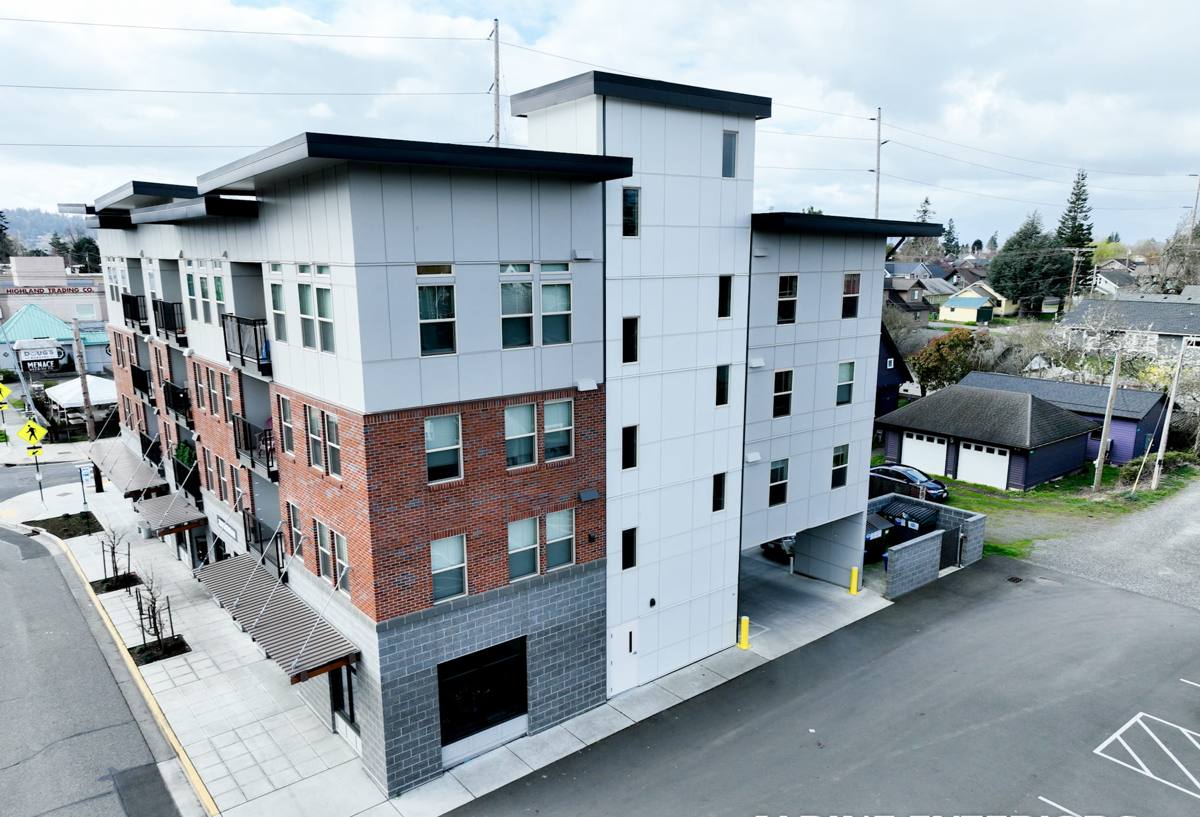
 Chuckanut Exterior
 What "New-Construction" Windows Actually Means
New-construction windows are built with a nailing fin around the perimeter of the frame, designed to be installed while the wall opening is still open to the studs and sheathing — before the weather-resistive barrier (WRB) and siding go on. That's different from a replacement or "insert" window, which gets fitted into an existing frame after the original sash is removed, with no access to the framing behind it.
If you're building new in or around Bellingham, adding an addition, or enlarging an existing rough opening, you're almost always looking at new-construction windows. The advantage is real: with the wall open, we can build a proper drainage plane and flashing assembly from scratch instead of working around what's already there. The trade-off is that there's no second chance once the siding closes it up — the install has to be right the first time.
Why Bellingham's Climate Raises the Stakes
Chuckanut and the greater Bellingham area sit right where marine weather off the Sound meets steep, wooded terrain, and that combination is hard on window openings in a few specific ways.
- Salt air: Proximity to Bellingham Bay means airborne salt reaches siding, trim, and window hardware more than an inland home would ever see. Cheap fasteners and low-grade cladding corrode faster here.
- Driving rain: Fall and winter storms regularly bring wind-driven rain that hits window openings sideways, not just straight down. A flashing detail that would pass in a calmer climate can still leak in Whatcom County if it relies on sealant alone.
- Long moss season: Persistent dampness on north- and west-facing walls means moss and algae get a long runway to establish themselves, and it means any moisture that does get trapped behind a window doesn't dry out quickly. A small flashing mistake here doesn't show up as a stain in a week — it shows up as rot a year or two later.
None of this means new-construction windows are riskier in Bellingham than anywhere else. It means the margin for error on the installation sequence is smaller, and it's why we treat flashing and drainage as the actual product, with the window itself as one part of the assembly.
Materials and Glass That Hold Up Locally
Frame Material
Vinyl, fiberglass, and aluminum-clad wood all have a place in new construction, and the right choice depends on the home's design and budget more than any single "best" answer. What matters more locally is hardware and cladding quality: stainless or corrosion-resistant fasteners and hinges hold up to salt air far longer than standard-grade hardware, and if you're leaning toward aluminum-clad wood, the quality of the cladding and finish matters more here than in a dry inland climate. We steer clients away from anything with exposed low-grade metal components on the exterior face — it's a maintenance headache waiting to happen, not a dealbreaker for the window itself.
Glazing Package
Dual-pane with a good low-E coating and argon fill is the baseline we recommend for this area; triple-pane makes sense on north-facing rooms or homes prioritizing comfort over budget. The spec that gets overlooked most often is condensation resistance. Whatcom County's humidity stays elevated much of the year, and a window with a weak condensation resistance (CR) rating will fog and drip on the interior in winter even if the U-factor looks fine on paper. We ask about CR ratings specifically when helping clients compare options — it's a better predictor of how the window will actually feel in a Bellingham winter than U-factor alone.
The Flashing and Installation Sequence That Actually Keeps Water Out
This is the part of the job that doesn't show once the siding's on, and it's also the part that determines whether the window performs for twenty years or leaks in five. A correct sequence looks like this:
- Rough opening is checked for square, level, and correct dimensions before the window ever shows up on site.
- A sill pan flashing is installed first, sloped toward the exterior so any water that does get past the window has somewhere to go besides the framing.
- The window's nailing fin is set into the opening and fastened per the manufacturer's schedule — skipping fasteners to save time is a common shortcut that voids warranties and weakens wind resistance.
- Flashing tape or housewrap is applied at the jambs, then the head, in a shingle-lap sequence — each layer overlapping the one below it, so water is always directed outward and down, never trapped behind the layer above.
- The WRB is integrated over the top flange with the sill left free-draining, not fully sealed, so any incidental moisture can still escape.
- Sealant is used as a secondary line of defense at specific joints, not as the primary strategy for keeping water out. A window that depends on a bead of caulk to stay dry will eventually fail — caulk is maintenance, not waterproofing.
This is standard best practice, but it's also the sequence that gets rushed on jobs where the crew is unfamiliar with coastal conditions or working off a generic checklist instead of understanding why each step matters.
New-Construction vs. Replacement Windows
| Factor | New-Construction (Nail Fin) | Replacement (Insert) |
|---|---|---|
| When it's used | New builds, additions, enlarged or relocated openings | Existing openings where framing stays as-is |
| Access to framing/flashing | Full access — flashing and WRB built from scratch | Limited — works within the existing frame's condition |
| Moisture management | Best-case: fully controlled drainage plane | Depends heavily on the condition of the original frame |
| Sightlines | Slightly larger glass area, cleaner sightlines | Slightly reduced glass area due to the insert frame |
| Typical timing | Before siding and trim go on | Any time, independent of siding schedule |
Energy Code and Performance Considerations in Whatcom County
Washington's state energy code sets minimum U-factor requirements for new windows, and Whatcom County falls within the marine climate zone that the code treats differently from drier, colder parts of the state — the emphasis leans toward moisture management and moderate insulation rather than extreme cold performance. A few things we check against local conditions:
- U-factor: Needs to meet or beat current code minimums for the project type, but going meaningfully better rarely pays for itself here the way it might in a colder climate.
- Condensation resistance: More relevant locally than in drier regions, given how much of the year runs damp and cool.
- Air leakage rating: Matters both for comfort and for keeping wind-driven rain from finding gaps during a storm.
We build these into the product selection conversation up front rather than treating code compliance as a box to check after the fact.
Our Process, Start to Finish
On a new-construction project, timing matters as much as technique. We coordinate directly with the builder or general contractor so windows go in at the right point in the framing schedule — not so early that the opening isn't ready, not so late that it holds up siding. Before installation, we walk each rough opening for square, level, and correct WRB prep. During installation, we follow the flashing sequence above on every opening, not just the ones facing the weather. Afterward, we document the work so it's ready for any required inspection, and we coordinate with the siding and trim crews on overhang and drip cap details so the whole assembly works together rather than as separate trades doing their own thing.
Checklist: What to Confirm on Your New-Construction Window Project
- Rough openings are checked for square and level before windows arrive
- Sill pan flashing is installed and sloped to drain outward
- Flashing follows a proper shingle-lap sequence at jambs and head
- Fasteners meet the manufacturer's schedule — not a reduced count to save time
- Sealant is used as backup, not as the sole water barrier
- Glazing package specs include condensation resistance, not just U-factor
- Hardware and fasteners are corrosion-resistant for salt-air exposure
- Installation is documented and ready for inspection sign-off
Why a Bellingham-Familiar Crew Matters
A lot of window installation advice online is written for a generic climate — it's not wrong, exactly, but it's not tuned to what actually happens on a hillside near Chuckanut versus a lot closer to the bay, or what a north-facing wall does after six months of moss season. A crew that works this area regularly knows which orientations need extra attention on flashing, which trim details hold up to salt air without constant upkeep, and how to sequence work around the wetter stretches of the year without compromising the install. We've also built working relationships with local building departments, which keeps inspections moving instead of turning into a back-and-forth over unfamiliar paperwork.
If you're planning new-construction windows for a build in the Bellingham area, we're glad to walk the plans with you and put together a straightforward, no-pressure estimate — just fill out the form below.