 Chuckanut Exterior
 Bellingham's Climate Is Hard on Siding — Here's Why
Bellingham sits close enough to the water that homes deal with a steady mix of salt-laden air, wind-driven rain, and long stretches of overcast, damp weather that can run from October through May. Add in the shade from mature evergreens that many Whatcom County lots are known for, and you get near-ideal conditions for moss, algae, and mildew to take hold on exterior walls. Siding here doesn't just need to look good on install day — it needs to hold up to years of moisture cycling, salt exposure, and organic growth without warping, rotting, or losing its finish.
This is the environment we design every Bellingham siding job around. It's also why we don't install every siding product on the market — some hold up to these conditions far better than others, and we'd rather put the right product on your home than the easiest one to sell.
What Driving Rain and Salt Air Actually Do to a Wall System
Wind-driven rain doesn't just fall on a house — it gets pushed sideways into seams, laps, and fastener points. Over years, a siding system with weak joints or poor water management lets moisture behind the cladding, where it soaks sheathing, framing, and insulation long before you'd see a problem from the curb. Salt air compounds this by accelerating corrosion on fasteners and trim hardware, and by leaving a fine residue that holds moisture against the wall surface longer than it would otherwise sit.
Meanwhile, the region's mild, wet winters and shaded lots create ideal breeding conditions for moss and algae. Once organic growth gets a foothold on a porous or poorly finished siding surface, it holds moisture against the material, which speeds up whatever decay process that siding is already prone to. On wood-based products, that's rot. On some fiber cement competitors, it's finish failure and surface degradation. The siding you choose either fights this cycle or feeds it.
Common Failure Points We See on Older Bellingham Homes
- Caulked or butt-jointed seams that were never properly flashed, letting water track behind the siding
- Fastener corrosion where the wrong nail or screw type was used near the coast
- Moss and algae staining on north- and shade-facing walls, especially under tree canopy
- Paint or coating failure on field-painted siding, requiring repainting every few years
- Soft or delaminating trim boards at corners, window returns, and fascia
- Siding installed too close to grade or hardscape, wicking ground moisture upward
Why We Install Only James Hardie Fiber Cement
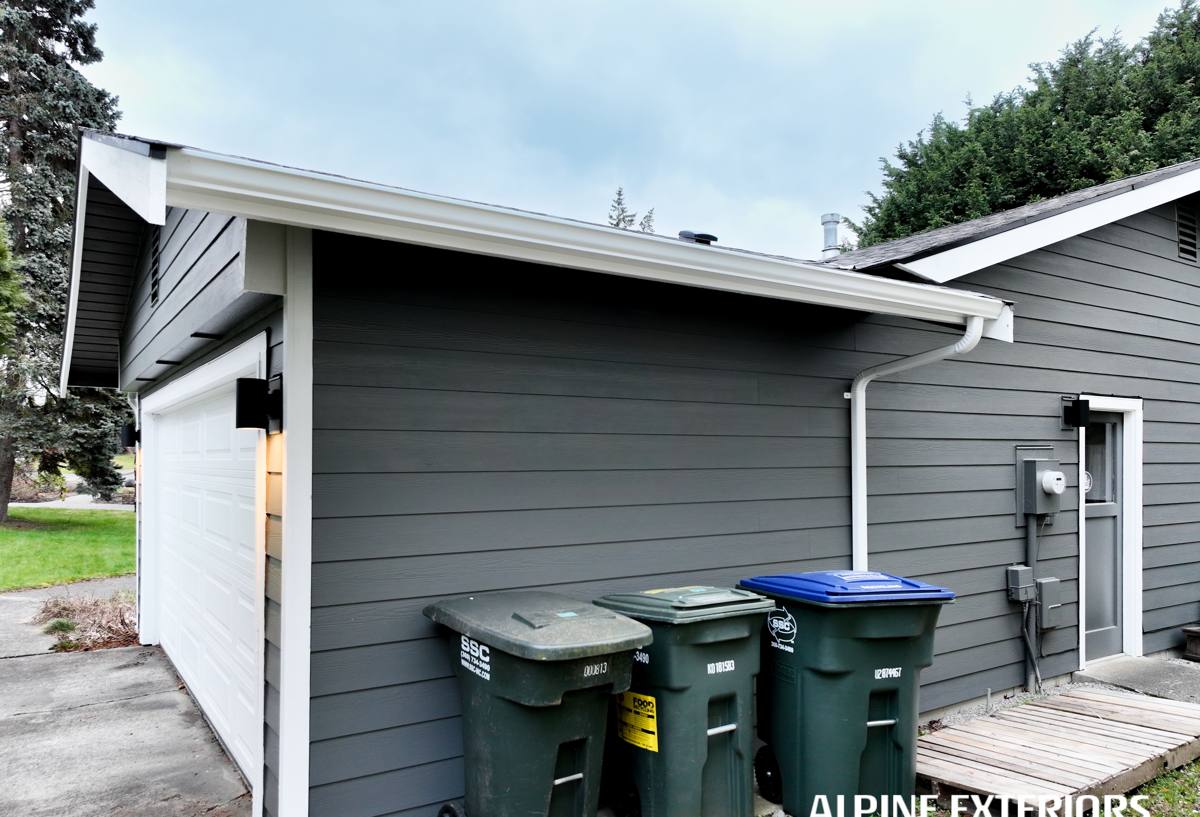
We standardized our entire company on James Hardie products, and we don't install vinyl, LP SmartSide, primed spruce, cedar, or other fiber cement brands like Cemplank or Allura. That's a deliberate call, not a sales preference. James Hardie is non-combustible fiber cement engineered specifically for demanding climates, and the company makes a version of its product line — the HZ5 formulation — built for exactly the kind of wet, marine-influenced weather Bellingham sees.
Fiber cement resists the two things that do the most damage to siding in this region: moisture absorption and organic growth. It doesn't swell, delaminate, or rot the way wood-based products can when they take on repeated moisture. And because James Hardie's ColorPlus finish is baked on at the factory under controlled conditions, it resists fading and holds up to the region's damp, shaded exposure far better than a field-applied paint job, which is more prone to peeling and mildew staining over time.
We're not going to tell you every other siding product is worthless — vinyl is inexpensive, LP SmartSide has real fans, and cedar has genuine curb appeal. But each of those comes with a trade-off we're not willing to install and then hope the homeowner never has a moisture problem: vinyl can warp and doesn't stop water intrusion on its own, engineered wood siding is still an organic material vulnerable to moisture if a seam ever fails, and cedar demands an ongoing maintenance commitment most homeowners underestimate. Fiber cement, installed correctly, removes most of that risk.
How James Hardie Siding Compares for This Climate
| Factor | James Hardie Fiber Cement | Vinyl | Cedar / Wood-Based |
|---|---|---|---|
| Moisture resistance | Engineered non-organic material, HZ5 line built for wet climates | Water-resistant itself, but seams and gaps can let moisture behind it | Absorbs moisture; prone to rot without diligent upkeep |
| Moss/algae resistance | Factory finish resists staining better than field-applied paint | Can stay damp in shaded areas, encouraging growth in seams | Porous surface holds moisture, feeds moss and mildew |
| Fire resistance | Non-combustible | Combustible, can melt or warp near heat sources | Combustible |
| Finish longevity | ColorPlus factory finish, long warranty period | Color molded in but can fade and become brittle over time | Requires repainting/staining every few years |
| Typical maintenance | Periodic washing, caulk checks | Occasional washing, watch for cracking | Regular staining or painting, moisture monitoring |
What a Correct James Hardie Installation Actually Involves
Fiber cement siding is only as good as the wall assembly behind it. A rushed or corner-cut install can leave a Bellingham home just as vulnerable to moisture as a lesser product. A correct job includes:
Water Management Before the First Board Goes Up
- A properly lapped weather-resistive barrier behind the siding, integrated with window and door flashing so water is directed out, not in
- Flashing at every horizontal transition — window heads, roof-to-wall intersections, deck ledgers — where wind-driven rain concentrates
- Correct starter strip placement and minimum clearance from grade, decks, and roof lines so the bottom edge of the siding never sits in standing water or splashback
Fastening and Fit
- Corrosion-resistant fasteners appropriate for coastal exposure, driven at the manufacturer's specified pattern and depth
- Proper joint treatment at butt seams and panel ends, sealed or flashed per James Hardie's installation instructions rather than just caulked over
- Correct nailing at studs with the right reveal and gap tolerances so boards can handle seasonal expansion without buckling
Finish Details That Matter Long-Term
- Factory-primed or ColorPlus-finished cut edges sealed in the field to prevent moisture wicking at trim and corner cuts
- Trim, corner boards, and soffit details that shed water away from seams rather than channeling it toward them
- A final walk-through checking caulk lines, fastener setting, and clearances before the job is called done
Skipping any one of these steps doesn't usually cause a visible problem right away. It shows up two, five, or ten years later as a soft spot, a stain, or a section of siding that has to be torn out and redone — usually costing far more than doing it right the first time would have.
Our Process for a Bellingham Siding Project
We walk every Bellingham job through the same sequence, adjusted for the specific exposure of your home — how much shade it gets, which walls face prevailing wind and rain, and what condition the existing wall assembly is in.
- On-site assessment. We look at your current siding, trim, and any moisture or moss patterns already showing, and check the wall assembly where accessible.
- Product and color selection. We go over James Hardie's HZ5 product options and ColorPlus finish choices suited to this climate and your home's style.
- Prep and tear-off. Old siding and any compromised sheathing or trim is removed and the wall is inspected before anything new goes on.
- Weather barrier and flashing. This is the step that determines whether your new siding actually keeps water out — we don't shortcut it.
- Installation. Panels or lap siding go up to James Hardie's fastening and clearance specifications, with attention to every seam, corner, and penetration.
- Final detailing and walk-through. Caulking, touch-up, and a final inspection with you before we call the job complete.
Why a Crew That Already Works Bellingham Matters
Siding installation standards don't change by zip code, but the conditions a crew needs to plan around do. A contractor who already works in and around Bellingham knows which walls in this area tend to take the worst of the driving rain, understands how much shade and moss exposure to expect on a given lot, and has already dealt with Whatcom County permitting and inspection requirements for exterior work. That familiarity shows up in fewer surprises mid-project and a finished install that's actually built for what this specific stretch of coastline throws at a house year-round.
It also means a shorter feedback loop if you ever have a question after the job is done — a local crew is easy to reach and already familiar with your home's specific installation.
Maintenance: What Bellingham Homeowners Should Actually Expect
James Hardie siding is low-maintenance, not zero-maintenance. In a climate like this, a small amount of regular attention goes a long way toward protecting the investment.
| Task | Why It Matters Here | Frequency |
|---|---|---|
| Gentle rinse with a garden hose | Removes salt residue and early moss/algae growth before it sets in | 1-2 times per year, more on shaded walls |
| Visual inspection of caulk lines | Caulk is the first line of defense at seams and trim; it degrades faster in wet climates | Annually |
| Trim vegetation away from walls | Reduces shade and moisture retention that feeds moss growth | As needed |
| Check gutters and downspouts | Overflowing gutters send extra water directly onto siding and trim | Twice yearly |
Cost Factors to Understand Before You Get a Quote
Every Bellingham home is different, and pricing depends on real variables rather than a flat per-square-foot number. Expect quotes to reflect:
- Total wall area and the complexity of the home's shape — dormers, gables, and multiple stories add labor
- Condition of the existing wall assembly, including whether sheathing or framing repair is needed before new siding goes on
- Product line and profile selected (lap siding, panel, or shingle-style James Hardie products) and ColorPlus finish choice
- Amount of trim, corner, and flashing work required around windows, doors, and rooflines
- Site access and staging conditions on the lot
We give straightforward, itemized estimates so you understand exactly what you're paying for and why — no vague lump-sum numbers.
Ready to Talk About Your Home?
If your Bellingham home's siding is showing moss staining, soft trim, or you're simply planning ahead for a replacement, we're happy to take a look and walk you through what a correctly installed James Hardie system would involve for your specific home. Reach out for a free, no-pressure estimate using the form below.