 Chuckanut Exterior
 Columbia's Siding Has to Fight a Climate Most Products Weren't Built For
Homes in the Columbia area near Chuckanut sit in one of the more demanding exterior environments in Whatcom County. You've got salt-laden air moving in off the water, long stretches of driving rain that don't just fall straight down but get pushed sideways into wall assemblies, and a moss and algae season that can run most of the year under the tree cover common to this part of the county. Any one of those on its own is manageable. Together, they're exactly the combination that exposes weak siding systems within a handful of years instead of a couple of decades.
This isn't a generic problem we're describing to sell a generic fix. It's the specific reason we install James Hardie fiber cement exclusively, and it's the reason a Columbia James Hardie project needs to be detailed differently than the same install would be done twenty miles inland.
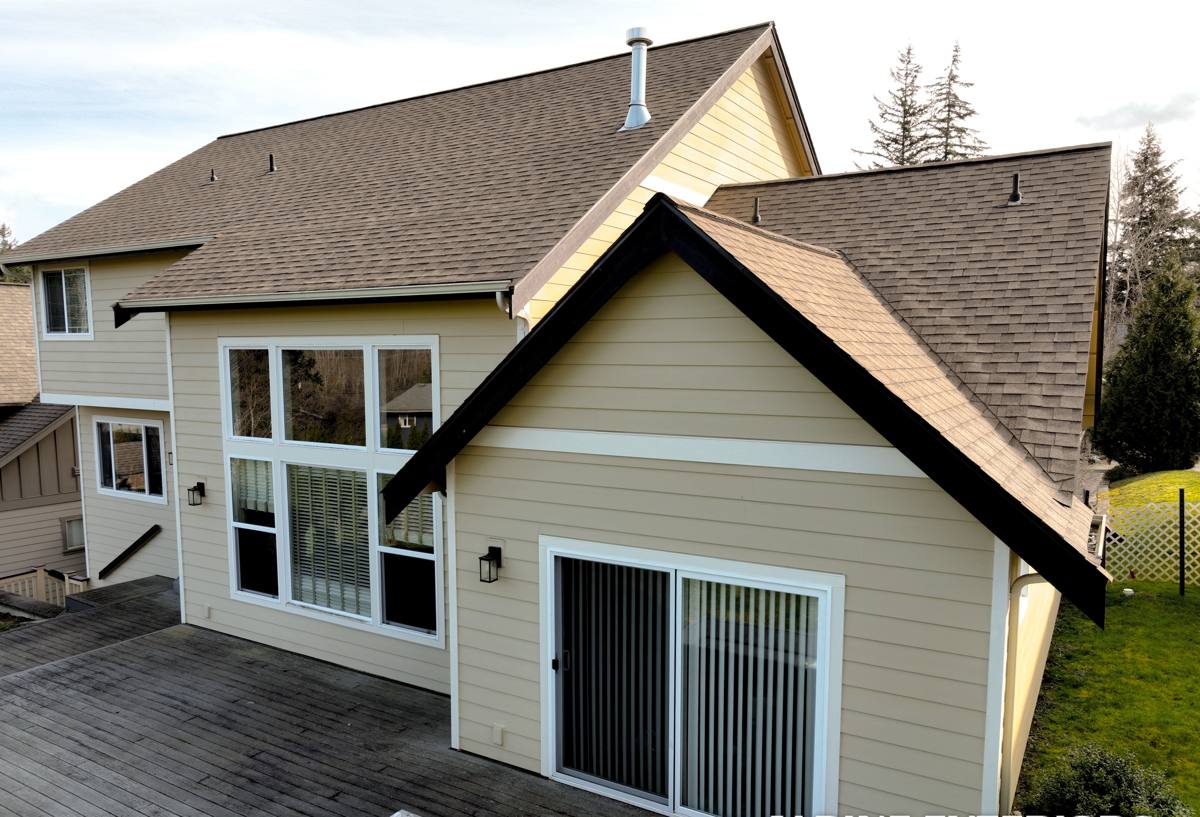
What Salt Air, Rain, and Moss Actually Do to a Wall System
Salt air
Airborne salt is corrosive to fasteners, trim, and any metal flashing that isn't rated for it. It also accelerates the breakdown of lower-grade paints and coatings, which is part of why field-painted or poorly primed siding tends to chalk and fade faster near the water.
Driving rain
Wind-driven rain doesn't respect a siding product's face-level water resistance. It gets forced up under laps, around penetrations, and into any gap where flashing or caulking was skipped. The failure almost never shows up at the surface first — it shows up as rot in the sheathing behind the siding, months or years after the water started getting in.
Moss and algae season
Shaded, moisture-retentive conditions under mature tree canopy — common throughout the Chuckanut area — keep siding damp longer after every rain event. Organic materials and porous coatings feed moss and mildew growth. Siding that can't shed water quickly or resist organic growth on its factory finish will show green and black staining well before it's structurally due for replacement.
How These Stressors Interact
| Climate Stressor | Common Failure Mode | What a Correct Hardie Install Addresses |
|---|---|---|
| Salt air | Corroded fasteners, degraded paint film | Corrosion-resistant fastening per manufacturer spec, factory-baked ColorPlus finish |
| Driving rain | Hidden moisture intrusion behind siding | Proper flashing, drainage gap, correct lap and gapping tolerances |
| Moss/algae shade | Surface staining, coating breakdown | Non-organic fiber cement substrate, factory finish resistant to moisture cycling |
Why We Only Install James Hardie in This Area
We don't install LP SmartSide, vinyl, Cemplank, Allura, primed spruce, or cedar. That's not a marketing position — it's a standard we hold because of what we see happen to those products in exactly this kind of environment. Wood-based and engineered-wood sidings depend on an intact factory or field coating to keep moisture out; once that coating is compromised by salt exposure or prolonged dampness, the substrate underneath is organic and can deteriorate. Vinyl doesn't rot, but it can't compete with fiber cement on impact resistance, dimensional stability in temperature swings, or long-term color retention, and it tends to show its age faster under UV and salt exposure near the water.
James Hardie fiber cement is non-combustible, dimensionally stable, and doesn't feed moss or fungal growth the way organic materials can. Combined with a factory-applied ColorPlus finish, it holds up to the specific combination of salt, rain, and shade that Columbia homes deal with — provided it's installed to spec, which is the part most failures actually come down to.
HZ5 Climate Engineering: Why the Product Line Matters, Not Just the Brand
James Hardie engineers its siding lines for different climate zones, and the Pacific Northwest falls under the HZ5 category — built to handle sustained moisture exposure rather than the drier conditions HZ10 products are optimized for. Using the correct climate-engineered product line matters as much as the installation itself. An HZ5 panel is formulated and tested for a wetter, cooler climate profile, which is exactly what the Chuckanut area experiences for a large part of the year.
This is one of the areas where hiring a crew unfamiliar with coastal Whatcom County work creates risk — the wrong climate-zone product, or a general contractor who orders whatever their supplier has in stock, can leave a home with siding that technically carries the Hardie name but wasn't engineered for the conditions it's facing.
What a Correct Installation Involves
James Hardie siding is only as good as the details behind it. The product itself is engineered to perform, but every warranty claim and every failure we've seen traced back to a Hardie product almost always comes down to installation, not the material. A correct job on a Columbia home includes:
- A drainage plane and weather-resistive barrier installed and lapped correctly behind the siding, not just present
- Proper flashing at every window, door, and penetration — the single most common point of water entry when skipped
- Correct fastener type, spacing, and placement per Hardie's published installation specifications, not generic siding nailing patterns
- Minimum ground clearance and proper gapping at trim, corners, and butt joints to allow the panels to manage moisture and temperature movement
- Caulking only where Hardie's spec calls for it — over-caulking traps moisture just as reliably as under-caulking lets it in
- Field-cut edges sealed or primed where required to protect the cut face of the fiber cement
Skipping any one of these doesn't usually cause an immediate problem. It causes a problem in year four or five, which is exactly the kind of failure a homeowner has no way to inspect for after the siding is closed up.
Our Process for a Columbia Project
1. On-site assessment
We look at the specific exposure of your home — how much direct weather it takes, how much tree cover keeps walls shaded and damp, and the condition of the sheathing and trim underneath the existing siding wherever it's accessible.
2. Tear-off and substrate check
Old siding comes off and we inspect the sheathing for any rot or moisture damage before anything new goes up. This is the point where hidden problems from a prior installation typically surface, and it needs to be addressed before, not after, new siding covers it back up.
3. Barrier and flashing
Weather-resistive barrier and flashing go in at every penetration, window, and door, sequenced so water sheds down and out rather than getting trapped behind the cladding.
4. Hardie installation to manufacturer spec
Panels or lap siding go up with correct fastening, gapping, and flashing integration — following James Hardie's published fastening and clearance specifications rather than shortcuts.
5. Final inspection
We walk the finished exterior checking caulking, trim, and clearances before we consider the job complete.
Why a Crew That Already Works in Columbia and the Chuckanut Area Matters
Siding work in this part of Whatcom County isn't the same job as siding work in a dry inland subdivision. A crew that regularly works this stretch already understands how much wind-driven rain a wall assembly here actually takes, how long moss-prone shaded sides stay damp after a storm, and what permitting and inspection expectations apply locally. That familiarity shows up in small decisions — where extra flashing attention is warranted, how much drainage capacity a shaded wall needs, which sides of a home take the worst of the weather — that a crew unfamiliar with the area has to guess at or learn on your project.
Maintenance Expectations in a Moss-Prone, Salt-Air Environment
Correctly installed James Hardie siding is low-maintenance, not no-maintenance. In an environment like Columbia's, a little seasonal attention goes a long way:
- Rinse siding periodically to remove airborne salt residue and organic debris, especially on shaded elevations
- Keep vegetation and tree limbs trimmed back from siding to reduce prolonged shade and moisture retention
- Inspect and clear gutters before the wet season so overflow doesn't run down and saturate siding and trim
- Check caulking at trim and penetrations annually — caulk is a maintenance item even on a well-installed system
- Address any moss or algae staining early with a gentle wash rather than letting it establish
What Drives Cost on a Columbia Siding Project
| Cost Factor | Why It Matters Here |
|---|---|
| Existing sheathing condition | Hidden moisture damage from a prior installation adds repair scope before new siding goes on |
| Home exposure and elevation count | Walls facing prevailing wind-driven rain need more careful flashing and detailing |
| Product line and profile | HZ5 lap siding, panel, and trim selections vary in material cost and labor complexity |
| Trim, fascia, and accessory work | Full exterior packages cost more than siding-only scopes but reduce future water-entry points |
| Access and site conditions | Tree cover, slope, and staging access common in the Chuckanut area can affect labor time |
We won't quote a number without seeing the home — anyone who does hasn't accounted for the condition of what's underneath the existing siding, which is the single biggest cost variable on almost every project in this area.
Ready to Talk About Your Home
If you're in Columbia or elsewhere around Chuckanut and thinking about re-siding, we're happy to come take a look and give you a straight, no-pressure assessment of what your home actually needs. There's no obligation and no hard sell — just an honest read on the condition of your exterior and what a correct James Hardie installation would involve. Use the form below to request your free estimate.